Drag Your Office Aircon Into The 21st Century With Wi-Fi Control

We’ll all have worked in offices that have air-conditioning, but a little too much of it. It’s wonderful on a baking-hot day to walk into the blessèd cool of an air-conditioned office, but after an hour or two of the icy blast you’re shivering away in your summer clothing and you skin has dried out to a crisp. Meanwhile on the other side of the building [Ted] from Marketing has cranked up the whole system to its extreme because he’s got a high metabolism and an office in the full force of the midday sun.

Wouldn’t it be nice if individual air-conditioning units could be easily controlled. To that end, [Maya Posch] has made a rather nicely designed board that takes a NodeMCU board with its ESP8266 processor, and uses four of its outputs as PWM to produce 0-10 volt analogue outputs via filters and op-amps to control individual units. In addition there is an onboard CO2 sensor and a temperature sensor, with provision for an external temperature sensor. The whole fits very neatly into a standard electrical outlet enclosure.

Software wise, the system uses the Sming framework providing an MQTT  communication with a backend server that allows the users to control their aircon experience. This is very much a work in progress, so the software has yet to be put up. (Hint, [Maya], hint!) The whole project though is an extremely tidy build, in fact a thing of beauty to a standard you’d expect from a high-quality commercial product. It’s this that tipped the balance into our featuring it before the software is released, it’s one to keep an eye on, because quality like this doesn’t come every day.

This isn’t the first aircon control we’ve brought you, take a look at this one controlled through Slack.

Accidental Satellite Hijacks Can Rebroadcast Cell Towers

A lot of us will use satellite communications without thinking much about the satellite itself. It’s tempting to imagine that up there in orbit is a communications hub and distribution node of breathtaking complexity and ingenuity, but it might come as a surprise to some people that most communications satellites are simple transponders. They listen on one frequency band, and shift what they hear to another upon which they rebroadcast it.

This simplicity is not without weakness, for example the phenomenon of satellite hijacking has a history stretching back decades. In the 1980s for example there were stories abroad of illicit trans-atlantic serial links nestling as unobtrusive single carriers among the broad swathe of a broadcast satellite TX carrier.

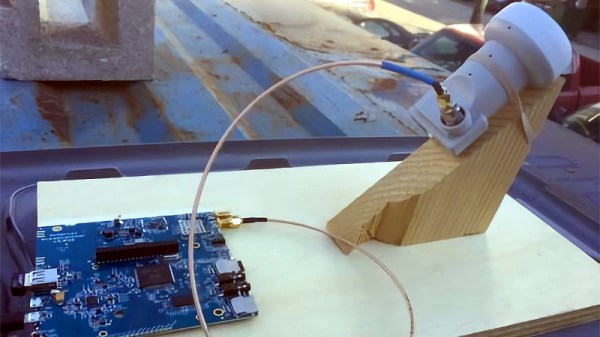
Just sometimes, this phenomenon happens unintentionally. Our attention was drawn to a piece by [Harald Welte] on the unintended rebroadcast of GSM base station traffic over a satellite transponder, and of particular interest is the presentation from a conference in 2012 that it links to. The engineers show how they identified their interference as GSM by its timing frames, and then how they narrowed down its source to Nigeria. This didn’t give them the uplink in question though, for that they had to make a downconverter from an LNB, the output of which they coupled to an aged Nokia mobile phone with a wire antenna placed into an RF connector. The Nokia was able to decode the cell tower identification data, allowing them to home in on the culprit.

There was no fault on the part of the GSM operator, instead an unterminated port on the uplink equipment was enough to pick up the GSM signal and introduce it into the transponder as a parasitic signal for the whole of Europe and Africa to hear. Meanwhile the tale of how the engineers identified it contains enough detective work and outright hardware hacking that we’re sure the Hackaday readership will find it of interest.

If satellite hacks interest you, how about reading our thread of posts on the recapture of ISEE-3, or maybe you’d like to listen for a lost satellite from the 1960s.

Thanks [Kia] for the tip.

A Bit Of Mainstream Coverage For The Right To Repair

Here at Hackaday, we write for a community of readers who are inquisitive about the technology surrounding them. You wouldn’t be here if you had never taken a screwdriver to a piece of equipment to see what makes it work. We know that as well as delving inside and modifying devices being core to the hardware hacker mindset, so is repairing. If something we own breaks, we try to work out why it broke, and what we can do to fix it.

Unfortunately, we live in an age in which fixing the things we own is becoming ever harder. Manufacturers either want to sell us now hardware rather than see us repair what breaks, or wish to exercise total control over the maintenance of their products. They make them physically impossible to repair, for example by gluing together a cellphone, or they lock down easy-to-repair items with restrictive software, for example tractors upon which every replacement part must be logged on a central computer.

This has been a huge issue in our community for a long time now, but to the Man In The Street it barely matters. To the people who matter, those who could change or influence the situation, it’s not even on the radar. Which makes a piece in the British high-end weekly newspaper The Economist particularly interesting. Entitled “A ‘right to repair’ movement tools up“, it lays out the issues and introduces the Repair Association, a political lobby group that campaigns for “Right to repair” laws in the individual states of the USA.

You might now be asking why this is important, why are we telling you something you already know? The answer lies in the publication in which it appears. The Economist is aimed at politicians and influencers worldwide. In other words, when we here at Hackaday talk about the right to repair, we’re preaching to the choir. When they do it at the Economist, they’re preaching to the crowd who can make a difference. And that’s important.

You may recognise the tractors mentioned earlier as the iconic green-and-yellow John Deere. We’ve written about their DRM before.

Neon sign, All Electronics Service, Portland, Visitor7 [CC BY-SA 3.0].

Hackaday Prize Entry: Hand Tremor Suppression Wearable Device

It is extremely distressing to watch someone succumb to an uncontrollable hand tremor. Simple tasks become frustrating and impossible, and a person previously capable becomes frail and vulnerable. Worse still are the reactions of other people, in whom the nastiest of prejudices can be unleashed. A tremor can be a debilitating physical condition, but it is not one that changes who the person afflicted with it is.

An entry from [Basian Lesi] in this year’s Hackaday Prize aims to tackle hand tremors, and it takes the form of a wearable device that tries to correct the tremors by applying small electrical stimuli in response to the motion it senses from its built-in accelerometer. At its heart is an ATMega328p microcontroller and an MPU6050 accelerometer chip, and the prototype is shown using a piece of stripboard mounted in a 3D-printed box. It’s still in development and testing, but they have posted a video showing impressive results that you can see below the break, claiming an 85% reduction in tremors.

Continue reading “Hackaday Prize Entry: Hand Tremor Suppression Wearable Device”

The Russians And The Americans Only Want The Moon

For the generations who lived through the decades of the Space Race, the skies above were an exciting place. Every month it seemed there was a new announcement of a new mission, a Lunar landing, new pictures from a planetary probe, or fresh feats of derring-do from astronauts or cosmonauts. Space was inspiring!

As we moved through the Shuttle, Mir, and ISS eras, the fascinating work didn’t stop. The Mars rovers, the Cassini probe, the Chang-e Lunar mission, or the Hubble telescope, to name just a very few. But somehow along the way, space lost the shine for the general public, it became routine, mundane, even. Shuttle missions and Soyuz craft carrying ISS astronauts became just another feature on the news, eventually consigned only to the technology section of the broadcaster’s website. The TV comedy Big Bang Theory derived humor from this, when a character becomes an ISS astronaut, yet is still a nobody on his return to Earth.

If you yearn for a bit of that excitement from the Space Race days you may just find it in another story tucked away in the tech sections, though it comes from a collaboration rather than a competition. NASA and the Russian space agency Roscosmos have announced a partnership to take what will be the next step towards a future of deep space exploration, to place a manned space station in a Lunar orbit. The idea is that it would serve first as a valuable research platform for missions in deeper space than the current relatively low orbit of the ISS, and then as a launch base for both lunar missions and those further afield in the Solar System.

Of course, there is no lunar-orbiting station, yet. There is a long and inglorious history of proposed space missions that never left the drawing board, and this one may yet prove to be the next addition to it. But what are real are the two indisputable facts, that NASA and Roscosmos have inked this partnership, and eventually there will have to be a replacement for the ISS. This project stands a good chance of being that replacement, which makes it of great interest to anyone with an interest in technology. It’s a little out of the world of usual Hackaday fodder, but if you are like us you will want to believe that one day it will be launched.

Even with a lunar orbiting space station, it will be a very long time indeed before we see manned missions going significantly further into the Solar system. Perhaps another approach is required to go further, a laser-driven silicon wafer aimed at a nearby star.

Moon image: 阿爾特斯 [CC BY-SA 3.0].

Hackaday Prize Entry: Wheelchair User Pressure Relief Indicator System

It is difficult to put yourself as an able-bodied person into the experiences of a person with a physical disability. Able-bodied people are quick with phrases such as “Confined to a wheelchair” with little idea of what that really means, and might be surprised to meet wheelchair users who would point out that far from being a prison their chair might, in fact, be their tool of liberation.

It is also difficult for an able-bodied person to understand some of the physical effects of using a wheelchair. In particular, some wheelchair users with paralysis can suffer from dangerous pressure sores without being aware of them due to their loss of feeling. Such people, therefore, have a regime of exercises designed to relieve the pressure that causes the sores, and these exercises must be completed as often as every half hour. They can be inconvenient and difficult to perform, so in an effort to help people in that position there is a Hackaday Prize entry that provides feedback on how effectively the exercise regime has been performed.

The project puts an array of force-sensitive resistors on the bed of the chair underneath its cushion and monitors them with an Arduino before giving a feedback to the user via a set of LEDs. So far they have created a first prototype, and are awaiting parts and recruiting users for testing a second.

It would be nice to think that this project would have a positive impact on the lives of the people it aims to help. It’s not the first time the Hackaday Prize has ventured into this field, as the 2015 winner demonstrates.

The Hackers And The Hurricane

When natural disasters strike, particularly if they are in some of the less remote parts of the world, we see them unfolding in real-time on our television screens. They become a 24-hour rolling news exercise in disaster titillation, each fresh horror ghoulishly picked over by breathless reporters live-telecasting from windswept streets, and endlessly rehashed by a succession of in-studio expert guests.

Then once the required image of a dusty child being pulled from the rubble or a tearful mother describing her daughter being swept away is in the can, a politician somewhere is found in bed with a model or a tinpot dictator rattles his sabre, and the world moves on. The BAFTA or the Emmy is a certainty for this one, did you see the anguish!

Meanwhile on the ground, the situation remains the same. There is no power, no sanitation, no communications, no food, and help seems very far away. In the wake of the recent hurricane season across the Caribbean, there are millions of people whose worlds have been wrecked, and several international governments have faced significant criticism for their lethargic response.

In our world of hardware hackers and makers, we are on the whole practical people. We exist to make, and do, rather than to endlessly talk. Seeing the plight of the victims of Irma, Jose, or Maria leaves us wanting to do practical things to help, because that’s what we do. But of course, we can do nothing, because we’re thousands of miles away and probably lack whatever skills or training are in demand on the islands.

It’s heartening then to hear of just a few moments when our wider community has managed to be in the right place at the right time to offer some help. We’ve had a couple in our tips line lately we’d like to share.

[Csp3r] writes about the Derbycon conference held in Louisville, at which [Carlos Perez] and [Jose Quinones Borreros], information security specialists from Puerto Rico, were in attendance. They mentioned a need for emergency radios, and the community at the conference came together to raise money for much more than just a few radios. $15,000 was raised in all, spent on radios, solar chargers, generators, flashlights, USB battery packs, and tools. This amounted to a significant bulk, so Hackers For Charity helped secure some space on an aid flight to the island.

Then [Bruce Perens, K6BP] writes about a request from the American Red Cross to the ARRL for 50 radio amateurs to help with their relief efforts in Puerto Rico. They will perform the role you might expect of enabling essential communications, as well as to quote the ARRL: “help record, enter, and submit disaster-survivor information into the ARC Safe and Well system”. This is a request unprecedented in its scale, and reflects the level of damage across the island.

For most of us, the best we can do when helping out with these events will be to drop coins into an OXFAM or Red Cross collecting tin and leave it to the experts. But as we’ve noted above, for just a few of us the opportunity to do something a bit more useful presents itself. If you find yourself in that position, make it count!

We’ve looked at the role of amateur radio in public service before, and we’ve even featured it in one or two projects. This emergency box for example has all you’d need to provide this type of service.

Cyclone Catarina image from the ISS, [Public domain].