Studying QR Code Degradation

It’s fair to say that QR codes are a technology that has finally come of age. A decade or more ago they were a little over-hyped and sometimes used in inappropriate or pointless ways, but now they are an accepted and useful part of life.

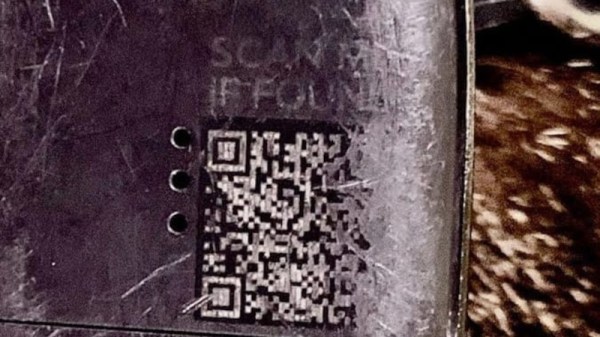
They’re not without their faults though, one of which is that despite four increasingly redundant levels of error correction, there comes a point at which a degraded QR code can no longer be read. [HumanQR] is soliciting these broken QR codes for research purposes and inclusion in an eventual open-source database, and they’ll even have a shot at repairing your submissions for you.

It’s a problem inherent to all digital media, that once the limit of whatever error correction they contain has been reached, they arrive at a cliff-edge at which they go immediately from readability to non readability. The example given in the linked article is a locator tag on a stray cat, it had been rubbed away in part. Improving its contrast, sharply defining its edges, and improving the definition of its fiducials was able to revive it, we hope leading to the cat being returned home.

The idea is that by studying enough damaged codes it should be possible to identify the means by which they become degraded, and perhaps come up with a way to inform some repair software. Meanwhile if you are interested, you might want to learn more about how they work, the hard way.
Another Old ThinkPad Gets A New Motherboard

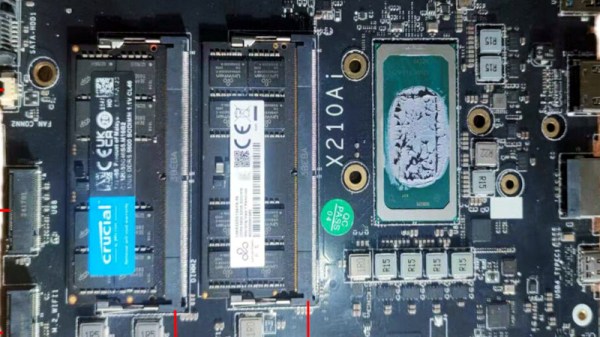
The Thinkpad line of laptops, originally from IBM, and then from Lenovo, have long been the choice of many in our community. They offer a level of robustness and reliability missing in many cheaper machines. You may not be surprised to find that this article is being written on one. With such a following, it’s not surprising that a significant effort has gone into upgrading older models. For example, we have [Franck Deng]’s new motherboard for the Thinkpad X200 and X201. These models from the end of the 2000s shipped as far as we can remember with Core 2 Duo processors, so we can imagine they would be starting to feel their age.

It’s fair to say the new board isn’t a cheap option, but it does come with a new Core Ultra 7 CPU, DDR5 memory, M.2 interfaces for SSDs alongside the original 2.5″ device, and USB-C with Thunderbolt support. There are a range of screen upgrade options. For an even more hefty price, you can buy a completely rebuilt laptop featuring the new board. We’re impressed with the work, but we have to wonder how it would stack up against a newer Thinkpad for the price.

If you’re curious to see more of the same, this isn’t the first such upgrade we’ve seen.

Thanks [Max] for the tip.

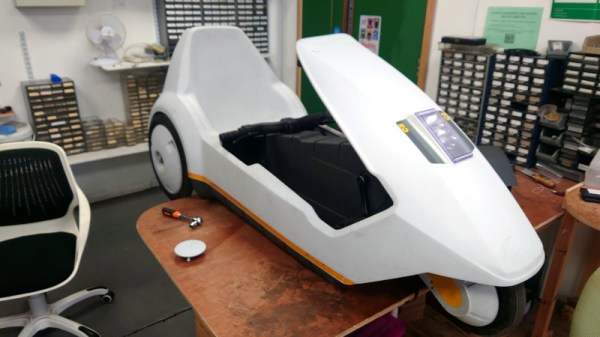
Restoring A Sinclair C5 For The Road

The Sinclair C5 was Sir Clive’s famous first venture into electric mobility, a recumbent electric-assisted tricycle which would have been hardly unusual in 2025. In 1985, though, the C5 was so far out there that it became a notorious failure. The C5 retains a huge following among enthusiasts, though, and among those is [JSON Alexander, who has bought one and restored it.

We’re treated to a teardown and frank examination of the vehicle’s strengths and weaknesses, during which we see the Sinclair brand unusually on a set of tyres, and the original motor, which is surprisingly more efficient than expected. Sir Clive may be gone, but this C5 will live again.

We’ve had the chance to road test a C5 in the past, and it’s fair to say that we can understand why such a low-down riding position was not a success back in the day. It’s unusual to see one in as original a condition as this one, it’s more usual to see a C5 that’s had a few upgrades.

A Single Chip Computer For The 8051 Generation

The Intel 8051 series of 8-bit microcontrollers is long-discontinued by its original manufacturer, but lives on as a core included in all manner of more recent chips. It’s easy to understand and program, so it remains a fixture despite much faster replacements appearing.

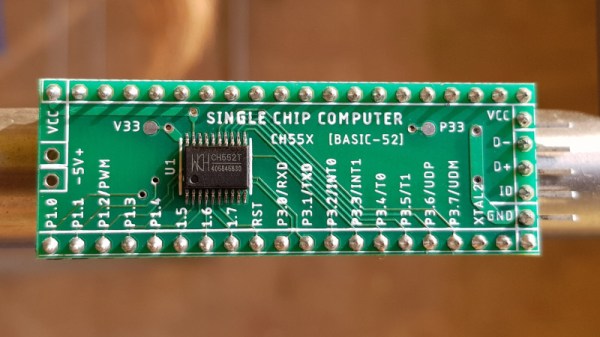
If you can’t find an original 40-pin DIP don’t worry, because [mit41301] has produced a board in a compatible 40-pin format. It’s called the single chip computer not because such a thing is a novelty in 2025, but because it has no need for the support chips which would have come with the original.

The modern 8051 clone in use is a CH558 or CH559, both chips with far more onboard than the original. The pins are brought out to one side only of the board, because on the original the other side would interface with an external RAM chip. It speaks serial, and can be used through either a USB-to-serial or Bluetooth-to-serial chip. There’s MCS-BASIC for it, so programming should be straightforward.

We can see the attraction of this board even though we reach for much more accomplished modern CPUs by choice. Several decades ago the original 8051 on Intel dev boards was our university teaching microcontoller, so there remains here a soft spot for it. We certainly see other 8051 designs, as for example this Arduino clone.

There’s A Venusian Spacecraft Coming Our Way

It’s not unusual for redundant satellites, rocket stages, or other spacecraft to re-enter the earth’s atmosphere. Usually they pass unnoticed or generate a spectacular light show, and very rarely a few pieces make it to the surface of the planet. Coming up though is something entirely different, a re-entry of a redundant craft in which the object in question might make it to the ground intact. To find out more about the story we have to travel back to the early 1970s, and Kosmos-482. It was a failed Soviet Venera mission, and since its lander was heavily over-engineered to survive entry into the Venusian atmosphere there’s a fascinating prospect that it might survive Earth re-entry.

A model of the Venera 7 probe, launched in 1970.
This model of the earlier Venera 7 probe shows the heavy protection to survive entry into the Venusian atmosphere. Emerezhko, CC BY-SA 4.0.

At the time of writing the re-entry is expected to happen on the 10th of May, but as yet due to its shallow re-entry angle it is difficult to predict where it might land. It is thought to be about a metre across and to weigh just under 500 kilograms, and its speed upon landing is projected to be between 60 and 80 metres per second. Should it hit land rather than water then, its remains are thought to present an immediate hazard only in its direct path.

Were it to be recovered it would be a fascinating artifact of the Space Race, and once the inevitable question of its ownership was resolved — do marine salvage laws apply in space? –we’d expect it to become a world class museum exhibit. If that happens, we look forward to bringing you our report if possible.

This craft isn’t the only surviving relic of the Space Race out there, though it may be the only one we have a chance of seeing up-close. Some of the craft from that era are even still alive.

Header: Moini, CC0.

Hydrogen Trains: Not The Success Germany Hoped They Would Be

As transport infrastructure in Europe moves toward a zero-carbon future, there remain a number of railway lines which have not been electrified. The question of replacing their diesel traction with greener alternatives, and there are a few different options for a forward looking railway company to choose from. In Germany the Rhine-Main railway took delivery of a fleet of 27 Alstom hydrogen-powered multiple units for local passenger services, but as it turns out they have not been a success (German language, Google translation.). For anyone enthused as we are about alternative power, this bears some investigation.

It seems that this time the reliability of the units and the supply of spare parts was the issue, rather than the difficulty of fuel transport as seen in other failed hydrogen transport problems, but whatever the reason it seems we’re more often writing about hydrogen’s failures than its successes. We really want to believe in a hydrogen future in which ultra clean trains and busses zip around on hydrogen derived from wind power, but sadly that has never seemed so far away. Instead trains seem inevitably to be following cars, and more successful trials using battery units point the way towards their being the future.

We’re sure that more hydrogen transport projects will come and go before either the technological problems are overcome, or they fade away as impractical as the atmospheric railway. Meanwhile we’d suggest hydrogen transport as the example when making value judgements about technology.

Hackaday Podcast Ep 318: DIY Record Lathe, 360 Degree LIDAR, And 3D Printing Innovation Lives!

This week Elliot Williams was joined by fellow Europe-based Hackaday staffer Jenny List, to record the Hackaday Podcast as the dusk settled on a damp spring evening.

On the agenda first was robotic sport, as a set of bipedal robots competed in a Chinese half-marathon. Our new Robot overlords may have to wait a while before they are fast enough chase us meatbags away, but it demonstrated for us how such competitions can be used to advance the state of the art.

The week’s stand-out hacks included work on non-planar slicing to improve strength of 3D prints. It’s safe to say that the Cartesian 3D printer has matured as a device, but this work proves there’s plenty more in the world of 3D printing to be developed. Then there was a beautiful record cutting lathe project, far more than a toy and capable of producing good quality stereo recordings.

Meanwhile it’s always good to see the price of parts come down, and this time it’s the turn of LIDAR sensors. There’s a Raspberry Pi project capable of astounding resolution, for a price that wouldn’t have been imaginable only recently. Finally we returned to 3D printing, with an entirely printable machine, including the motors and the hot end. It’s a triumph of printed engineering, and though it’s fair to say that you won’t be using it to print anything for yourself, we expect some of the very clever techniques in use to feature in many other projects.

The week’s cant-miss articles came from Maya Posch with a reality check for lovers of physical media, and Dan Maloney with a history of x-ray detection. Listen to it all below, and you’ll find all the links at the bottom of the page.

Still mourning the death of physical media?  Download an MP3 and burn it to CD like it’s 1999!

Continue reading “Hackaday Podcast Ep 318: DIY Record Lathe, 360 Degree LIDAR, And 3D Printing Innovation Lives!”