Repairing A Sony Dream Machine

Have you ever fancied a gadget but been put off by what seems like an excessive price? [leadacid44] did just that back in 2009, in his case the gadget in question was a Sony Dream Machine ICF-CL75iP. It’s an alarm clock radio, albeit a very fancy one featuring an iPod dock, SD card slot, and an electronic photo frame. Back then it was just too expensive, but in 2016 [leadacid44] spotted one on an auction site for pennies, and so snapped it up.

Of course, with something cheap there is so often a catch. In the case of this Dream Machine, it would not keep time — something pretty important in a clock. But rather than throw it on the “Hack later” pile, [leadacid44] decided to investigate, and turned up a surprising culprit. The glue Sony had used to secure the timing crystal in 2009 had become conductive with age, causing the oscillator to stop oscillating. A simple fix involving a bit of glue removal and a touch of resoldering, and the clock was back with us.

This was a very simple repair when the problem was diagnosed, but it tells us something about electronic product design, and about quality control. Sony have spent a very long time building a reputation for quality manufacture, and it is likely the Dream Machine was built with their full attention to detail. It is highly unlikely that the Sony engineers chose their crystal glue in the knowledge it would break down, after all the company is likely to make far more money selling a new TV or phone to a satisfied alarm clock owner than it is by selling them a new alarm clock. Instead it tells us that even Sony with a legendary attention to quality control can be caught out by unexpected component failures, and that as engineers we should always expect the unexpected.

So [leadacid44] has a new alarm clock, and presumably now always wakes up on time. It’s interesting to look at the Dream Machine from another perspective, to compare what was hot in 2009 with what you might see now. The Apple Dock connector for instance, or the full-size SD card. Both of which are now becoming historical curiosities, even though this device is not much more than six years old.

Over the years we’ve featured a lot of clocks, and even the odd clock radio. But this isn’t really about clock radios, and with that out of the way we’ve certainly featured a few Sony hacks.

Odroid C2 Bests Raspberry Pi 3 In Several Ways

It’s been a big week in the world of inexpensive single board computers, and everyone’s talking about the new Raspberry Pi 3. It blows away the competition they say, nobody can touch it for the price.

Almost nobody, that is.

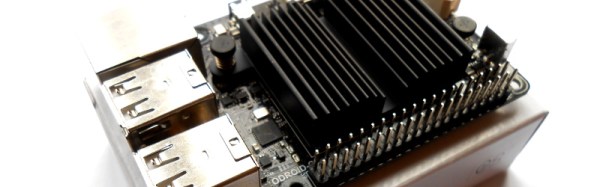
With a lot less fanfare on these shores, another cheap and speedy 64-bit quad-core ARM-based SBC slips onto the market this week, Hardkernel’s Odroid C2. And looking at the specification it seems as though the Pi 3 may be given a run for its money. Like the BCM2837 in the Pi 3 its Amlogic S905 SoC is a quad-core ARM Cortex-A53, but the C2’s 2GHz clock speed gives the raspberry to the 1.2GHz of the Pi 3. There is twice the RAM of the Pi 3 at 2Gbytes, and the onboard Mali-450 GPU can deliver 4K video.

Unlike the Pi 3 there is no wireless or Bluetooth on board, but the C2 has a Gigabit Ethernet port which is wired directly into the SoC. Compared to the Pi 3’s 100 megabit port which suffers through being on a USB interface, that’s likely to be very quick.

Storage can be a choice of either the usual micro SD card or eMMC. Given that the two boards share a very similar form factor it is no surprise that they have very similar GPIO capabilities, however it is worth noting that the C2 has a built-in analog-to-digital converter. As to operating systems, the C2 can run Ubuntu 16.04, or Android Lollipop.

Of course, we’ve seen so many boards touted as Pi-killers, and like all those also-ran tablets touted as iPad killers a few years ago we’ve never heard of most of them again after a brief moment of chatter. They look so good on paper but the price always lets them down.

The C2 could just escape that fate though, its $40 price point is very close to that of the Pi 3. Setting aside for a moment how much shipping and customs might cost for a package from Korea, that sounds interesting to us.

Why might you buy a C2 then, and why might you buy a Pi 3? That the C2 has a much faster processor is beyond doubt. This and its faster wired networking would make it a much more interesting prospect for anyone whose work involves network-attached data processing. But even though a USB wireless network adaptor can be had for only a few dollars the Pi 3’s onboard wi-fi and Bluetooth makes it much more attractive to a home user or someone using a computer on a platform unfettered by wires.

However impressive the C2 may be it is overwhelmingly likely that the Pi 3 will outsell it many times over. This will not just be due to the massive publicity advantage achieved by the Pi Foundation, but the huge ecosystem of hardware and software developers that have made the Pi boards perform to the limit of their abilities in all directions. If you don’t mind forgoing that support though, you could just find that the board from Korea gives you enough extra bang for your buck to make having it on your bench worthwhile.

We’ve followed the Odroid products from the start here at Hackaday. The C2 is just the latest of a procession of boards from Hardkernel, and we’ve featured a few projects that include them. Theirs is always the name at the top of the list when the subject turns to Raspberry Pi competitors, perhaps with the C2 they’ve got a winner.

Our thanks to [Derrick].

Boldport Tribute To Bob Pease

We have lost something in PCB design over the last few decades. If you open up a piece of electronics from the 1960s you’ll see why. A PCB from that era is a thing of beauty, an organic mass of curving traces, an expression of the engineer’s art hand-crafted in black crêpe paper tape on transparent acetate. Now by comparison a PCB is a functional drawing of precise angles and parallel lines created in a CAD package, and though those of us who made PCBs in both eras welcome the ease of software design wholeheartedly we have to admit; PCBs just ain’t pretty any more.

It doesn’t have to be that way though. Notable among the rebels are Boldport, whose latest board, a tribute to the late linear IC design legend [Bob Pease], slipped out this month. They use their own PCBmodE design software to create beautiful boards as works of art with the flowing lines you’d expect from a PCB created the old-fashioned way.

The board itself is an update to an earlier Boldport design, and features Pease’s LM331 voltage to frequency converter IC converting light intensity to frequency and flashing an LED. It’s one of the application circuits from the datasheet with a little extra to drive the LED. Best of all the kit is a piece of open-source hardware, so you can find all its resources on GitHub.

We are fans of Boldport’s work here at Hackaday, and it should come as no surprise that we have featured them before. From one of their other kits through several different pieces of PCB wall art, to their work making an appearance in Marie Claire magazine they have graced these pages several times, and we hope this latest board will be one of many more.

A Wooden Performance Is Fine WIth This Sequencer

You could sometimes be forgiven for thinking that making popular music has become too easy. With a laptop and suitable software almost anybody can now assemble something that had they secured the services of a canny promoter would be in with a shot at stardom. So many performances have been reduced to tightly choreographed dance acts to mask the absence of musicians or indeed musical talent, and our culture is poorer for it. It’s not that music made with modern technology or outside the performance is an indicator of lack of talent, indeed when a truly talented musician makes something with the resources of a modern technology the results are astounding. Instead it perhaps seems as though the technology is cheapened by an association with mediocrity when it should be a tool of greatness.

So it was with pleasure that we noticed a fresh project on Hackaday.io this morning which provides a marriage of accessible music technology and a requirement for performance. [Ernest Warzocha] has made a wooden sequencer.

It’s true, audio sequencers are old hat, so a new one will have to work hard to enthuse a seasoned Hackaday reader who’s seen it all. What makes [Ernest’s] sequencer different is that he’s made one with a very physical interface of wooden pucks placed in circular recesses on a wooden surface. Each recess has an infra-red reflective sensor that detects the surface texture of the puck placed in it and varies the sample it plays accordingly. It’s all held together underneath by an Arduino, and MP3 samples are played by a Sparkfun MP3 shield. At a stroke, he has turned the humble sequencer from a workaday studio tool into a performance art form that you can see in the video below, and we like that.

Home made sequencers have a special place in maker culture, and as you might expect over the years we’ve featured quite a few of them. Shift registers, CMOS analogue switches or even turntables as the sequencer elements, Lego as a human interface, a sequencer made from a cash register, and a rather lovely steampunk sequencer, to name but a few. So this one joins a rich tradition, and we look forward to more in the future.

Continue reading “A Wooden Performance Is Fine WIth This Sequencer”

Rasberry Pi Analog Input Using Only Passive Components

The Raspberry Pi is a very capable device whose hardware has been pushed to the limit in all sorts of interesting ways. But even the most ingenious of experimenters have to agree on one point; it doesn’t possess an analog-to-digital converter. If you want analog inputs you will have to buy or build them.

[Mincepi] has done just that, but not as you might expect by adding an integrated circuit on one of the Pi’s interfaces. Instead the circuit [Mincepi] is using consists only of passive components, measuring the time taken to discharge the parasitic capacitance of one of the Pi’s inputs from logic 1 voltage to logic 0 voltage through a resistor into the voltage to be measured. This is a long-established approach to A to D conversion, one that was achieved back in the day with purpose-designed timers as microprocessor ancillaries.

The problem is that the Pi does not have a timer peripheral, so [Mincepi] has used the shift registers that form part of the Pi’s SPI and PCM inputs to perform this task on two channels. A sample rate of 100kHz and 6-bit resolution is claimed, with enough voltage range for a 1V peak-to-peak audio signal to be sampled.

Of course, simplicity does not guarantee a good ADC, and this circuit does not perform very well. It is noisy, non-linear, and as [Mincepi] puts it, probably sensitive to temperature. And though [Mincepi] talks in detail about the software to drive it, none is forthcoming. To quote: “It doesn’t include code since I’m in the process of writing a proper sound device module. My previous code was a simple character device, but it worked just fine, and served to prove the concept.

We really want this to work, even if it’s not the best ADC ever. So we eagerly await the sound device module, and look forward to more news from the project.

This may be the simplest of simple ADCs we’ve yet featured here on Hackaday, but it’s not the first we’ve seen. There is this one using a comparator for example, or this one using a flip-flop. It is the essence of creative electronics to eke a function from a component that was never meant to be, please keep them coming!

Mechatronic Cat Ears For The Rest Of Us

Every now and then you see a project that makes you smile. It may not be something that will deliver world peace or feed the hungry, but when it opens in your browser in the morning you go to work a bit happier for the experience.

Just such a project is [Radomir Dopieralski’s] set of wearable mechatronic cat ears. A cosplay accessory that moves as you do. Very kawaii, but fun.

You may have seen the commercially available Necomimi brainwave activated mechatronic ears. [Radomir’s] version does not share their sophistication, instead he’s using an accelerometer to detect head movement coupled to an Arduino Pro Mini driving a pari of servos which manipulate the ears. He provides the source code, and has plans for a miniaturised version using an ATtiny85 on its own PCB.

Amusing cuteness aside, there are some considerations [Radomir] has had to observe that apply to any a head-mounted wearable computer. Not least the problem of putting the Pro Mini and its battery somewhere a little more unobtrusive and weatherproof than on top of his head. He also found that the micro-servos he was using did not have enough range of movement to fully bend the ears, something he is likely to address in a future version with bigger servos. He’s yet to address a particularly thorny problem: that a pair of servos mounted on your head can be rather noisy.

We’ve covered quite a few cosplay stories over the years. This is not even our first cat ear story. More than one example of a Pip Boy, a HAL 9000 costume, and a beautifully made Wheatley puppet have made these pages, to name a few. So scroll down and enjoy [Radomir’s] video demonstration of the ears in action.

Continue reading “Mechatronic Cat Ears For The Rest Of Us”

Samsung ARTIK Dev Boards Start To Ship

Another week’s news, another single board computer aimed at Internet of Things applications is launched. This time it’s Samsung’s Artik 5, a platform they’ve been talking about for a while now but which you can now buy as a dev board from Digi-Key for $99.99. For that you get Wi-Fi, Bluetooth and Zigbee connectivity, a dual-core ARM Cortex A7 running at 1GHz, 512MB of memory, and 4GB of eMMC storage. There are the usual plethora of interfaces: GPIO, I2C, SPI, UART, SDIO, USB 2.0, JTAG, and analogue.

The single board computer marketplace is starting to look rather crowded, and with so many competitors to choose from at more reasonable prices you might ask yourself why the ARTIK could be of interest to a maker. And given that Samsung are positioning it in their literature on its increased security for use in commercial  applications such as IoT hubs, IP cameras and industrial and commercial lighting systems, you’d probably be on to something. If you were to make a very rough analogy with the Raspberry Pi range this has more in common with the Compute Module when it comes to intended marketplace than it does with the Pi Zero.

One answer to that question though could be that it is one of the first devices to support the Thread networking protocol for IoT devices. Thread is a collaboration between Google and a range of other interested parties that has been designed to deliver reliable and secure mesh networking for IoT devices in connected homes. As with all new connectivity protocols only time will tell whether Thread is the Next Big Thing, but it is interesting to note in this board nevertheless.

The ARTIK hasn’t made many waves as yet, though we covered the story when it was announced last year. It is worth mentioning that the ARTIK 5 is only the first of three platforms, the ARTIK 1 will be a tiny board with Bluetooth LE aimed at portable and wearable applications while the ARTIK 10 will be an octo-core powerhouse aimed at mulitmedia processing and network storage applications.