A Trackball 3D Controller

We use CAD packages in our 3D work, and it’s likely that many of us have become annoyed by the limitations of controlling the view of a 3D object using a 2D interface, our mouse. Joystick-like 3D controllers exist for this purpose, but [David Liu] found them inconvenient. He tried a trackball, but that didn’t improve matters. His response was to take the trackball and change the way it controlled the software, turning it from the equivalent of a ball rolling over a surface to a ball representing the object on the screen itself. He can turn and rotate the object intuitively just by moving the ball.

He started with a Kensington off-the-shelf trackball and adapted its electronics and handy twin optical sensors such that it worked in the required fashion. There was a lot of iterating and tuning to get the control feeling right, but he’s ended up with a peripheral that replaces both mouse and 3D joystick, and leaves the other hand free for those keyboard shortcuts.

Continue reading “A Trackball 3D Controller”

2026 Green Powered Challenge: A Portable Solar Panel, Made Better

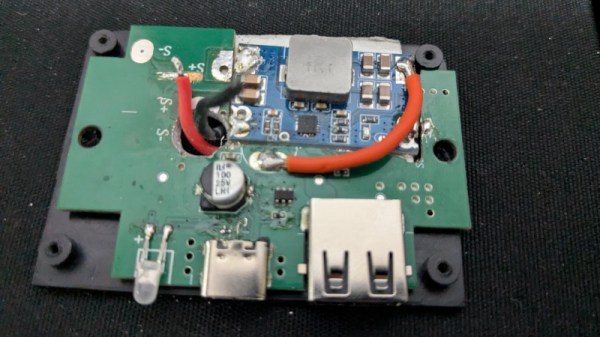
Many of us will have seen the portable solar panels offered on our favourite online purveyors of electronics, but some who have bought them remain unimpressed with their performance.  [t.oster92] had just such an issue, and concluded that since it had great dull-day performance, it wasn’t the panels themselves that were at fault. There followed a teardown and an investigation of the circuitry inside.

The panels fed a small PCB containing a buck converter, with an 8-pin SOIC carrying an untraceable part number. Some detective work revealed it was likely to be a rebadged version of a more common part, which exposed the problem as a converter without the rating to deliver the power it should. The solution, at least in part, was to replace it with a more powerful chip on a module and reap the benefits.

This would be the end of the story, but this is an ongoing project. Next up will be adding MPPT capability to extract the last bit of juice from those panels. That makes this one a story to keep an eye on, because we could all use a decent set of panels.

This hack is part of our 2026 Green Powered Challenge.

2026 Green Powered Challenge: Ventilate Your Way To Power!

Have you ever looked out across the rooftops of a city and idly gazed at the infrastructure that remains unseen from the street? It seems [varunsontakke80] has, because here’s their project, harvesting energy from the rotation of a rooftop ventilator.

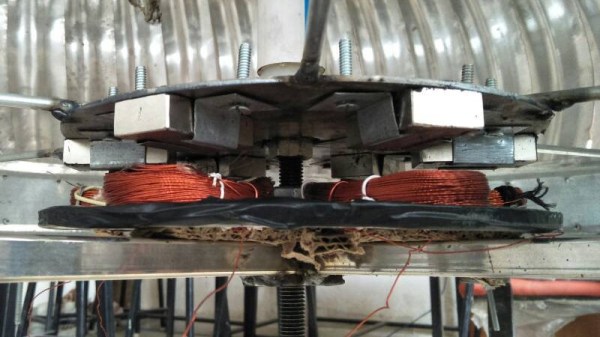
The build is a relatively straightforward one, with a pair of disks with magnets attached being mounted on the ventilator shaft inside its dome. A third disk sits between them and is stationary, with a set of coils in which the magnets induce current as they move. A rectifier and charge circuit completes the picture.

This appears to be part of a college project, but despite searching, we can’t find any measure of how much power this thing generates. We’d be concerned that it might reduce the efficiency of the ventilator somewhat. There will be an inevitable tradeoff as power is harvested. Still, it’s a neat use of a ubiquitous piece of hardware, and we like it for that.

This hack is part of our 2026 Green Powered Challenge. You’ve got time to get your own entry in, so get a move on!

2026 Green Powered Challenge: Cook With The Sun!

One of the problems facing any solar power installation comes in storing enough power for high-intensity operations such as cooking. The high-tech and expensive way involves battery banks and inverters, but [Solar Genius] is taking a more direct route by skipping the energy storage entirely.

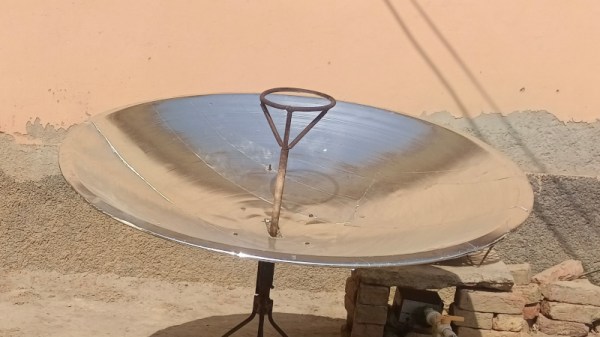
A pair of parabolic antennas are pressed into service as mirrors, catching and focusing the sun’s energy onto a cooking pot. Of course, solar cookers like this are nothing new, so what makes this one different is the in-depth analysis of its performance. This thing can cook!

One antenna is covered in square mirrors while the other is covered in sticky chrome-effect mirror sheeting. They’re described as sun tracking, but since we don’t see any mechanism we’re guessing the tracking is done by hand. The experiment takes place in Pakistan, so there’s a plentiful supply of sunlight that those of us in more northern climes can only dream of.

This hack is part of our 2026 Green Powered Challenge. You’ve just got time to get your own entry in, so get a move on!

KernelUNO, An OS For The Arduino Uno

If you were to point to a single device responsible for much of Hackaday’s early success, it might be the Arduino Uno. The little board from an Italian university with its easy to use dev environment changed microcontroller hacking forever, and while it’s now very much old hat, its shadow lies long across single board computing.

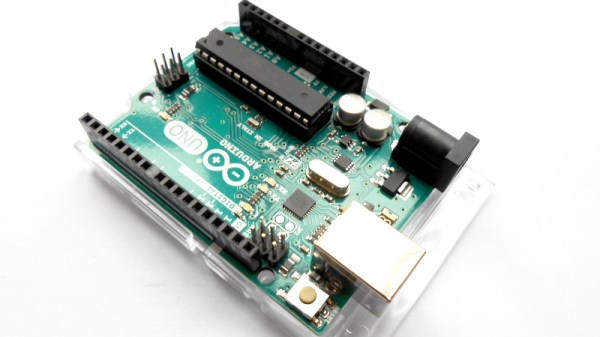
Just in case you thought there wasn’t much more life in that old AVR in 2026, along comes [Arc1011], with KernelUNO, describing itself a “A lightweight RAM-based shell for Arduino UNO with filesystem simulation, hardware control, and interactive shell“. It’s an OS for your Arduino, of sorts.

For flashing it to your Uno, you get a shell with some familiar looking filesystem and system commands, the ability to write to files though no editor, and a set of commands to control pins. It’s extremely basic, but you can see the potential.

If we were to speculate as to how this might become more useful then perhaps it might involve a more permanent filesystem perhaps on a flash chip. If possible, the ability to run script files containing a list of commands would also be very nice. Though we are guessing that maybe the reason these features are not in place lies in the meager specifications of an ATmega328, for which we can’t blame the developer at all. Even if it can’t be extended in this way though, it’s still a cool project.

We have to go back quite a while, but this isn’t the first time something like this has appeared on these pages.

AI For The Skeptics: The Universal Function For Some Things Only

It’s a phrase we use a lot in our community, “Drink the Kool-Aid”, meaning becoming unreasonably infatuated with a dubious idea, technology, or company. It has its origins in 1960s psychedelia, but given that it’s popularly associated with the mass suicide of the followers of Jim Jones in Guyana, perhaps we should find something else. In the sense we use it though, it has been flowing liberally of late with respect to AI, and the hype surrounding it. This series has attempted to peer behind that hype, first by examining the motives behind all that metaphorical Kool-Aid drinking, and then by demonstrating a simple example where the technology does something useful that’s hard to do another way. In that last piece we touched upon perhaps the thing that Hackaday readers should find most interesting, we saw the LLM’s possibility as a universal API for useful functions.

It’s Not What An LLM Can Make, It’s What It Can Do

When we program, we use functions all the time. In most programming languages they are built into the language or they can be user-defined. They encapsulate a piece of code that does something, so it can be repeatedly called. Life without them on an 8-bit microcomputer was painful, with many GOTO statements required to make something similar happen. It’s no accident then that when looking at an LLM as a sentiment analysis tool in the previous article I used a function GetSentimentAnalysis(subject,text) to describe what I wanted to do. The LLM’s processing capacity was a good fit to my task in hand, so I used it as the engine behind my function, taking a piece of text and a subject, and returning an integer representing sentiment. The word “do” encapsulates the point of this article, that maybe the hype has got it wrong in being all about what an LLM can make. Instead it should be all about what it can do. The people thinking they’ve struck gold because they can churn out content slop or make it send emails are missing this. Continue reading “AI For The Skeptics: The Universal Function For Some Things Only”

2026 Green Powered Challenge: A Low Power Distraction Free Writing Tool

Distraction free writing tools are a reaction to the bells and whistles of the modern desktop computer, allowing the user to simply pick up the device and write. The etyper from [Quackieduckie] is one such example, packing an e-paper screen into a minimalist case.

These devices are most often made using a microcontroller such as an ESP32, so it’s interesting to note that this one uses a full-fat computer — if an Orange Pi Zero 2W can be described as “Full-fat”, anyway. There’s an Armbian image for it with the software pre-configured, and also mention of a Raspberry Pi port. It works with wired USB-C keyboards, and files can be retrieved via Bluetooth. It doesn’t look as though there’s a framebuffer or other more general driver for the display so it’s likely you won’t be using this as a general purpose machine, but maybe that’s not the point. We like it, though maybe it’s not a daily driver.

This hack is part of our 2026 Green Powered Challenge. You’ve just got time to get your own entry in, so get a move on!