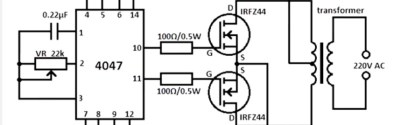
If you search the internet for 12 volt to mains AC inverter designs, the chances are you’ll encounter a simple circuit which has become rather ubiquitous. It features a 4047 CMOS astable multivibrator chip driving a pair of MOSFETs in a push-pull configuration which in turn drive a centre-tapped mains transformer in reverse. Not a new design, its variants and antecedents could be found even in those pre-Internet days when circuits came from books on the shelves of your local lending library.
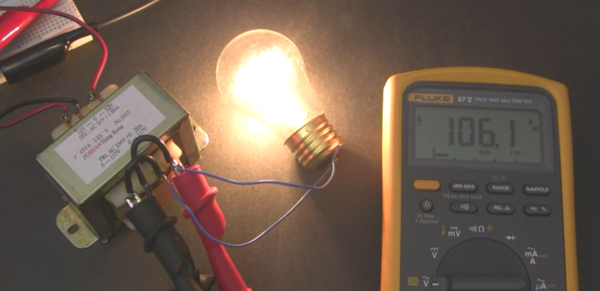
[Afroman], no stranger to these pages, has published a video in which he investigates the 4047 inverter, and draws attention to some of its shortcomings. It is not the circuit’s lack of frequency stability with voltage that worries him, but the high-frequency ringing at the point of the square-wave switching when the device has an inadequate load. This can reach nearly 600 volts peak-to-peak with a 120 volt American transformer, or over a kilovolt if you live somewhere with 230 volt mains. The Internet’s suggested refinement, a capacitor on the output, only made the situation worse. As he remarks, it’s fine for powering a lightbulb, but you wouldn’t want it near your iPhone charger.
If this video achieves anything, it is a lesson to the uninitiated that while simple and popular designs can sometimes be absolute gems it must not be assumed that this is always the case.
The World War II German Enigma encoding machine is something of an icon in engineering circles not just for its mechanical ingenuity but for the work of the wartime staff at Bletchley Park in decoding its messages. Without it we would not have had Colossus, the first programmable digital electronic computer, and subsequent technological developments might have taken a slower pace towards what we take for granted today.
Sadly for the Enigma enthusiast though, real machines are now few and far between. Our grandparents’ generation saw to that through the chaos and bombing of the fight across Europe. If you want to handle one you will have to either have an outrageous amount of money, work for a museum, or maybe for the GCHQ archivist.
This has not stopped our community building Enigma replicas, and the latest one to come to our attention here at Hackaday shows some promise. [lpaseen]’s meinEnigma is an electronic Enigma driven by an Arduino Nano, with rotary encoders to represent the Enigma rotors and multi-segment alphanumeric displays standing in for the lighted letters in the original. It supports all the different variations of rotors from the original in software, has a physical plugboard, and a serial port over USB through which all machine functions can be controlled. The machine as it stands is a fully working prototype, the plan is that a final machine will resemble the original as closely as possible.
We’ve featured a few Enigma machines on Hackaday over the years. One was built into a wristwatch, another into a hacked child’s toy, but the closest in aim to [lpaseen]’s offering is this rather attractive replica also driven by an Arduino. It is also worth mentioning that should your travels ever take you to Buckinghamshire you can visit the Bletchley Park Museum and neighboring National Museum of Computing, to get the Enigma and Colossus story from the source.
If you read our recent feature about the Tal-y-Llyn Railway, the world’s first preserved line, you may have taken a while to watch the short film about the railway in the early 1950s. It was the work of an American film maker, [Carson “Kit” Davidson].
His other work includes some films that might be of interest to Hackaday readers, including one filmed in 1977: “100 Watts 120 Volts”. In it, he follows the manufacture of Duro-Test 100-watt light bulbs through all the stages of their assembly as neck, filament and envelope are brought together in strangely beautiful twentieth century production machinery.
[Morphje] has always wanted to build a geodesic dome. The shape and design, and the possibility of building one with basic materials interest him. So with the help of a few friends to erect the finished dome, he set about realising his ambition by building a 9.1 metre diameter structure.
The action took place at Rev Space (Dutch language site), the hackspace in The Hague, Netherlands. [Morphje] first had to create a huge number of wooden struts, each with a piece of tube hammered down to a flat lug set in each end, and with a collar on the outside of the strut to prevent it from splitting. The action of flattening the ends of hundreds of pieces of tube is a fairly simple process if you own a hefty fly press with the correct tooling set up in it, but [Morphje] didn’t have that luxury, and had to hammer each one flat by hand.
The struts are then bolted together by those flattened tube lugs into triangular sections, and those triangles are further bolted together into the final dome. Or that’s the theory. In the video below you can see they make an aborted start assembling the dome from the outside inwards, before changing tack to assemble it from the roof downwards.
This project is still a work-in-progress, [Morphje] has only assembled the frame of the dome and it has no covering or door as yet. But it’s still a build worth following, and we look forward to seeing the finished dome at one or other of the European maker events in the summer.
There are some standard components that have been so continuously refined as to have become if not perfect then about as good as they’re going to get. Take the Arduino Uno for instance, and compare it with its ancestor from a decade ago. They are ostensibly the same board and they are compatible with each other, yet the Uno and its modern clones have more processing power, memory and storage, a USB interface rather than serial, and a host of small component changes to make them better and cheaper.
You’d think that just another Arduino clone couldn’t bring much to the table then. And you’d be right in a broad sense, just what is there left to improve?
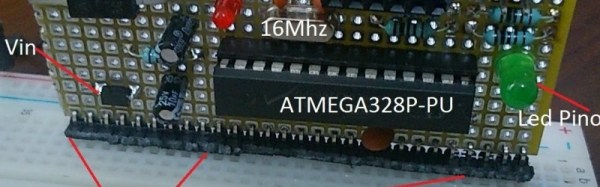
[Clovis Fritzen] has an idea for an Arduino clone that’s worth a second look. It’s not an amazing hardware mod that’ll set the Arduino world on fire, instead it’s a very simple design feature. He’s created an Arduino that mounts vertically on a single row of pins. Why might you find that attractive, you ask? A SIL vertical Arduino takes up a lot less breadboard space than one of the existing DIL Arduinos. A simple idea, yet one that is very useful if you find yourself running out of breadboard.
[Clovis] took the circuit of an Arduino Uno and simplified it by removing the USB interface, so this board has to be programmed through its ICSP header. And he’s made it a through-hole board for easy construction by those wary of SMD soldering. The resulting board files can all be found on GitHub.
Every now and then along comes a hack so simple, obvious, and useful that it makes you wonder just why you didn’t think of it yourself. Many of us will have used a DIL Arduino and probably found ourselves running out of breadboard space. This board probably won’t change the world, but it could at least make life easier in a small way for some of us who tinker with microcontrollers.
This is just the latest of many Arduino clones to find its way onto these pages. In 2013 we asked why the world needed more when featuring one made as a PCB design exercise. There’s even a Hackaday version called the HaDuino developed by [Brian Benchoff]. But while it’s true that Yet Another Vanilla Arduino Clone brings nothing to the table, that should not preclude people from taking the Arduino and hacking it. Every once in a while something useful like this project will come from it, and that can only be a benefit to our community.
Hackaday.io user [J. M. Hopkins] had a problem with his rocketry. Telemetry from the rockets came down to Earth via a 433MHz serial link, but picking just the bits he needed from a sea of data for later analysis on a laptop screen on bright sunny days was getting a little difficult.
His solution was to bring the serial data from his transceiver module to an ESP8266, and from that both share it over WiFi and display pertinent information via I2C to an LCD for easy reference. And he’s put the whole lot with a power supply in a rather splendid wooden case with an SMA socket on the back to attach his Yagi.
All information received from the telemetry is passed to a client connecting via Telnet over the WiFi, but pertinent information for the LCD is selected by sending it from the rocket enclosed in square brackets. We hope that the source code will be forthcoming in time.
Preserved railways are now an established part of the tourist itinerary. It doesn’t matter if you call it a railroad, railway, chemin de fer, Eisenbahn or whatever, the chances are that somewhere near you there will be a line rescued from dereliction on which you can spend a Saturday afternoon in vintage rolling stock being hauled by a locomotive long ago withdrawn from regular service. They are established enough to have become an industry in their own right, with the full range of support services to maintain hundred-year-old machinery and even build entire new locomotives.
So we’ve become used to seeing preserved railways in a state of polished perfection. Sometimes a little too perfect, there was a wry observation in a recent BBC documentary on the subject that a typical British preserved railway represents an average day in the 1950s when the Queen was about to visit. Anyone who lived through that era will tell you the reality was a little different, how run down the system was after World War II and just how dirty everything became when exposed to decades of continuous coal smoke.
A particularly worn-out section of railway in those days could be found at Tywyn, on the Welsh coast. A 2’3″ narrow-gauge line built in the 1860s to serve a slate quarry and provide a passenger service to local communities, the Tal-y-Llyn Railway (Welsh pronunciation help) had been in continuous decline for decades and on the death of its owner in 1950 faced closure. With only one of its two locomotives operational and its track in a parlous state it attracted the attention of the author Tom Rolt, already famous for kick-starting the preservation of Britain’s inland waterway system. A preservation society was formed, and in a joint enterprise with the former owner’s estate the line was saved. The world’s first preserved railway had commenced operations.
“Lawnmower” Locomotive in 1952 [Source: talyllyn.co.uk]In a country reeling from the economic effects of fighting a world war there was no infrastructure for a group of enthusiasts rescuing a near-derelict railway. Nobody had ever done this before, there was no body of expertise and certainly no handy suppliers to call when parts were required. To rebuild their line the Tal-y-Llyn volunteers had to reach into their own well of initiative gained over the “Make do and Mend” war years and build their own way out of any challenges they encountered. In case you were wondering what the relevance to Hackaday readers has been in the last few paragraphs there’s your answer: what would you do if you were handed seven and a quarter miles of run-down track and a single barely serviceable locomotive that is one of the oldest in the world still running?
We are fortunate that in 1953 an American film maker, Carson “Kit” Davidson, visited the line, and through his affectionate short film we have a portrayal of the railway’s state in the early stages of preservation. When the footage was shot they had secured a second serviceable locomotive courtesy of the nearby and recently closed Corris Railway, but had yet to replace the majority of the worn-out and overgrown track. It’s a treat to watch, and sets the stage very well for the home-made machinery that is to follow.

 [Afroman], no stranger to these pages, has published a video in which he investigates the 4047 inverter, and draws attention to some of its shortcomings. It is not the circuit’s lack of frequency stability with voltage that worries him, but the high-frequency ringing at the point of the square-wave switching when the device has an inadequate load. This can reach nearly 600 volts peak-to-peak with a 120 volt American transformer, or over a kilovolt if you live somewhere with 230 volt mains. The Internet’s suggested refinement, a capacitor on the output, only made the situation worse. As he remarks, it’s fine for powering a lightbulb, but you wouldn’t want it near your iPhone charger.