Retrotechtacular: Eidophor, An Unknown Widely Used Projector

If you own a video projector, be it a module small enough to fit in a mobile phone or one designed for a cinema screen, the chances are it will have a DLP at its heart. An array of microscopic mirrors on an integrated circuit, the current state of the art in video projection technology.

Perhaps you own an older video projector, or maybe a cheaper new one. If so the chances are it’ll have a small LCD screen doing its work, taking the place of the Kodachrome in something very similar to your grandparents’ slide projector or their grandparents’ magic lantern.
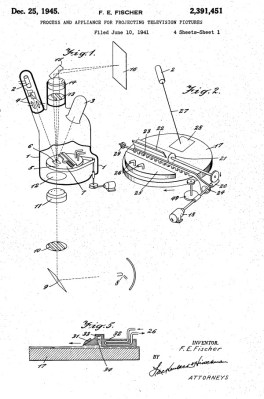
eidophore-patent-image-600pxLCD technology was invented in the 1970s, while DLP was invented at the end of the 1980s. So how did the video projectors that were such a staple of televised spectaculars in the preceding decades work? For that matter, how did NASA project their status displays on the huge screen at Mission Control? Certainly not with CRT technology, even the brightest CRT projectors weren’t up to filling a cinema-sized screen.

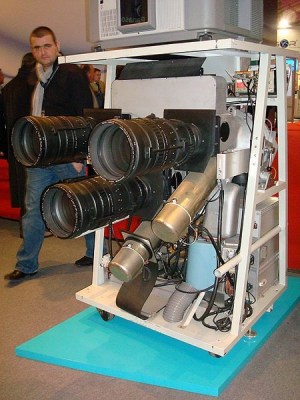
The answer came from the Eidophor (Greek: ‘eido’ and ‘phor’, ‘image’ and ‘bearer’), a device invented in the years before World War II by the Swiss physicist Dr. Fritz Fischer and granted a US patent in 1945. It featured a complex vacuum device in which an electron gun painted the video frames as a raster on an oil-covered mirror in the light path of a fairly conventional projector. High-voltage electric charges have the effect of deforming the surface of mineral oils, and it was this effect that was exploited to vary the effectiveness of the mirror as the raster was drawn. An unfortunate side-effect of tracing an oil surface with an electron beam is that a charge will build up on the oil surface, so the entire oil-covered mirror assembly had to rotate within its vacuum enclosure and pass under an electrode which removed any charge build-up.
Eidophor-wikipedia
Eidophor [by Topquark2 CC-BY-SA 3.0]
The resulting machine as seen in this 1952 issue of Popular Science was very large, complex, and expensive to run, but delivered by far the brightest and sharpest projected video available. In a literal sense they painted the backdrop to our culture, as they found a home not only in NASA’s control room but in television studios and at large televised events. This Shirley Bassey performance from the 1960s for example, or the spectacular video light show on this rather poor quality VHS YouTube clip from Seville Expo 1992.

You will probably be unaware of the exact date you last saw an eidophor performance. Quince Imaging tell us their last one was used at the TWA Dome in St Louis in July 2000. Eidophores may have become more compact over the decades but they remained costly to run, and through the 1990s they were suplanted by DLP devices that did substantially the same job with a lot less fuss.

It is not often that a search in the Hackaday archives for a technology returns no results, but the eidophor is one of those cases. Perhaps that is a fitting epitaph for a device that created its own show but never starred in it, that it is only its spectacular performances that live on.

Birthday Celebrations The Pi Way

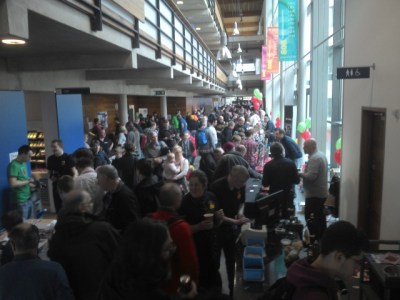
The William Gates Building concourse packed with Pi enthusiasts

On a damp and cold Saturday in early March the Cambridge University Computer Laboratory threw open its doors to the Raspberry Pi community. The previous Monday had been the fourth (or first, if you are a leap year pedant!) birthday of the little single-board computer, and last weekend saw its official birthday celebration.

The festivities took the form of an exhibition floor with both traders and community show-and-tell exhibits, plus a packed schedule of workshops and talks. With the Raspberry Pi 3 launch only a few days before there were no surprise announcements of exciting new hardware, but it did provide a good networking opportunity for the Pi community and a chance to test the state of the Raspberry Pi nation.

The most obvious first impression at the event was that it was one that catered for a diverse range of ages and ability groups. Side-by-side with parents and their children were educators, and the maker community. The range of exhibits was therefore slanted somewhat towards a younger age range with games and interactive exhibits, and there was more than a slight educational flavour to the event. This was entirely in keeping with the Foundation’s objectives, and since it is events like these that are inspiring the Hackaday readers of the next decade, a very welcome sight. Join us after the break for a look at all that was happening at the event.

Continue reading “Birthday Celebrations The Pi Way” →

Raindrops On An Oscilloscope

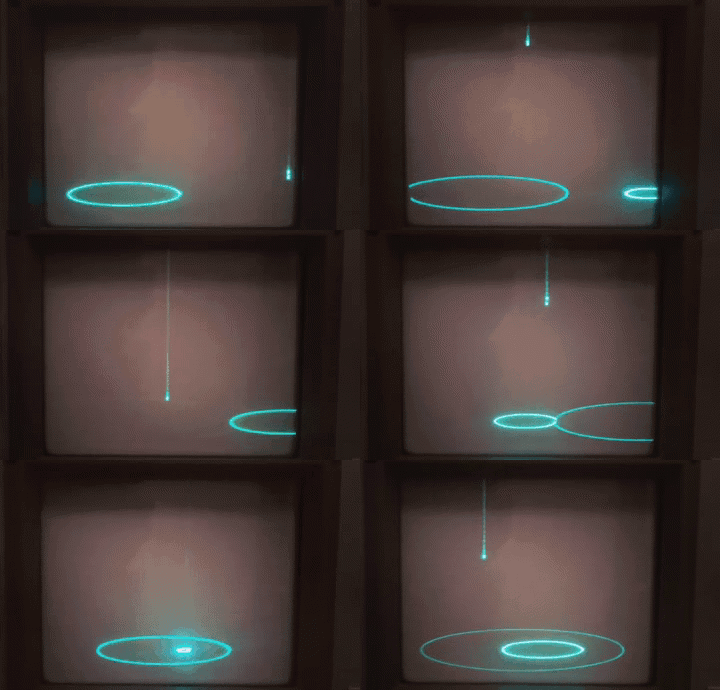
Something very beautiful appeared in our feed this evening, something that has to be shared. [Duncan Malashock] has created an animation of raindrops creating ripples. Very pretty, you might say, but where’s the hack? The answer is, he’s done it as a piece of vector display work on an oscilloscope.

He’s using [Trammell Hudson’s] V.st Teensy-powered vector graphics board. We’ve featured this board before, but then it was playing vector games rather than today’s piece of artwork. The ‘scope in question is slightly unusual, a Leader LBO-51, a device optimized for vector work rather than the general purpose ‘scopes we might be used to. The artwork is written using Processing, and all the code is available in a GitHub repository.

So sit back and enjoy the artwork unfolding in the video. We look forward to more work featuring this hardware.

Continue reading “Raindrops On An Oscilloscope” →

Digital Zoetrope Powered By Pi

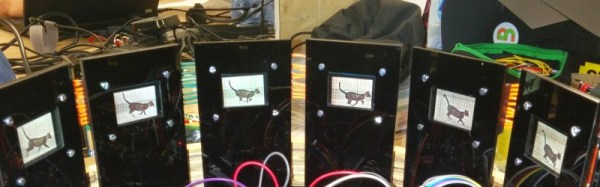
A zoetrope is a charming piece of Victoriana, a device that gives the sensation of a moving image by exposing its successive frames through slits in a rotating drum. [Brian Corteil] however is not content with a mere 19th century parlour amusement, he’s connected twelve OLED displays to a Raspberry Pi and mounted them on a circular platform with a rotary encoder to make a fully digital zoetrope.

Connecting 12 SPI devices to the Pi was always going to be something of a challenge, because only two CS lines are provided. [Brian] has a rather elegant solution to this problem, he’s daisy-chained his displays to form a shift register in which each image is passed to the next display on a rotational increment.

His resulting zoetrope sits on a laser-cut frame which rotates over an encoder disc which looks to be made from printed paper. It is still something of a work in progress, but he has plans to record video on the Pi camera for immediate playback on his creation. You can take a look at his code for the zoetrope on GitHub.

This isn’t the first zoetrope we’ve covered here at Hackaday, or even the first digital one. We’ve seen a couple of 3d-printed ones, and one featuring laser-cut images captured with a Kinect. But it’s a good piece of work, and has the promise of more to come if his camera plans come to fruition. Continue reading “Digital Zoetrope Powered By Pi” →

Endless Pancakes

Sometimes along comes a machine so simple yet so alluring in what it does and how it achieves its aim that you just want one. Doesn’t matter what it does or indeed whether ownership is a practical proposition, you wish you could have one in your possession.

What machine could trigger this reaction, you ask? [Robbie Van Der Walt] and [Christiaan Harmse] have the answer, their machine performs the simple but important task of cooking an endless pancake. A hopper dispenses a layer of pancake batter onto a slowly rotating heated roller that cooks the ribbon of pancake on one side, before it is transferred to another roller that cooks the other side. It seems simple enough yet the simplicity must hide a huge amount of product refinement and probably many miles of lost pancake. Pancakes it seems are a traditional South African delicacy, evidently they must have king-sized appetites to satisfy.

In the video below (Afrikaans, English subtitles) they make an attempt at a world record for the longest ever pancake, though sadly they don’t seem to appear in a Guinness  World Records search so perhaps they didn’t achieve it. Still, their machine is a work of art, and we applaud it. Continue reading “Endless Pancakes” →

Shoot Hard Drive Platters Skywards On The Power Of Magnetism

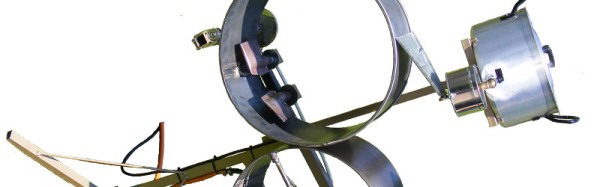
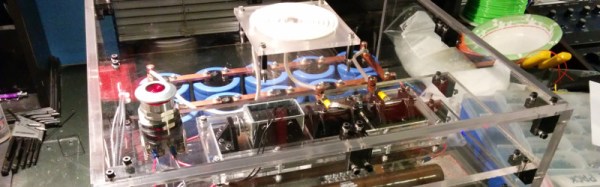
Project Hathor is an electromagnetic ring launcher that launches aluminium hard drive platters 45 feet skywards at the touch of a button. The hard work is done by a bank of capacitors which are charged to 2kV from a microwave oven transformer, before being discharged into a coil of wire on which the hard drive platter is sitting. The resulting burst of magnetic field induces a huge current in the platter, and that current in turn creates an opposing field which launches the ring into the air.

The launcher is the work of [Krux], at the Syn Shop hackerspace in Las Vegas, and he’s made a beautiful job of it. The capacitor bank has ten 3900uF 400V electrolytic capacitors wired as a single 1560uF 2kV capacitor, there are two 225W 2Kohm wire wound discharge resistors, and a beautifully designed home-made high voltage contactor featuring tungsten electrodes. The whole project has been carefully built into an acrylic case for safety, for as [Krux] points out, microwave oven transformers will kill you.

As well as the project web site, there is a YouTube playlist, an image gallery, and a GitHub repository containing all the project’s details. You can see the launcher in action in the video below, launching platters into the Nevada night right on cue.

Continue reading “Shoot Hard Drive Platters Skywards On The Power Of Magnetism” →

Snowball Machine Gun

[Mark Rober] is an uncle to three nieces and nephews, and when there is snow on the ground he faces the relentless onslaught of three elite juvenile snowball aces. Lesser men would face the fact that they are over the hill when it comes to snow-based combat, but not [Mark]. He has brought technology to his aid, and with the help of his brother created a snowball machine gun capable of firing 13 snowballs at the unruly youths in half a second.

Power for his creation comes from a leaf blower, and the gun itself is made from ABS pipe fixed onto the blower outlet. Magazines made from pipe with its top section cut away are loaded via a 45 degree junction fitting, and the rate of fire is set by how fast the operator pushes the line of snowballs with a wooden block. He has made full build instructions available as a PDF, so assuming you are reading this in a part of the world where it snows, what are you waiting for! Those of us who live in paces where it rarely snows and what snow we get is wet and slushy can only look on with envy.

The video below has the full story, complete with gratuitous destruction of fruit, youngsters cowering in their snow forts, and finally [Mark] receiving his snowy comeuppance.

Continue reading “Snowball Machine Gun” →