Creating A Numbers Station Of Your Very Own

Numbers stations are a weird phenomenon where odd voices read out long strings of numbers or random codewords to the confusion of the vast majority of the listening audience. If you’ve ever wanted to build one of your own, you could follow the example of [AudioWanderer].

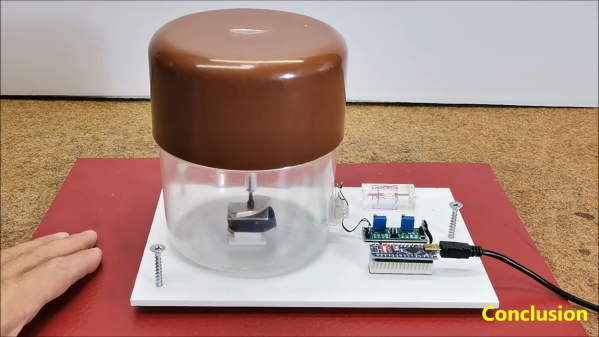
NumberMumble, as it’s called, is a numbers station emulator. It doesn’t signal spy networks or reveal national secrets. Instead, it randomly plays audio samples using an Arduino, including characteristic bursts of white noise that make it sound more authentic. It relies on the Mozzi library to help with audio tasks, including generating white noise and playing back samples. It’s also kitted out with a filter knob for varying the tone. Audio output is via PWM.

If you want to confuse your neighbours with oddball audio, put this thing on a radio transmitter and get broadcasting. But don’t, because that’s illegal without the proper licenses or — you know — if you happen to be a real spy. Video after the break.

Continue reading “Creating A Numbers Station Of Your Very Own”

Arduino Turned Into Something Kinda Like A Pager

Video may have killed the radio star, but cell phones and smart phones all but killed the pager. They still exist, of course, but only in very niche applications. [João Santos] wanted a pager-like experience for himself, though, so he enlisted an Arduino and got to work. Watch a video of the system working below.

The build uses an Arduino Uno to drive a simple HD44780 LCD display with 16 characters each across two lines of text. It’s hooked up to a Wemos D1, which uses its WiFi connection to get online. To this end, it’s capable of talking to a web application which allows users to enter text messages. It receives these messages, passes them to the Arduino Uno over I2C, and then the Uno shuttles the message to the display. It’s overkill, but [João] just found it quicker to get everything up and running via this route.

Continue reading “Arduino Turned Into Something Kinda Like A Pager”

A Simple Seismometer You Can Build Yourself

If you’re a child, there are certain things you’re taught even though they’re probably not directly relevant to your life. We teach young kids all about dinosaurs, and we teach older kids all about how the mitochondria is the powerhouse of the cell. We also teach kids about natural phenomena like earthquakes, and the equipment used to measure them. Namely, seismometers. You might like to satisfy your own child-like curiosity by building one of your own, like [mircemk] did.

Output from the build showing tremors in the Earth.

The build starts with a sensitive geophone of [mircemk’s] own design. That’s basically a microphone but it’s for picking up vibrations in the ground, not in the air. However, a geophone is not enough. You need to be able to pick up the signals from the geophone and then plot them if you want a seismometer.

First, the signals from the geophone must be amplified, which is achieved with a small circuit based around the LM358 op-amp. From there, the signal is sent to an Arduino where the output is captured via the analog-to-digital converter. This passes the signal to an attached PC which plots the results using a piece of software called NERdaq, which was developed for schools that built their own slinky-based seismometers.

[mircemk] reports that this setup has served as a reliable tool for visualizing earthquake activity for over 6 years. Though, it bears noting, it’s not calibrated so don’t expect to get science grade results out of it. Regardless, though, it’s a super cool way to understand more about what is going on with the geology around us. Video after the break.

Continue reading “A Simple Seismometer You Can Build Yourself”

Cheap DIY Microscope Lamp Makes Tiny Macro Shots Look Great

For optical microscopes, light is everything. If you don’t have a good amount of light passing through or bouncing off your sample, you’ve got nothing for your eyeballs or a camera to pick up. To aid in this regard, [Halogenek] whipped up a nifty microscope lamp with some LEDs.

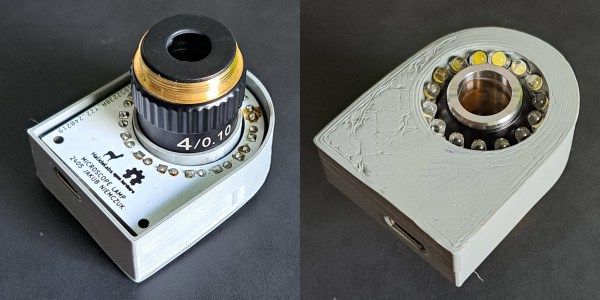
The build uses a neat arch-shaped PCB with a hole in the middle for the microscope’s optics to pass through. Surrounding this are the LEDs, which provide a circle of light focused on the sample, akin to the ring lights so favored by today’s online influencers. The LEDs are powered via USB C, so the lamp can be run off of any garden-variety phone charger you might have lying around.

[Halogenek] reports that the lamp has proven useful for extreme macro shots of PCBs. It’s an easy build to replicate or redesign your own way if you’re doing similar work.

Microscopes are super useful, and there are all kinds of hacks you can do to make them perform better in your quest for science. Meanwhile, if you’ve been jazzing up your own lab hardware, let us know—we’d love to hear about it!

Retro Unit Converter Is A Neat Little Gadget

These days, unit conversions aren’t something we have to worry about so much. If you’re sitting at a computer, you can usually just tap away in your browser to get a quick conversion done, or you can ask your smartphone for an answer. [HackMakeMod] wanted a bespoke device for this, though, and built a tiny little retro-styled unit converter.

It’s a straightforward build that uses a handful of familiar components. An ESP8266 D1 Mini development board is the heart of the operation, running off a small battery harvested from a disposable vape pen. It runs a 0.96 inch OLED display which has a menu system for selecting from a whole bunch of different unit conversions. Navigating the menu is done via a rotary encoder with an integrated push button. Everything’s wrapped up in a neat 3D printed enclosure that was given a nice worn, weathered finish after printing.

[HackMadeMod] also clearly thought about usability, too. Turning the encoder dial faster ramps up the numbers exponentially so you’re not stuck jogging for ages when you need to enter a bigger figure.

It’s not something a lot of us would have a use case for, given that smartphones are always there and probably faster to use. However, it is a tidy little gadget, and a well-presented one at that. Video after the break.

Continue reading “Retro Unit Converter Is A Neat Little Gadget”

Bonkers Nerf Blaster Sprays Balls Everywhere

Nerf blasters are fun toys, to be sure. However, they’re limited by factors like price and safety and what Hasbro thinks parents will put up with. Few caregivers would ever countenance a build like this one from [ItllProbablyWork].

It’s a blaster designed to fire 48 darts in a second or so, or a truly ludicrous 288 Nerf balls. Like so many rapid fire blaster designs, it’s based on a pair of rotating wheels which fling darts out at rapid speed. The trick to the rapid fire ability is the delivery of ammunition. In this case, the blaster has a rotating drum of 12 barrels, which can each be loaded with 4 darts or 24 balls. As the drum rotates into position, a trigger mechanism unlatches a spring which forces the contents of the barrel out through the wheels and on to the target.

It’s mostly pretty good with darts, but with balls, it tends to send them flying everywhere, including jamming a bunch into the blaster’s internals. It is very funny to watch, though.

We’ve seen some other great blaster builds recently, too. Video after the break.

Continue reading “Bonkers Nerf Blaster Sprays Balls Everywhere”

Building A Hydraulic Loader For A Lawn Tractor

Lawn tractors are a great way to mow a large yard or small paddock. They save you the effort of pushing a mower around and they’re fun to drive, to boot. However, they can be even more fun with the addition of some extra hardware. The hydraulic loader build from [Workshop from Scratch] demonstrates exactly how.

The build is based around a John Deere LX188 lawn tractor, which runs a 17 horsepower Kawasaki engine and features a hydrostatic transmission. It’s a perfectly fine way to mow a lawn. In this case, though, it’s given new abilities with the addition of a real working loader. It’s fabricated from raw steel from the arms right down to the bucket. It’s all run from a hydraulic pump, which is mounted to the engine via an electromagnetic clutch. The clutch can be engaged when it’s desired to use the hydraulics to actuate the loader.

As you might expect, the humble lawn tractor isn’t built for this kind of work. Thus, to support the extra equipment, the mower was also given some frame reinforcements and a wider track for stability.

If you’re trying to give your neighbours mower envy, this is how you do it. Or, you could go another route entirely. Video after the break.
Continue reading “Building A Hydraulic Loader For A Lawn Tractor”