Building A Continuously Variable Transmission With Lego

The first continuously variable transmission fitted to an automobile actually has its roots in the late 19th century, though the technology has only become popular in the last two decades or so. While a relatively complex technology in its modern automotive form, it’s still possible to illustrate the basic principles with everyone’s favourite mechanical learning toy – Lego.

The transmission as built isn’t great at high torque delivery, as the belt tends to slip on the smooth plastic of the cones. Increasing friction would help.

The build consists of a Lego motor driving the transmission’s input shaft, upon which a cone is mounted. A similar cone is mounted on the output shaft, and a rubber belt stretched between the two. With the cones mounted in opposing directions, the gear ratio can be continually varied by changing where upon the cones the belt rides. By riding on the small diameter section of the input cone, the belt correspondingly rides on the large diameter section of the output cone, leading to a slower, high torque output. By sliding the belt to the other end of the cone, the ratios are reversed, leading to high output speed with less torque.

The demonstration works somewhat differently than modern automotive models, but the basic concept is the same. It’s also limited in its torque transfer ability by the coefficient of friction of the plastic Lego parts. Despite this, it’s a quick way to illustrate the mechanisms at play, and where some of the common losses are in such a system. If you prefer your gearboxes of a more classic sequential design, we’ve seen those too, of course. Video after the break.

Continue reading “Building A Continuously Variable Transmission With Lego”

Custom Ignition For A Citroën Mehari

The 20th century saw a great many cheap, utilitarian vehicles enter the marketplace. Cars like the Mini and the original Jeep offered low-cost, no-frills motoring. However, they were also decidedly low-tech, and not as reliable as modern cars by a long shot. The Citroën Mehari fits into this category neatly, and when [FVFILIPPETTI] grew tired of the unreliable points ignition system, he decided to build a more modern replacement.

The system is based around at ATmega328, the venerable chip many are familiar with from its starring role in the Arduino Uno. The chip tracks engine position with a magnet mounted on the flywheel combined with a hall-effect sensor, passed through an optocoupler to avoid nasty high-voltage spikes from the spark system interfering with the microcontroller. The chip then charges the ignition coil and fires it at the necessary time to ignite the air fuel mixture.

Old-school mechanical ignition systems were, if we’re honest, terrible compared to more modern solutions. This build has rewarded [FVFILIPPETTI] with a far more reliable ride, which we’re sure is very satisfying. If all this hacking has you thirsty for an automotive project of your own, dive into our primer on how to get into cars!

Cooking Eggs With Hand Warmers

Handwarmers are great to keep your fingers functional in icy weather, but can they do more? [Greg] wondered if they could be put to good use cooking an egg, and got down to work.

The handwarmers in question are the HotHands brand, based on an iron chemistry. The warmers create their heat from the exothermic reaction between iron and oxygen that creates rust. Thus, these handwarmers need plenty of airflow to heat up. To enable this, [Greg] 3D printed a small crate with plenty of vents, into which he stacked six hand warmer sachets. An egg was nestled in the center – a perfect choice as it can be cooked in its own packaging. The pile reached temperatures of 160 F and was able to maintain that level for an hour, important as egg proteins tend to start coagulating and denaturing around 150 F. Once removed, [Greg] hoped to find a solid egg, but instead was rewarded with a somewhat gooey, semi-solid result instead. Regardless, the egg had reached an elevated temperature and shown some signs of cooking, and as [Greg] appears to be still putting out videos, we’ll assume he hasn’t yet died of salmonella.

We’d love to see this turn into an engineering competition, though, with prizes for the best cooked egg with the least amount of handwarmers. We’ve featured other egg cooking apparatus before, too. Video after the break.

Continue reading “Cooking Eggs With Hand Warmers”

Sewage Maceration Is As Gross As It Sounds

Day to day, few of us really contemplate what’s happening on a deep, mechanical level when we use the toilet. The business is done, the toilet is flushed, and we go about our day. However, the magnificent technology of indoor sanitation should not be sniffed at, given the manner in which it facilitates a cleaner, more comfortable existence for us all.

The vast majority of flush toilets rely on the benefit of gravity to remove waste from the house. This necessitates that the toilet be installed above the sewage lines that exit the house. For most installations at ground floor and above, this isn’t a problem. However, on occasions you may encounter basements or houses with rooms at lower levels where a regular toilet simply won’t work. Obviously, a pump is in order, but human sewage being a mixture of liquids and solids makes this impractical. Instead, it must be turned into a slurry that can be pumped; a process known as sewage maceration. Buckle up!

Continue reading “Sewage Maceration Is As Gross As It Sounds”

Driving Upside Down With An RC Fan Car

We’ve all seen those tiny little RC cars that can climb walls thanks to the suction generated with fans. Their principle is essentially the opposite to that of a hovercraft. [Engineering After Hours] wanted to build his own RC car that could do the same, driving upside down and generating huge amounts of grip.

The build is based on a Traxxas RC car, but heavily modified for the task. An undertray is crafted, with ducts feeding a pair of twin 50mm electric fans. A skirt is fitted around the edge of the undertray, helping create a seal to maximise the downforce generated. This skirt is the area of much engineering effort, as it must form a good seal with the ground, particularly over minor pertubations, without creating undue levels of friction. Suspension components correspondingly need to be beefed up to stop the car bottoming out with the huge downforce generated by the fan system.

After much experimentation, the kinks are worked out, and the car is able to drive upside down successfully. It generates far more downforce than earlier wing experiments from [Engineering After Hours], as expected – with a tradeoff of higher weight and complexity. With the plan to create an RC car capable of huge lateral acceleration, we can’t wait to see what comes next. Video after the break.

Continue reading “Driving Upside Down With An RC Fan Car”

Manual Pick And Place Turntable Makes Board Assembly Easier

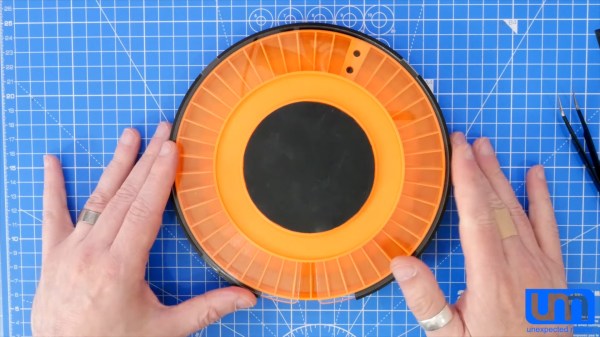
Surface mount devices were once upon a time considered a huge imposition for the electronics hobbyist. Tiny, difficult to solder by hand, and barely even labelled, many wondered whether the pastime was about to hit a brick wall entirely. Instead, enterprising hackers and makers set about learning new tricks and techniques to work with the technology, and we’ve never looked back since. [Seon] is one such enthusiast, and has built a useful turntable for making manually picking and placing boards easier. (Video, embedded below.)

The design is something [Seon] has refined gradually over time, having built two initial versions of the turntable before finally feeling ready to do a wider public release with version 3. It consists of a rotating caddy that has radial slots that hold all the tiny SMD parts, that can be labelled for easy parts identification. There’s also an acrylic window that ensures only one segment of the caddy is open at a time, to avoid accidentally dropping similar, tiny looking parts into adjacent slots – a big improvement over the first design. There’s then a smaller rotating central pad upon which a PCB can be placed, ready to receive parts.

Files are available on Github for those wanting to build their own. [Seon] does a great job explaining how the final design came about, after populating hundreds of boards on his earlier designs and learning their limitations. If doing it by hand just doesn’t cut it for you, though, you can always built a fully automated PnP.

Continue reading “Manual Pick And Place Turntable Makes Board Assembly Easier”

Arducam Now Working With The RPi Pico

The Raspberry Pi Pico came out of absolutely nowhere, and has taken the maker world by storm. At the low, low cost of $4, packing some seriously grunty original silicon, and even available free on the cover of magazines, it’s already got a legion of fans. As with any new popular platform, there’s a scramble to get everything under the sun running on the hardware. Already, ArduCAM is up and running on the Raspberry Pi Pico!

Based on the OV2640 image sensor, the ArduCAM is useful for microcontroller applications thanks to its onboard JPEG encoder. This limits the amount of RAM needed onboard the microcontroller to deal with the images fed from the camera. With the Pico now on the market, the team behind ArduCAM set about writing a library to get everything playing nicely with the SPI camera. It’s available on Github, complete with an example program so you can check everything is functional right out of the box. The easiest way to get up and running is from a Raspberry Pi environment, but the Pico acts as a USB Mass Storage device so can be programmed from virtually anywhere.

We’ll likely see the whole cavalcade of microcontroller bits and pieces ported to the Pico in the coming months, along with plenty of interesting uses of the special IO features. Video after the break.

Continue reading “Arducam Now Working With The RPi Pico”