2025 One Hertz Challenge: Educational Tool Becomes 10 Stopwatches

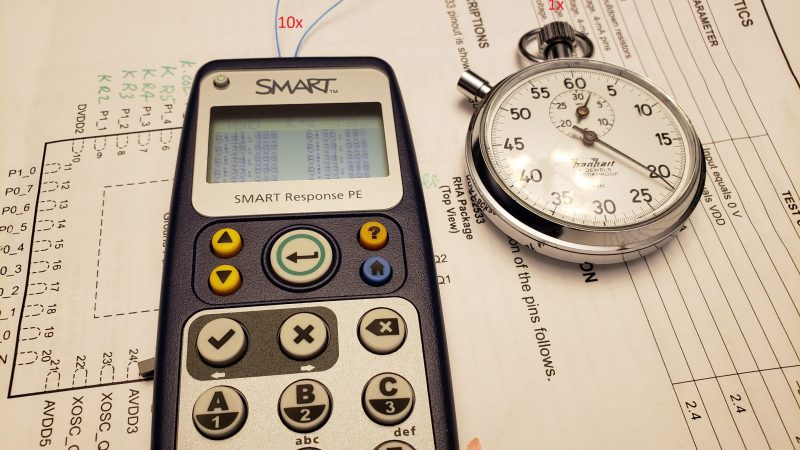
Around the globe, some classrooms are using fancy digital handheld devices to let people answer questions. One such example of this hardware is the Smart Response PE. These devices are largely useless outside the classroom, so [Ray Burne] decided to hack one for our 2025 One Hertz Challenge.

The Smart Response PE device is similar in shape and size to an old-school candybar cellphone. It runs on a Texas Instruments CC2533 microcontroller, which drives a simple black-and-white LCD. User interface is via a numeric keypad and a few extra control buttons on the front panel. Thanks to Github user [serisman], there are readily available development tools for this hardware. [Ray] notes it provides a straightforward Arduino-like programming experience.

[Ray] decided to modify the hardware to act as a stopwatch. But not just one stopwatch—ten stopwatches at once! Pressing a number from 0 to 9 will activate that given timer, and it will start ticking up on the LCD screen. One can pause the screen updates to get a temporary laptime reading by pressing the enter key. Meanwhile, pressing the Home button will reset the screen and all timers at once. [Ray] also explains on the project page how to add a real power switch to the device, and how to modify the programming pins for easy access.

It’s a fun build, and one that could prove useful if you regularly find yourself having to time ten of something at once. Maybe eggs? In any case, it’s certainly easier than juggling ten separate stopwatches at once! Meanwhile, if you’re hacking your own obscure hardware finds, don’t hesitate to notify the tipsline!


2025 One Hertz Challenge: An Arduino-Based Heart Rate Sensor

How fast does your heart beat? It’s a tough question to answer, because our heart rate changes all the time depending on what we’re doing and how our body is behaving. However, [Ludwin] noted that resting heart rates often settle somewhere near 60 bpm on average. Thus, they entered a heart rate sensor to our 2025 One Hertz Challenge!

The build is based around a Wemos D1 mini, a ESP8266 development board. It’s hooked up to a MAX30102 heart beat sensor, which uses pulse oximetry to determine heart rate with a photosensor and LEDs. Basically, it’s possible to determine the oxygenation of blood by measuring its absorbance of red and infrared wavelengths, usually done by passing light through a finger. Meanwhile, by measuring the change in absorption of light in the finger as blood flows with the beat of the heat, it’s also possible to measure a person’s pulse rate.

The Wemos D1 takes the reading from the MAX30102, and displays it on a small OLED display. It reports heart rate in both beats per minute and in Hertz. if you can happen to get your heartrate to exactly 60 beats per minute, it will be beating at precisely 1 Hertz. Perhaps, then, it’s the person using Ludwin’s build that is actually eligible for the One Hertz Challenge, since they’re the one doing something once per second?

In any case, it shows just how easy it is to pick up biometric data these days. You only need a capable microcontroller and some off-the-shelf sensors, and you’re up and running.

Continue reading “2025 One Hertz Challenge: An Arduino-Based Heart Rate Sensor”

Gentle Processing Makes Better Rubber That Cracks Less

Rubber! It starts out as a goopy material harvested from special trees, and is then processed into a resilient, flexible material used for innumerable important purposes. In the vast majority of applications, rubber is prized for its elasticity, which eventually goes away with repeated stress cycles, exposure to heat, and time. When a rubber part starts to show cracks, it’s generally time to replace it.

Researchers at Harvard have now found a way to potentially increase rubber’s ability to withstand cracking. The paper, published in Nature Sustainability, outlines how the material can be treated to provide far greater durability and toughness.

Continue reading “Gentle Processing Makes Better Rubber That Cracks Less”

Rediscovering Microsoft’s Oddball Music Generator From The 1990s

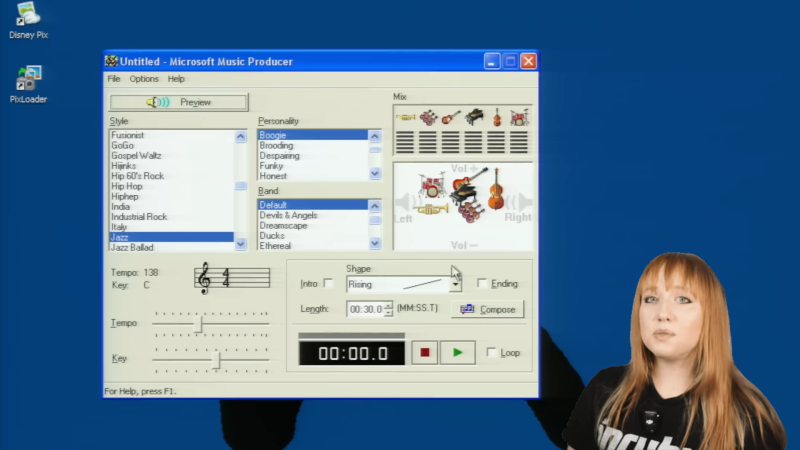
There has been a huge proliferation in AI music creation tools of late, and a corresponding uptick in the number of AI artists appearing on streaming services. Well before the modern neural network revolution, though, there was an earlier tool in this same vein. [harke] tells us all about Microsoft Music Producer 1.0, a forgotten relic from the 1990s.

The software wasn’t ever marketed openly. Instead, it was a part of Microsoft Visual InterDev, a web development package from 1997. It allowed the user to select a style, a personality, and a band to play the song, along with details like key, tempo, and the “shape” of the composition. It would then go ahead and algorithmically generate the music using MIDI instruments and in-built synthesized sounds.

As [harke] demonstrates, there are a huge amounts of genres to choose from. Pick one, and you’ll most likely find it sounds nothing like the contemporary genre it’s supposed to be recreating. The more gamey genres, though, like “Adventure” or “Chase” actually sound pretty okay. The moods are hilariously specific, too — you can have a “noble” song, or a “striving” or “serious” one. [harke] also demonstrates building a full song with the “7AM Illusion” preset, exporting the MIDI, and then adding her own instruments and vocals in a DAW to fill it out. The result is what you’d expect from a composition relying on the Microsoft GS Wavetable synth.

Microsoft might not have cornered the generative music market in the 1990s, but generative AI is making huge waves in the industry today.

Continue reading “Rediscovering Microsoft’s Oddball Music Generator From The 1990s”

2025 One Hertz Challenge: Blinking An LED With The Aid Of Radio Time

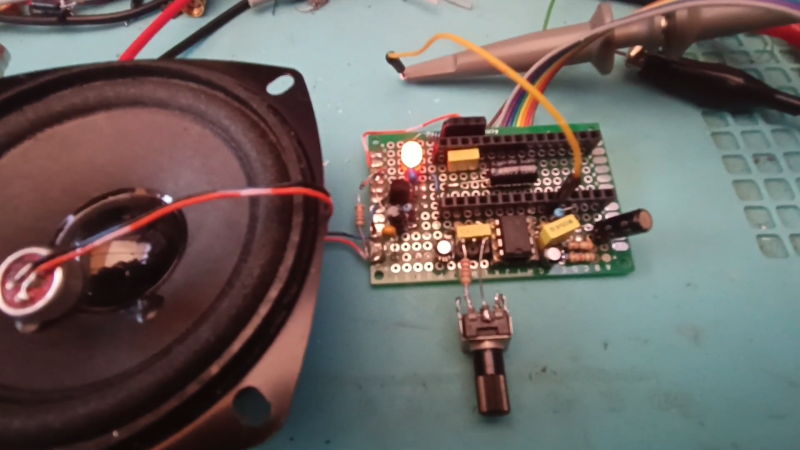
If you want to blink an LED once every second, you could use just about any old timer circuit to create a 1 Hz signal. Or, you could go the complicated route like [Anthony Vincz] and grab 1 Hz off a radio clock instead. 

The build is an entry for the 2025 One Hertz Challenge, with [Anthony] pushing himself to whip up a simple entry on a single Sunday morning. He started by grabbing a NE567 tone decoder IC, which uses a phase-locked loop to trigger an output when detecting a tone of a given frequency. [Anthony] had used this chip hooked up to an Arduino to act as a Morse decoder, which picked up sound from an electret mic and decoded it into readable output.

However, he realized he could repurpose the NE567 to blink in response to output from radio time stations like the 60 KHz British and 77.5 KHz German broadcasts. He thus grabbed a software-defined radio, tuned it into one of the time stations, and adjusted the signal to effectively sound a regular 800 Hz tone coming out of his computer’s speakers that cycled once every second. He then tweaked the NE567 so it would trigger off this repetitive tone every second, flashing an LED.

Is it the easiest way to flash an LED? No. It’s complicated, but it’s also creative. They say a one hertz signal is always in the last place you look.

Continue reading “2025 One Hertz Challenge: Blinking An LED With The Aid Of Radio Time”

How The Widget Revolutionized Canned Beer

Walk into any pub and order a pint of Guinness, and you’ll witness a mesmerizing ritual. The bartender pulls the tap, fills the glass two-thirds full, then sets it aside to settle before topping it off with that iconic creamy head. But crack open a can of Guinness at home, and something magical happens without any theatrical waiting period. Pour it out, and you get that same cascading foam effect that made the beer famous.

But how is it done? It’s all thanks to a tiny little device that is affectionately known as The Widget.

Continue reading “How The Widget Revolutionized Canned Beer”

2025 One Hertz Challenge: Digital Clock Built With Analog Timer

You can use a microcontroller to build a clock. After all, a clock is just something that counts the passage of time. The only problem is that microcontrollers can’t track time very accurately. They need some kind of external timing source that doesn’t drift as much as the microcontroller’s primary clock oscillator. To that end, [Josh] wanted to try using a rather famous IC with his Arduino to build a viable timepiece.

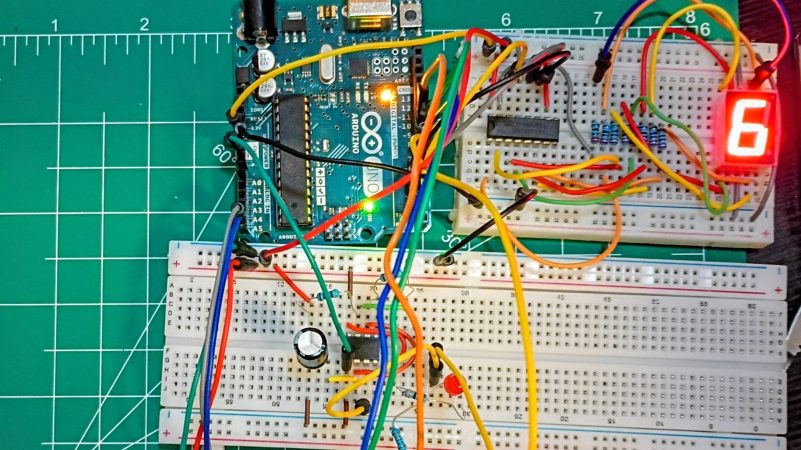
[Josh]’s idea was straightforward—employ a 555 timer IC to generate a square wave at 1 Hz. He set up an Arduino Uno to count the pulses using edge detection. This allowed for a reliable count which would serve as the timebase for a simple 24-hour clock. The time was then displayed on an OLED display attached over I2C, while raw pulses from the 555 were counted on a 7-segment display as a useful debugging measure. Setting the time is easy, with a few pushbuttons hooked up to the Arduino for this purpose.

[Josh] claims a drift of “only ~0.5 seconds” but does not state over what time period this drift occurs. In any case, 555s are not really used for timekeeping purposes in this way, because timers based on resistor-capacitor circuits tend to drift a lot and are highly susceptible to temperature changes. However, [Josh] could easily turn this into a highly accurate clock merely by replacing the 555 square wave input with a 1PPS clock source from another type of timer or GPS device.

We’ve had quite a few clocks entered into the One Hertz Competition already, including this hilariously easy Nixie clock build. You’ve got until August 19 to get your own entry in, so wow us with your project that does something once a second!