ICQ Will Shut Down On June 26 This Year

In many ways, ICQ has always been a bit of a curiosity. It was one of the first major instant messenger clients of the 1990s. It saw broad uptake alongside the likes of AOL Instant Messenger and MSN Messenger. Yet, it outlasted both of them despite not being attached to an industrial juggernaut like AOL or Microsoft. After 27 years, however, it seems that the last petal will drop, with the shutdown of ICQ announced on the ICQ website for June 26, 2024.

Originally launched by an Israeli company, Mirabilis, in June of 1996, it took the Internet by storm, leading to AOL buying Mirabilis in June of 1998. Under the wing of AOL, ICQ kept growing its user base until it was sold to Digital Sky Technologies (now VK, which operates Mail.ru) in 2010. Around this time, the likes of Facebook and Google, with their own messaging solutions, came onto the scene, leaving ICQ to flounder. Ultimately, ICQ found a new home in the Russian market as a mobile messaging system until its imminent shutdown. Users are urged to move to the VK Messenger instead.

The demise of ICQ obviously led to a blast of nostalgia on sites like Hacker News, even though it has lost relevance in the West for many years. We’re sad to see this chapter end and will mourn the demise of our UINs (RIP, 61007952) along with our fellow compatriots in the usual IRC channels.

This is what happens when you depend on the grid. Going off the grid doesn’t have to look homemade, either.

Germany’s Solar Expansion And The Negative Effects Of Electricity Overproduction

Amidst the push for more low-carbon energy, we see the demolishing of one of the pillars of electric grids: that of a careful balancing between supply and demand. This is not just a short-term affair. It also affects the construction of new power plants, investments in transmission capacity, and so on. The problem with having too much capacity is that it effectively destroys the electricity market, as suppliers need to make a profit to sustain and build generators and invest in transmission capacity. This is now the problem that Germany finds itself struggling with due to an overcapacity of variable renewable power sources (VRE) like solar and wind.

With a glut of overcapacity during windy and sunny days, this leads to prices going to zero or even negative. While this may sound positive (pun intended), it means that producers are not being paid. Worse, it means that when, for example, France buys German wind power for negative Euros via the European Electricity Exchange (EEX), it means that Germany actually pays France, instead of vice versa. The highly variable output of wind and solar also means a big increase in curtailment and redispatch measures to keep the grid stable, all of which costs money and drives up operating costs.

Continue reading “Germany’s Solar Expansion And The Negative Effects Of Electricity Overproduction”

A Look At 3D Printed Shoes: Hybrid, Fully Printed And Plain Weird

In the eternal quest to find more things to do with 3D printers, shoes have been in the spotlight for a while now. But how practical is additive manufacturing in this field really?

Adidas Ultra 4D running shoes with 3D printed midsole.

This is where [Joel Telling] of the 3D Printing Nerd YouTube channel puts in his two cents, with a look at a range of commercial and hobbyist ideas and products. Naturally, the first thing that likely comes to mind at the words ‘3D printed shoes’ is something akin to the plastic version of wooden clogs, or a more plastic-y version of the closed-cell resin of Crocs.

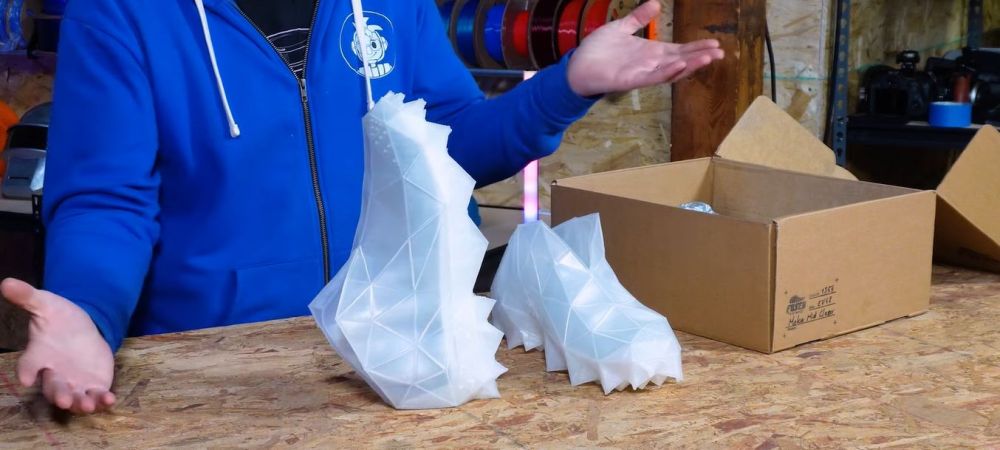
First on the list are the white & spiky Kaiju Gojira shoes from Fused Footwear, printed from TPE filament to order. TPE is softer to the touch and more flexible than TPU, but less durable. In contrast the Adidas Ultra 4D running shoes (from their 4D range) are a hybrid solution, with a standard rubber outsole, 3D printed midsole with complex structures and mostly fabric top part. Effectively a Nike Air in initial impression, perhaps.

Meanwhile ‘3D printed’ shoes ordered off Chinese store Shein turned out to be not 3D printed at all, while [Joel] seems to be really into fully 3D printed shoes from Zellerfeld, who appear to be using TPU. While it’s hard to argue about taste, the Adidas shoes might appeal to most people. Especially since they’d likely let your feet breathe much better, a fact appreciated not only by yourself, but also family members, roommates and significant others. So which of these (partially) 3D printed shoes would you pick, or do you have some other favorite?

Continue reading “A Look At 3D Printed Shoes: Hybrid, Fully Printed And Plain Weird”

Mapping The Human Brain And Where This May Lead Us

In order to understand something, it helps to observe it up close and study its inner workings. This is no less true for the brain, whether it is the brain of a mouse, that of a whale, or the squishy brain inside our own skulls. It defines after all us as a person; containing our personality and all our desires and dreams. There are also many injuries, disorders and illnesses that affect the brain, many of which we understand as poorly as the basics of how memories are stored and thoughts are formed. Much of this is due to how complicated the brain is to study in a controlled fashion.

Recently a breakthrough was made in the form of a detailed map of the cells and synapses in a segment of a human brain sample. This collaboration between Harvard and Google resulted in the most detailed look at human brain tissue so far, contained in a mere 1.4 petabytes of data. Far from a full brain map, this particular effort involved only a cubic millimeter of the human temporal cortex, containing 57,000 cells, 230 millimeters of blood vessels and 150 million synapses.

Ultimately the goal is to create a full map of a human brain like this, with each synapse and other structures detailed. If we can pull it off, the implications could be mind-bending.

Continue reading “Mapping The Human Brain And Where This May Lead Us”

Nuclear Fusion R&D In 2024: Getting Down To The Gritty Details

To those who have kept tabs on nuclear fusion research the past decades beyond the articles and soundbites in news outlets, it’s probably clear just how much progress has been made, and how many challenges still remain. Yet since not that many people are into plasma physics, every measure of progress, such as most recently by the South Korean KSTAR (Korea Superconducting Tokamak Advanced Research) tokamak, is met generally by dismissive statements about nuclear fusion always being a certain number of decades away. Looking beyond this in coverage such as the article by Science Alert about this achievement by KSTAR we can however see quite a few of these remaining challenges being touched upon.

Recently KSTAR managed to generate 100 million degrees C plasma and maintain this for 48 seconds, a significant boost over its previous record from 2021 of 30 seconds, partially due to the new divertors that were installed. These divertors are essential for removing impurities from the plasma, yet much like the inner wall of the reactor vessel, these plasma-facing materials (PFM) bear the brunt of the super-hot plasma and any plasma instabilities, as well as the constant neutron flux from the fusion products. KSTAR now features tungsten divertors, which has become a popular material choice for this component.

Researching the optimal PFMs, as well as plasma containment modes and methods to suppress plasma instabilities are just some of the challenges that form the road still ahead before commercial fusion can commence.

Continue reading “Nuclear Fusion R&D In 2024: Getting Down To The Gritty Details”

Using A Spring As A Capacitive Touch Button

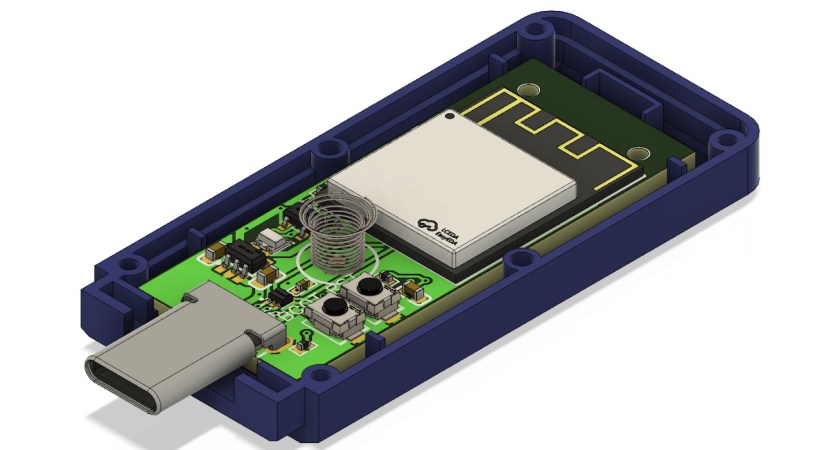
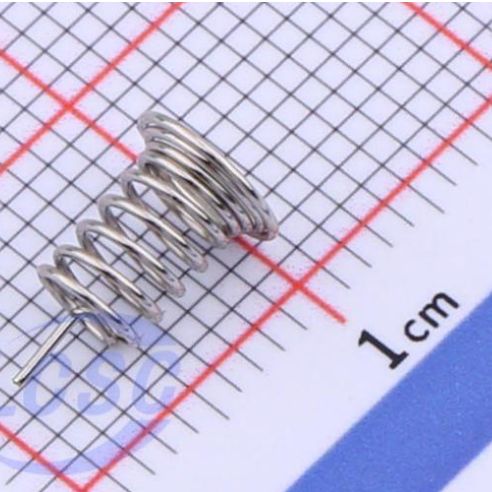
When [Daniel Eichhorn] designed the Pendrive S3 project, he wanted to use an off-the-shelf USB enclosure but also add a button for the user to start certain actions. Drilling a hole into the enclosure would be an option, but decided a touch sensor on the top of the enclosure would be much more elegant — not to mention better at keeping dirt and moisture out. To bridge the 6.3 mm spacing between the PCB and the top of the enclosure [Daniel] used a small, 7 mm PCB-mounted spring.

The spring used to create a capacitive touch sensor. (Source: JLCPCB parts)

Although capacitive sensing works with just about  anything that’s electrically conductive, it’s important to get the conductive element as close to the user’s digits as possible. Using a spring here has the advantage that when the enclosure is closed up, the lid will push down onto the spring, which will not only compress slightly, but also provide the best capacitive sensing experience when e.g. the enclosure flexes or warps over time on account of always being pressed against the inside of the lid.

While hardly world-changing, this is another neat design tip when you’re looking to turn more surfaces into touch controls. Just keep in mind that capacitive sensing is notoriously fussy and any trace and spring are also excellent antennae for stray EMI. Nobody likes random capacitive button inputs, after all.

Static Recompilation Brings New Life To N64 Games

Over the past few years a number of teams have been putting a lot of effort into taking beloved Nintendo 64 games, decompiling them, and lovingly crafting them into highly portable C code. This allows for these games to not only run natively on PCs, but also for improvements to be made to the rendering engine and other components.

Yet this artisan approach to porting these games means a massive time investment, something which static binary translation (static recompilation) may conceivably speed up. Enter the N64: Recompiled project, which provides a binary translation tool to ease the translation of the N64’s binaries into C code.

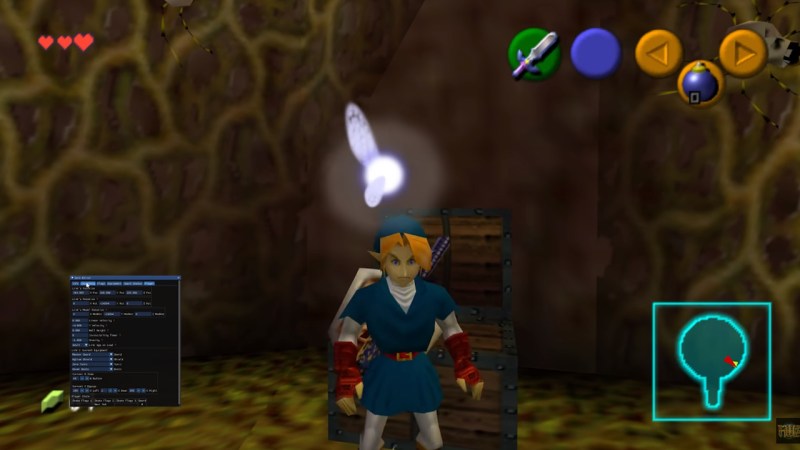
This is effectively quite similar to what an emulator does in real-time, just with the goal of creating a permanent copy of the translated instructions. After this static binary translation, the C code can be compiled again, but as noted by the project’s documentation, a suitable runtime is needed to get a functional game. An example of this is the Zelda 64: Recompiled project, which uses the N64: Recompiled project at its core, while providing the necessary scaffolding and wrappers to create a working copy of The Legend of Zelda: Majora’s Mask as output.

In the video below, [Modern Vintage Gamer] takes the software for a test drive and comes away very excited about the potential it has to completely change the state of N64 emulation. To be clear, this isn’t a one-button-press solution — it still requires capable developers to roll up their sleeves and get the plumbing in. It’s going to take some time before you favorite game is supported, but the idea of breathing new life into some of the best games from the 1990s and early 2000s certainly has us eager to see where this technology goes

Continue reading “Static Recompilation Brings New Life To N64 Games”