Creating A New Metal Rohde & Schwarz EB200 Miniport Receiver Dial Knob

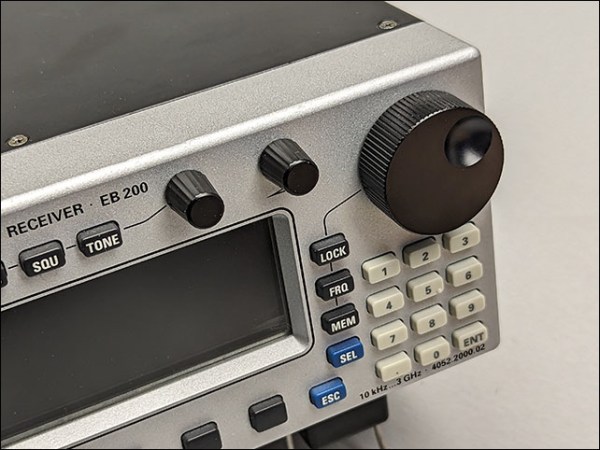
Recently [Roberto Barrios] got his hands on a Rohde & Schwarz EB200 monitoring and surveillance receiver that, despite its late 90s vintage, was in mint condition. Aside from damage to the main dial, that is, which was very much broken. With no off-the-shelf replacement available in 2023, the obvious answer was to get a close-enough dial knob with the rough proportions and use a lathe to machine it into shape. Initially, [Roberto] had used some filler material to replace the front of the original knob that was missing, but this was a decidedly inferior tactile experience with questionable long-term reliability.
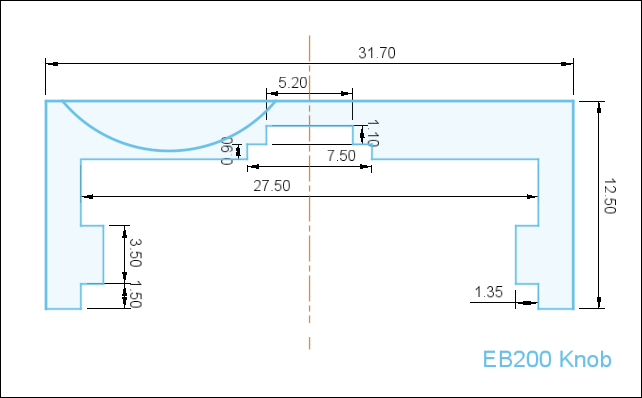
Dimensions of the Rhode & Schwarz EB200 dial knob. (Credit: Roberto Barrios)

The challenge in replacing the original knob with a proper replacement was in how the dial knob is mounted on the receiver, as an internally threaded shell that goes on the internal dial encoder assembly. With a lathe at his behest, taking an off-the-shelf dial knob that accepts a 6 mm shaft and turning it into a compatible knob was a straightforward affair. Removing the excess material and creating the internal 1 mm pitch thread allowed the newly made knob to fit on the receiver like an OEM part. The only niggle was having to remove 1.8 mm off the face of the brass body to get the knob to sit close to the front panel.

Unlike the old patched-up knob, this new one is fully out of metal and has the absolutely essential feature of the recessed area for easy fine-tuning. Although perhaps not the most exciting fix for old gear, it’s decidedly essential to keep it functional.
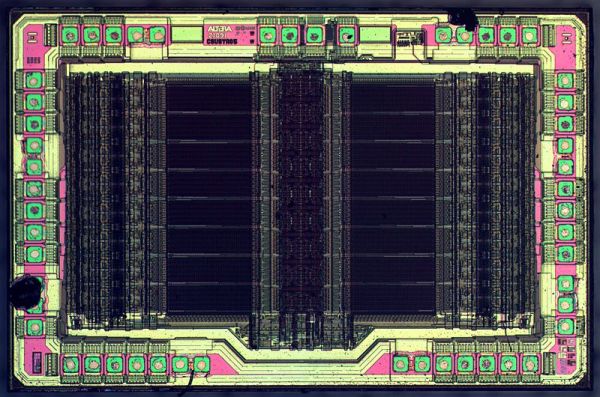
Die of an Altera EPM7032 EEPROM-based Complex Programmable Logic Device (CPLD). (Credit: ZeptoBars, Wikipedia)

Using EPROMS And EEPROMs As Programmable Logic With Lisp

That EPROMs, EEPROMs and kin can be used as programmable logic should probably not come as a major surprise, but [Jimmy] has created a Lisp-based project that makes using these chips as a logic array very straightforward. All it takes is importing the package into one’s Lisp project and defining the logic, before the truth function generates the binary file that can be written to the target chip.

Suggested is the one-time-programmable AT27C512R EPROM (64k x8), but any 8-bit parallel interface (E)EPROM should work, with non-OTP chips being nice unless the chip has to go into a production device. A possible future improvement is the addition of 16-bit (E)EPROM support.

The use of EEPROMs is common with PLA-replacements, as with, for example, the Commodore 64, where the official PLA IC tends to go bad over time. Due to the complexity of the logic in these PLA ICs, here CPLDs are used, which internally are still EEPROM-based, but feature many more programmable elements to allow for more complex logic. If all you need is a bit of glue logic and you are looking for something in between a stack of 74-logic ICs and a CPLD, an EEPROM may be just be the solution, regardless of whether you prefer to create the binary image with Lisp or C.

Continue reading “Using EPROMS And EEPROMs As Programmable Logic With Lisp”

The Many Ways To Play Colossal Cave Adventure After Nearly Half A Century

Born from a passion for caving and the wish to turn this into a digital adventure for all ages, Colossal Cave Adventure has grown from its quiet introduction in 1976 by William Crowther into the expanded game that inspired countless others to develop their own take on the genre, eventually leading to the realistically rendered graphical adventures we can play today. Yet even Colossal Cave Adventure has recently got a refresh in the form of a 3D graphical version, which has led [Bryan Lunduke] to take a look at how to best revisit the original text adventure.

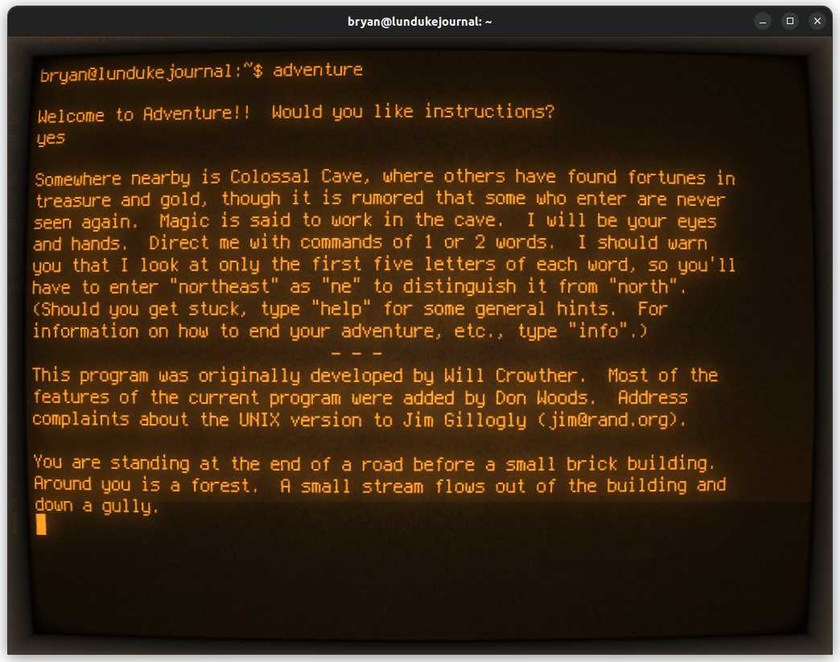
Your Colossal Cave Adventure awaits... (Credit: Bryan Lunduke)
Your Colossal Cave Adventure awaits… (Credit: Bryan Lunduke)

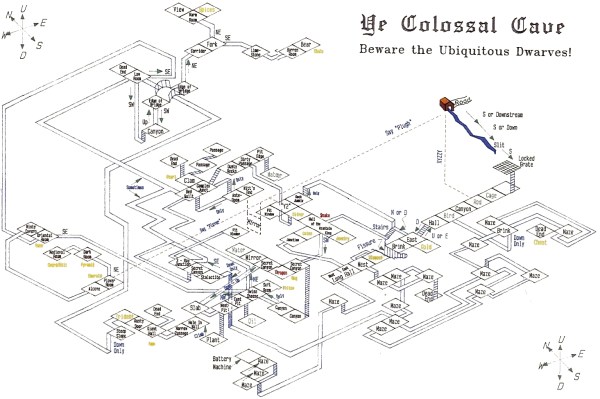
For those who are on Linux or a BSD system, the easiest way is to hop over to the package manager and install Colossal Cave Adventure straight away with the package bsdgames on Debian-based systems, or colossal-cave-adventure on others. A port by Eric S. Raymond of the 1995 version of the game can also be found as Open Adventure, and there’s a 1990-era DOS version you can experience on real hardware or even in a browser window, if that’s your thing. Or get it for your Amiga, Macintosh or OS/2. These days you can even get ready-to-use maps of the entire cave and surroundings, which along with walkthroughs can make things far too easy. Continue reading “The Many Ways To Play Colossal Cave Adventure After Nearly Half A Century”

Remembering The MUDdiest Of Times With The MUD1 And MUD2 Online RPGs

Before there were massively multiplayer online role-playing games (MMORPGs) like EverQuest, the genre was called a Multi-User Dungeon (MUD), following in the trend of calling text adventures at that time ‘dungeon crawlers’. These multi-player games required you to bring along your own imagination, for these were purely text-based affairs. Despite the first of these (MUD1) having been released all the way back in 1978 for the DEC PDP-10, these games are still being played today, long after they stopped being in the (game) news cycle.

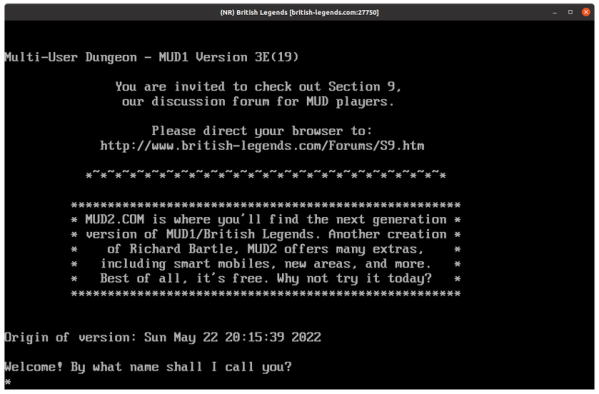
The brief history and today’s status of MUD1 is covered in a recent article by [Bryan Lunduke], following its creation in 1979 in the UK by [Richard Bartle] and [Roy Trubshaw], its struggles and eventual renaming to ‘British Legends

Technically all you need to play is a telnet client, though you can always use a graphical web browser to log into a text adventure. Much like playing a game like Zork — which heavily inspired MUDs — you got to use your wits and map drawing skills to figure out how to navigate around the world. You can also play the new and improved MUD: MUD2. Make sure to take a peek on [Richard]’s aesthetically yellow MUD-related website and the latest gossip in the Muddled Times before joining either the UK MUD2 server or the Canadian one.

Although definitely leaning on one’s imagination more than the advanced graphics of a graphical MUD like EverQuest require, there’s a lot of fun to be had in these MUDs, as well as the plethora of others.

Thanks to [Stephen Walters] for the tip.

The Simulated Universe Thought Experiment And Information Entropy

Do we live in a simulation? This is one of those questions which has kept at least part of humanity awake at night, and which has led to a number of successful books and movies being made on the subject, topped perhaps by the blockbuster  movie The Matrix. Yet the traditional interpretation of the ‘simulated universe’ thought experiment is one in which we – including our brains and bodies – are just data zipping about in a hyper-advanced simulation rather than physical brains jacked into a computer. This simulation would have been set up by (presumably) a hyper-advanced species who seem to like to run their own version of The Sims on a Universe-sized scale.

Regardless of the ‘why’, the aspect of this question where at least some scientific inquiry is possible concerns whether or not it would be possible to distinguish anything uniquely simulation-like in our environment that’d give the game away, like a sudden feeling of déjà vu in the world of The Matrix where you can suddenly perceive the fabric of the simulation. However, the major problem which we have to consider when trying to catch a simulation in the act is that to this point we cannot ourselves create even a miniature galaxy and intelligent beings inside it to provide a testable hypothesis.

Beyond popular media like movies and series like Rick & Morty, what do science and philosophy have to say about this oddly controversial subject? According to some, we have already found the smoking gun, while others are decidedly more skeptical.

Continue reading “The Simulated Universe Thought Experiment And Information Entropy”

Using LEDs To Determine A Video Camera’s True Framerate

Interpolation and digital cropping are two techniques which are commonly used by marketing folk to embellish the true specifications of a device. Using digital cropping a fictitious zoom level can be listed among the bullet points, and with frame interpolation the number of frames per second (FPS) recorded by the sensor is artificially padded. This latter point is something which [Yuri D’Elia] came across with a recently purchased smartphone that lists a 960 FPS recording rate at 720p. A closer look reveals that this is not quite the case.

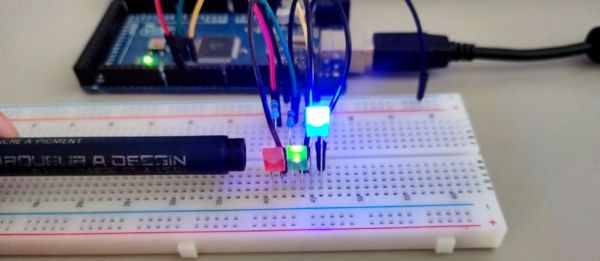
The smartphone in question is the Motorola Edge 30 Fusion, which is claimed to support 240 and 960 FPS framerates at 720p, yet the 50 MP OmniVision OV50A sensor in the rear camera is reported as only supporting up to 480 FPS at 720p. To conclusively prove that the Motorola phone wasn’t somehow unlocking an unreported feature in this sensor, [Yuri] set up an experiment using three LEDs, each of which was configured to blink at either 120, 240 or 480 Hz in a side-by-side configuration.

As [Yuri] explains in the blog post, each of these blinking frequencies would result in a specific pattern in the captured video, allowing one to determine whether the actual captured framerate was equal to, less than or higher than the LED’s frequency. Perhaps most disappointingly about the results is that this smartphone didn’t even manage to hit the 480 FPS supported by the OV50A sensor, and instead pegged out at a pedestrian 240 FPS. Chalk another one up for the marketing department.

NASA JPL’s Voyager Team Is Patching Up Both Voyagers’ Firmware

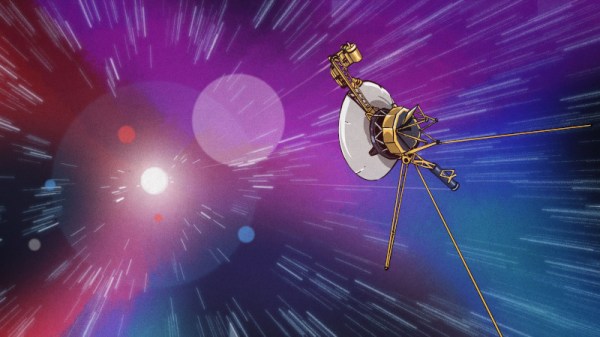
It’s not every day that you get to update the firmware on a device that was produced in the 1970s, and rarely is said device well beyond the boundaries of our solar system. This is however exactly what the JPL team in charge of the Voyager 1 & 2 missions are facing, as they are in the process of sending fresh firmware patches over to these amazing feats of engineering. These patches should address not only the attitude articulation and control system (AACS) issues that interrupted Voyager 1’s communication with Earth a while ago, but also prevent the thruster propellant inlet tubes from getting clogged up as quickly.

Voyager 2 is the current testbed for these patches, just in case something should go wrong despite months of Earth-based checking, testing and validation. As Voyager 1 is the furthest from Earth, its scientific data is the more valuable, but ideally neither spacecraft should come out worse for wear after this maintenance session.

The AACS fixes are more of an insurance policy, as the original cause of the issue was found to be that the AACS had entered into an incorrect mode, yet without a clear understanding of how this could have happened. With these changes in place, recovery should be much easier. Similarly, the changes to the use of the thrusters are relatively minor, in that they will mostly let the spacecraft drift a bit more out of focus before the thrusters engage, reducing total thruster firings and thus the build-up of material in these inlet tubes.

With these changes the antennae of both spacecraft should remain trimmed firmly towards the blue planet which they left over forty-five years ago, and enable them to hopefully reach that full half century mark before those of us who are still listening have to say our final farewells.