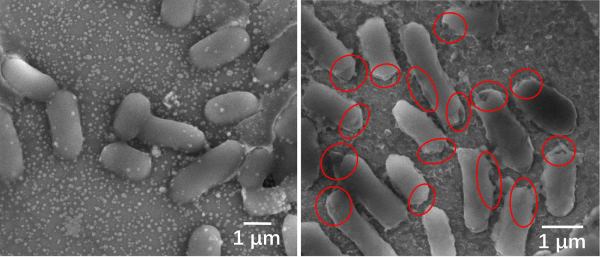
Microscopic images of E. coli before (left) and after disinfection. The bacteria died quickly after sunlight produced chemicals that caused serious damage to the bacterial cell membranes, as shown in the red circles. (Image credit: Tong Wu/Stanford University)

Generating Hydrogen Peroxide For Disinfecting Water Using A Solar-Driven Catalyst

Ensuring that water is safe to use and consume can be a real chore, especially for those who live in impoverished areas without access to safe drinking water. Here is where researchers at Stanford University hope that their recently developed low-cost catalyst can make a difference. This catalyst comes in the form of nano-sized particles (nanoflakes) consisting out aluminium oxide, molybdenum sulfide, copper and iron oxide. When exposed to sunlight,  the catalyst performs like a photon-sensitive semiconductor/metal junction (Cu-MoS2), with the dislodged electrons going on to react with the surrounding water, resulting in the formation of hydrogen peroxide (H2O2) and hydroxy radicals.
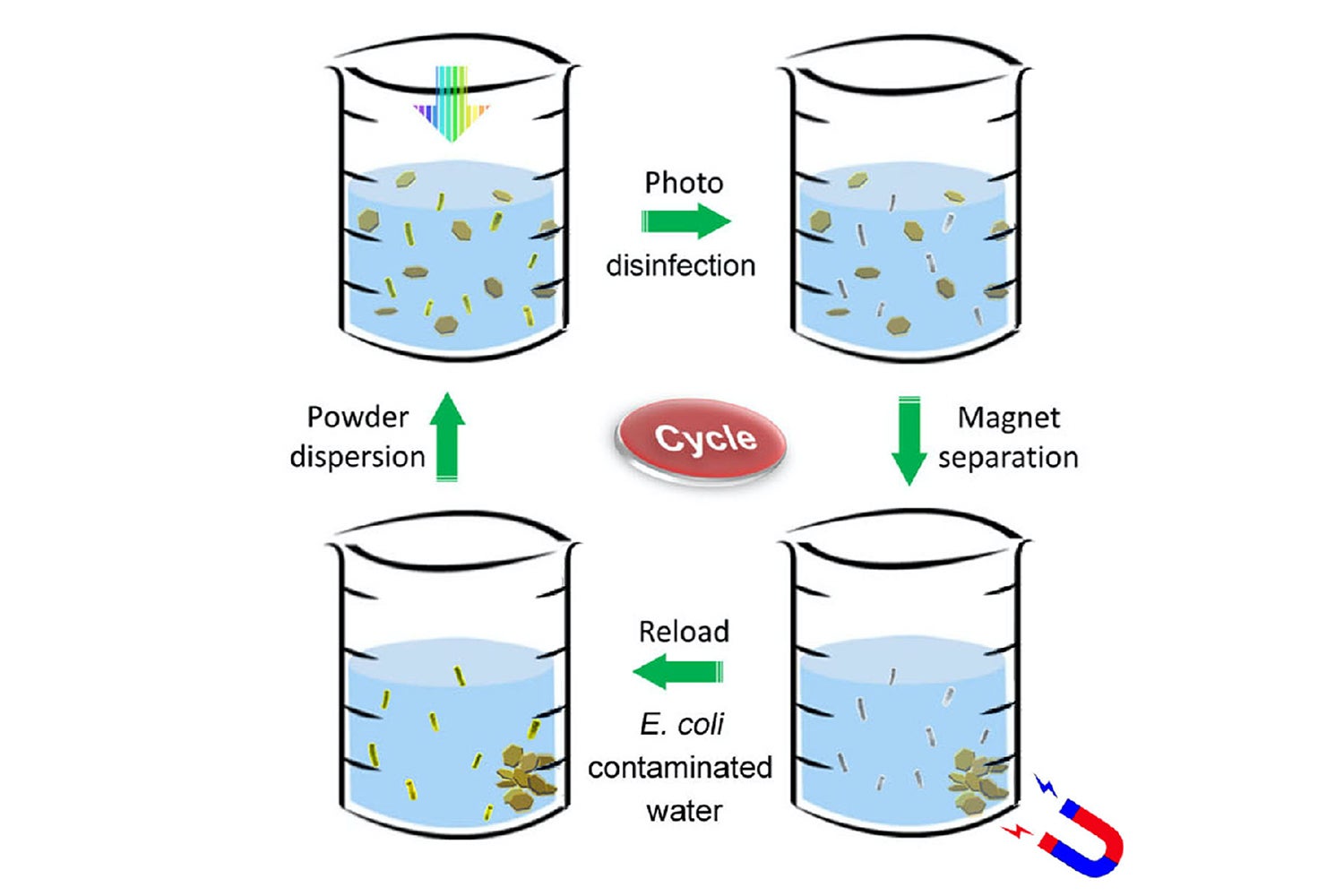
Disinfectant powder is stirred in bacteria-contaminated water (upper left). The mixture is exposed to sunlight, which rapidly kills all the bacteria (upper right). A magnet collects the metallic powder after disinfection (lower right). The powder is then reloaded into another beaker of contaminated water, and the disinfection process is repeated (lower left). (Image credit: Tong Wu/Stanford University)

Waterborne diseases are very common, with even the US reporting 7,000 deaths and 120,000 hospitalizations in 2021, according to the US CDC, and many more affected worldwide. Much of the harm is done by microbes, in particular bacteria such as E. coli, which are prolific in aquatic environments. By using this catalyst powder in contaminated water, the researchers reported that the Escherichia coli colonies in the tested samples were fully eradicated after a 60 second exposure to sunlight.

The reason for this is that hydrogen peroxide and similar reactive oxygen species are highly destructive to living cells, yet they are simultaneously very safe. Because of their high reactivity they are very unstable and thus short-lived. This is useful when the water with the now very dead microbes is consumed afterwards, with the catalyst itself being ferromagnetic and thus easily separated using a magnet.

With this proof of concept in hand, it’d be interesting to see what the product will look like, especially when it comes to the final separation step and making this as easy as possible. Since the catalyst is not consumed or presumably contaminated, it can last pretty much forever, making it an attractive alternative to water purification tablets and expensive filtration systems.

(Heading image: Microscopic images of E. coli before (left) and after disinfection. The bacteria died quickly after sunlight produced chemicals that caused serious damage to the bacterial cell membranes, as shown in the red circles. (Image credit: Tong Wu/Stanford University) )
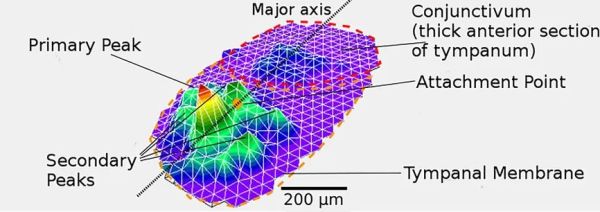

Mapping of the displacement of a tympanum of the lesser wax moth (Achroia grisella). (Credit: Andrew Reid)

3D Printing Bio-Inspired Microphone Designs Based On Moth Ears

If many millions of years of evolution is good for anything, it is to develop microscopic structures that perform astounding tasks, such as the marvelous biology of insects. One of these structures are the ears of the lesser wax moth (Achroia grisella), whose mating behavior involves ultrasonic mating calls. These can attract the bats which hunt them, leading to these moths having evolved directional hearing that can pinpoint not only a potential mate, but also bat calling sound.

What’s most astounding about this is that these moths that only live about a week as an adult can perform auditory feats that we generally require an entire microphone array for, along with a lot of audio processing. The key that enables these moths to perform these feats lies in their eardrum, or tympanum. Rather than the taut, flat surface as with mammals, these feature intricate 3D structures along with pores that seem to perform much of the directional processing, and this is what researchers have been trying to replicate for a while, including a team of researchers at the University of Strathclyde.

To create these artificial tympanums, the researchers used a flexible hydrogel, with a piezoelectric material that converts the acoustic energy into electric signals, connected to electrical traces. The 3D features are printed on this, mixed with methanol that forms droplets inside the curing resin, before being expelled and leaving the desired pores. One limitation is that currently used printers have a limited resolution of about 200 micrometers, which doesn’t cover the full features of the insect’s tympanum.

Assuming this can be made to work, it could be used for everything from cochlear implants to anywhere else that has a great deal of audio processing that needs downsizing.

(Heading image: Mapping of the displacement of a tympanum of the lesser wax moth (Achroia grisella). (Credit: Andrew Reid) )

AirTags, Tiles, SmartTags And The Dilemmas Of Personal Tracking Devices

In an ideal world we would never lose our belongings, and not spend a single hour fruitlessly searching for some keys, a piece of luggage, a smartphone or one of the two dozen remote controls which are scattered around the average home these days. Since we do not live in this ideal world, we have had to come up with ways to keep track of our belongings, whether inside or outside our homes, which has led to today’s ubiquitous personal tracking devices.

Today’s popular Bluetooth-based trackers constantly announce their presence to devices set up to listen for them. Within a home, this range is generally enough to find the tracker and associated item using a smartphone, after which using special software the tracker can be made to sound its built-in speaker to ease localizing it by ear. Outside the home, these trackers can use mesh networks formed by smartphones and other devices to ‘phone home’ to paired devices.

This is great when it’s your purse. But this also gives anyone the ability to stick such a tracker device onto a victim’s belongings and track them without their consent, for whatever nefarious purpose. Yet it is this duality between useful and illegal that has people on edge when it comes to these trackers. How can we still use the benefits they offer, without giving stalkers and criminals free reign? A draft proposal by Apple and Google, submitted to the Internet Engineering Task Force (IETF), seeks to address these points but it remains complicated.

Continue reading “AirTags, Tiles, SmartTags And The Dilemmas Of Personal Tracking Devices”

Intel Suggests Dropping Everything But 64-Bit From X86 With Its X86-S Proposal

In a move that has a significant part of the internet flashing back to the innocent days of 2001 when Intel launched its Itanium architecture as a replacement for the then 32-bit only x86 architecture – before it getting bludgeoned by AMD’s competing x86_64 architecture – Intel has now released a whitepaper with associated X86-S specification that seeks to probe the community’s thoughts on it essentially removing all pre-x86_64 features out of x86 CPUs.

While today you can essentially still install your copy of MSDOS 6.11 on a brand-new Intel Core i7 system, with some caveats, it’s undeniable that to most users of PCs the removal of 16 and 32-bit mode would likely go by unnoticed, as well as the suggested removal of rings 1 and 2, as well as range of other low-level (I/O) features. Rather than the boot process going from real-mode 16-bit to protected mode, and from 32- to 64-bit mode, the system would boot straight into the 64-bit mode which Intel figures is what everyone uses anyway.

Where things get a bit hazy is that on this theoretical X86-S you cannot just install and boot your current 64-bit operating systems, as they have no concept of this new boot procedure, or the other low-level features that got dropped. This is where the Itanium comparison seems most apt, as it was Intel’s attempt at a clean cut with its x86 legacy, only for literally everything about the concept (VLIW) and ‘legacy software’ support to go horribly wrong.

Although X86-S seems much less ambitious than Itanium, it would nevertheless be interesting to hear AMD’s thoughts on the matter.

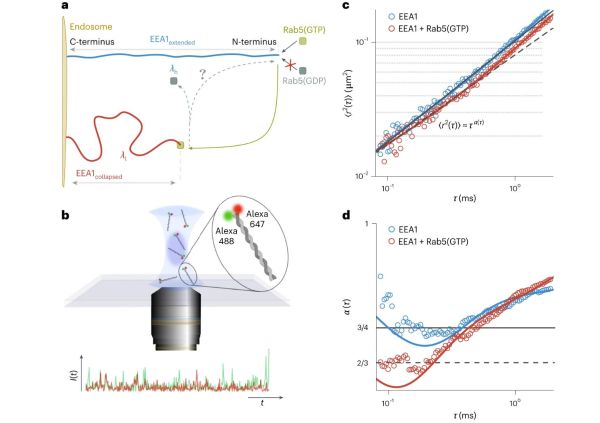
Binding of the Rab5(GTP) to EEA1 triggers a transition of the EEA1 molecule from a rigid, extended state to a more flexible, collapsed state. (Credit: Anupam Singh et al., 2023)

Not Just ATP: Two-Component Molecular Motor Using GTPase Cycle Demonstrates Mechanotransduction

For most of us who haven’t entirely slept through biology classes, it’s probably no secret that ATP (adenosine triphosphate) is the compound which provides the energy needed for us to move our muscles and for our body to maintain and repair itself, yet less know is guanosine triphosphate (GTP). Up till now GTP was thought to be not used for mechanical action like molecular motors, but recent research by Anupam Singh and colleagues in Nature Physics (press release) has shown that two GTPase hydrolase enzymes (Rab5 and EEA1) function effectively as a reversible molecular motor.

Although much of the heavy lifting in the body has shifted to use ATP with ATPases such as myosin and kinesin, GTPases have retained their functional roles in mostly signal transduction (acting as switches or timers), a tethered EEA1 enzyme performs mechanical force when a Rab5 enzyme (in its activated, GTP state) binds to it. Within e.g. a cell this can pull membranes and other structures together. Most importantly, the researchers found that no external influence was necessary for the inactive (GDP) Rab5 enzyme to separate and EEA1 to revert back to its original state, completing a full cycle.

This discovery not only gives us another intriguing glimpse into the inner workings of biological systems, but also increases our understanding of how these molecular motors work, opening intriguing possibilities for constructing our own synthetic structures such as protein engines, where mechanical movement is needed on scales which require such molecular motors.

(Heading image: Binding of the Rab5(GTP) to EEA1 triggers a transition of the EEA1 molecule from a rigid, extended state to a more flexible, collapsed state. (Credit: Anupam Singh et al., 2023) )

Human DNA Is Everywhere: A Boon For Science, While Terrifying Others

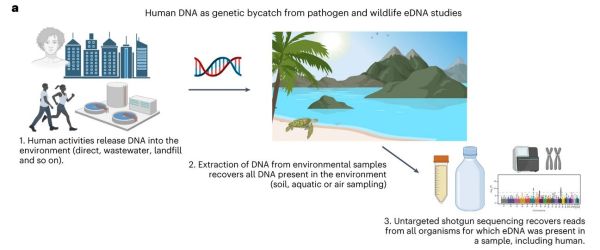
Environmental DNA sampling is nothing new. Rather than having to spot or catch an animal, instead the DNA from the traces they leave can be sampled, giving clues about their genetic diversity, their lineage (e.g. via mitochondrial DNA) and the population’s health. What caught University of Florida (UoF) researchers by surprise while they were using environmental DNA sampling to study endangered sea turtles, was just how much human DNA they found in their samples. This led them to perform a study on the human DNA they sampled in this way, with intriguing implications.

Ever since genetic sequencing became possible there have been many breakthroughs that have made it more precise, cheaper and more versatile. The argument by these UoF researchers in their paper in Nature Ecology & Evolution is that although there is a lot of potential in sampling human environmental DNA (eDNA) to study populations much like is done today already with wastewater sampling, only more universally. This could have great benefits in studying human populations much how we monitor other animal species already using their eDNA and similar materials that are discarded every day as a part of normal biological function. Continue reading “Human DNA Is Everywhere: A Boon For Science, While Terrifying Others”

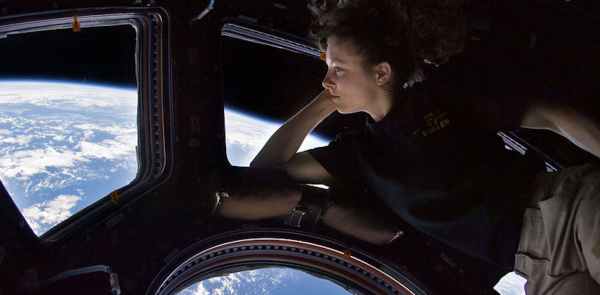
Astronaut Tracy Caldwell in the International Space Station. (Credit: NASA)

Making The Case For All-Female Exploration Missions To Mars And Beyond

A recent study in Nature Scientific Reports by Jonathan P. R. Scott and colleagues makes the case for sending exclusively all-female crews on long-duration missions. The reasoning here is simple: women have significant less body mass, with in the US the 50th percentile for women being 59.2 kg and 81.8 kg for men. This directly translates into a low total energy expenditure (TEE), along with a lower need for everything from food to water to oxygen. On a long-duration mission, this could conceivably save a lot of resources, thus increasing the likelihood of success.

With this in mind, it does raise the question of why female astronauts aren’t more commonly seen throughout Western space history, with Sally Ride being the first US astronaut to fly in 1983. This happened decades after the first female Soviet cosmonaut, when Valentina Tereshkova made history in 1963 on Vostok 6, followed by Svetlana Savitskaya in 1982 and again in 1984, when she became the first woman to perform a spacewalk.

With women becoming an increasingly more common sight in space, it does bear looking at what blocked Western women for so long, despite efforts to change this. It all starts with the unofficial parallel female astronaut selection program of the 1950s.

Continue reading “Making The Case For All-Female Exploration Missions To Mars And Beyond”