Pushing FPGA Config Files Via Serial Using ‘cat’

[Andrew] is trying to buckle down and hammer out his PhD project but was surprised by the sorry state of the configuration options for his FPGA/ARM dev board. Using JTAG was painfully slow, so he studied the datasheet to see if there was another way. It turns out the Xilinx FPGA he’s using does have a slave serial mode so he came up with a way to push configuration from the ARM to the FPGA serially.

Four of the connects he needed were already mapped to PortC pins on the AT91SAM9260 ARM System on a Chip. He ended up using the EN_GSM pin on the FPGA, since there is no GSM module on this board; connecting it to the microcontroller with a piece of wire. Now he can SSH into the ARM processor, grabbing information on the FPGA from /dev/fpga0. When it comes time to program, it’s as easy as using the cat command on the binary file and redirecting the output to the same hook.

Nuclear Taco Helmet Measures Reaction To Spicy Food

Apparently there was a Nuclear Taco eating contest at the 2010 Codebits Conference. The team from altLab, a Hackerspace in Lisbon, didn’t partake but the discomfort of those that did was burned into their memory. This year, the altLab members decided to build a spciy taco monitoring helmet as part of the conference’s 48 hour hacking competition.

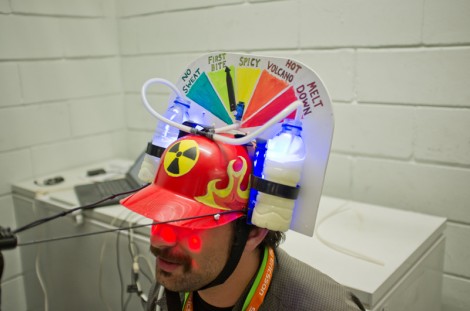
The helmet was inspired by those beer helmets that let you suck down two head-mounted cold ones through a forking straw. In this case, the beer has been replaced by bottles of milk to help quench your burning piehole. But if you do take a sip, observers will know because a flow sensor measures how much you suck down. There’s also a humidity sensor which monitors the sweat building up on your forehead. The Arduino that runs it all tracks this info and uses it to set the discomfort meter on top of the helmet, all while the audience gets a closeup from the camera projecting beyond the helmet’s brim.

We’re happy to say they won 1st place for the creation. Check out their 90-second presentation after the break.

Continue reading “Nuclear Taco Helmet Measures Reaction To Spicy Food”

Strap Yourself In And Let This Robot Arm Shake The Bejesus Out Of You

This man is strapped onto the business end of a huge robotic arm. If you’ve seen videos of industrial robots on automobile assembly lines and the like, you know how fast and strong these machines are. But this isn’t headed for the factory floor, it’s a new flight simulator built do train Australian fighter pilots.

Researchers at Deakin University were looking for a way to give a fighter pilot a more realistic simulator experience. What they ended up with is an apparatus that can spin continuously on two axes. This lets the pilot feel what it might be like to stall and have the aircraft spinning out of control.

The video after the break is not to be missed. You’ll see the test pilot (read: guinea pig) flung this way and that to the point that we almost decided this should be a “Real or Fake” post. But we’re confident that this actually exists. We expect that future renditions will include the front portion of the aircraft and be completely enclosed in a projection dome, just like the Lexus driving simulator.

Continue reading “Strap Yourself In And Let This Robot Arm Shake The Bejesus Out Of You”

FIGnition FLINT Is A Stripboard Build Of The Simple Computer

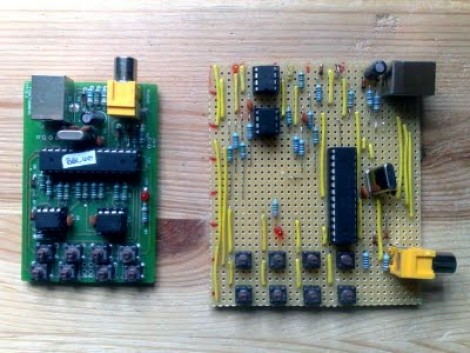
If you want people to really be impressed by your projects it’s often better not to have a fully finished look. In this case, we think hooking the stripboard version of FIGnition up to your TV will raise a lot more eyebrows than the PCB version will.

[Julian] put together a guide to building the computer on strip board. He’s using his own Java application for laying out circuits on this versatile prototyping substrate. This tool is worth a look as it may simplify those point-to-point solder prototypes you’ve been agonizing over. You’ll have to do some poking around on his site to gather all of the knowledge necessary to complete the build. Most of the components are easy to source, but unless you have them on hand, you’ll need put in a parts order for the crystal, the ATmega168, the SRAM chip, and the flash memory chip.

For those not familiar, FIGnition is an 8-bit computer with composite TV-out for a display and rudimentary input from the eight momentary push buttons.

MAME Cabinet 3D Modeled And CNC Milled

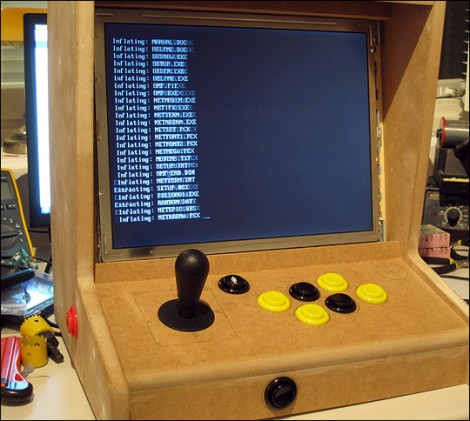
[Entropia] is just putting the final touches on his bar-top MAME cabinet (translated). The project started out as a 3D model to get the case dimensions just right. An old laptop is being, so the enclosure was designed to fit the bare LCD assembly and hide the rest of the computer. [Entropia] had access to a CNC mill through an education program and used it to cut most of the parts for the case out of MDF.

From there the build proceeds as normal. Mounting holes for the controls were cut with a drill and hole saws. We think it’s a bit easier to lay this design out once you have the control panel itself milled, rather than try to get it right in the 3D model. The image above is part way through the build. Since it was taken the case has been painted and a sound system was added but it looks like it’s still waiting for a bezel over the LCD and a marquee for the masthead.

You can see a demo of the game selection UI after the break.

Continue reading “MAME Cabinet 3D Modeled And CNC Milled”

Video Display From RGB Strips Makes It Seem So Easy

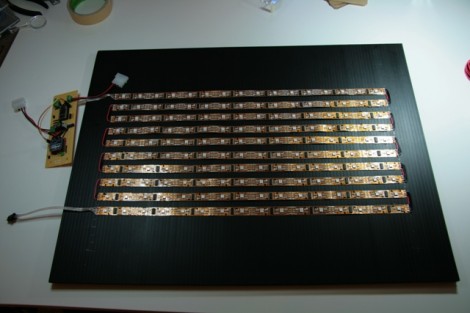
[Fabien] wrote in to share a link to this RGB video display which he made. He’s got some pretty cool routines that make it more functional than you would think, but first we want to comment on the construction. He used an RGB strip, which makes this look like an incredibly simple build. The strip has a data and power bus running the length of it. You can it into smaller segments, then just solder jumper wires to reconnect the buses. That’s exactly what he did here, making it what must be the fastest method of putting together a display of this size (16×10 pixels).

It’s driven by a Netduino which easily addresses the LPD8806 drivers responsible for the LEDs. It gets input from a computer via Xbee, making it easy to include data from the net, or to push visualizations. The video after the break shows a [Van Gogh] self-portrait. Since 160 pixel resolution wouldn’t do it justice, the visualization software shows a zoomed in portion of the painting which is constantly panning to let you see the entire work. It’s a fabulous effect.

Continue reading “Video Display From RGB Strips Makes It Seem So Easy”

Kitchen Hacks: Microwave Plays YouTube Videos Matched To Your Cooking Time

Behold the uWave, a microwave oven that plays YouTube videos while it cooks. [Kevin] and three classmates at the University of Pennsylvania developed the project for the 2011 PennApps hackathon. It uses a tablet computer to replace the boring old spinning food display microwaves are known for. Now, an Arduino reads the cook time and sends that information to a server via its Ethernet shield. The server then searches YouTube for a video that approximately matches the cooking time, then pushed that video to the tablet to start playing. The video demonstration embedded after the break shows this, as well as the tweet that the machine sends at the beginning of the process.

It’s an interesting concept, and we think the code used to push a video to the tablet has a lot of other applications (we’re keeping this one bookmarked). On the other hand, we wonder how long it will take for public microwaves to become ad-supported? We’re thinking it’s hard for companies selling antacids, acid reflux medicine, Cup ‘o Soup, and Hot Pockets to resist this opportunity.

Continue reading “Kitchen Hacks: Microwave Plays YouTube Videos Matched To Your Cooking Time”