Ikea Wine Rack Originally Sold As A Mattress Holder

[Jeremy Walworth] has been dumpster diving again. He noticed that his neighbor had a bucked of nice-looking wood out at the curb for garbage collection. He inquired about it and learned that it was an Ikea bed that had broken, and that the original hardware was still there in a separate bag. He dragged it to his lair and built this wine rack out of the parts.

The reused rails and hardware provide five shelves for the bottles. [Jeremy] wanted each vessel to stay in place if the shelf wasn’t full, so he grabbed a piece of mill work from the home store and cut dividers which were glued in place. Now he’s able to show off up to sixty bottles for just a couple of bucks in material expense.

It seems like Ikea is able to sell furniture for less than the cost of the materials sourced locally. We think this is a fantastic way to find parts for your own hacks, as the components that break can often be cut down to undamaged pieces. We also make sure to check the As-Is section on each visit for the ‘leftovers’ that are usually sold for pennies. Who know’s maybe you’ll find the parts you need to build a camera mount for documenting projects.
HEX Out Reveals The Secrets Your Data Bus Holds

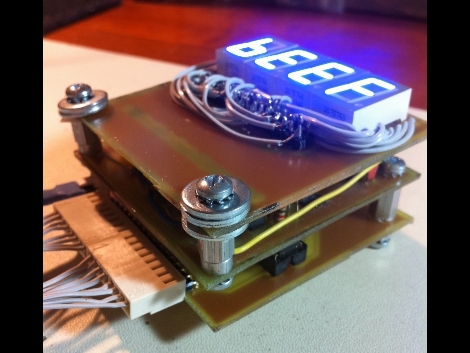
[Quinn Dunki] is looking to augment the tools she has available at her electronics bench and built the HEX Out as a mock-logic sniffer. The device reads 8 or 16-bit inputs, showing the current state of those connections on a 7-segment display. This requires that you’re comfortable reading Hex codes, but if you’re not it’s almost like studying flash cards; before long you’ll be able to read them without thinking about it.

She’s blogging about the design and build process in three parts. The link above is the first installment where she shares the development process for the top layer which hosts the display hardware. The other two parts should be up for your enjoyment in the next couple of weeks.

You’ll notice her design on this portion of the project still requires a lot of point-to-point soldering, even though she etched her own circuit boards. We didn’t look too closely, but it seems this would be worth going to the trouble of etching a double-sided board if you can.

UPDATE: Part Two is now available

Hackaday Links: November 6th, 2011

Build details for Raspberry Pi prototype

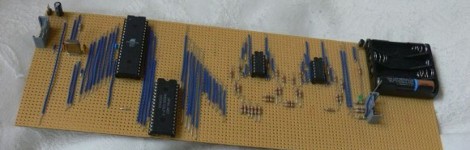
With the launch of Raspberry Pi approaching the development team released the details about the prototypes from about five years ago. The board was originally based on an ATmega644 and built on some perfboard.

‘Zero Energy Device’ challenge

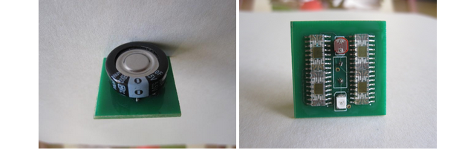
We call BS on the title of this one, but the goal of finding devices that don’t use disposable energy sources is a good thing in our book. For instance, can we get more stuff that uses long-life capacitors instead of batteries?

Command adhesive for mounting bulletin boards, etc.

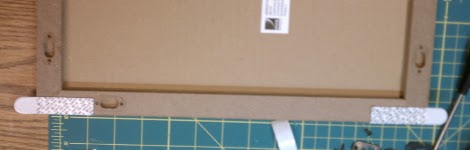
This seems like a no-brainer, but we’ve been using nails to mount bulletin boards and white boards for year. The problem is, when you stick a push-pin in one side, the other side pops off of the nail. [Zhanx] is using adhesive from 3M Command Hooks to keep his stuck to the wall.

Servo-driven gripping hand

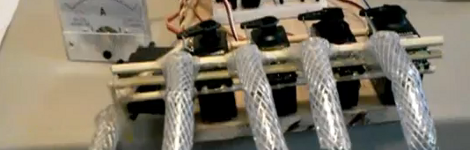
[Navic] has been hard at work on this robot hand. There’s few details but he shows it can grip objects under one pound and he’s been taking amperage measurement during testing.

Emergency cellphone charging

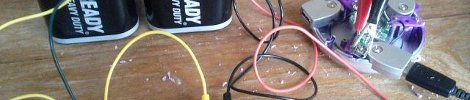
It might not have been an emergency this time, but [Chris] did figure out a way to charge his cellphone after the snow storm in New England knocked out his power. He connected to lantern batteries to a 7805 regulator, then patched that into a USB hub to get his phone connected. Not bad in a pinch!

CadSoft’s EAGLE 6 Hits Beta And Packs Goodies

Version 6 of the popular schematic and PCB layout software EAGLE is now in beta testing. The most notable change is the migration to XML file formats that we looked at last month.

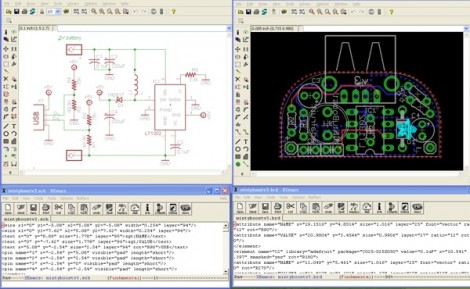
[PT] didn’t waste any time getting his hands on the software and giving it a thorough test drive. The image seen above shows the files of a MintyBoost. It’s impossible to make out at this resolution, but it is indeed spitting out human-readable (well maybe) XML in the windows below instead of the ‘no trespassing’ binaries they used to use.

Earlier today when working on a feature we had to jump on a different computer that had EAGLE installed in order to look at a .SCH file. We wonder if someone will put out a rendering package that can parse the new format and spit out a quick PNG? At the very least, we expect to see some useful hacks for part replacement or pin swapping. It shouldn’t be too hard to poke around and figure out what happens when changing some of the stored values. Got anything in mind that you can do by editing these by hand?

Oh, we almost forgot! The biggest benefit you get from this is the increased version control compatiblity since programs like git will be able to perform diff functions on the files.

Mimicing A Heartbeat In Sound And Electrical Pathways

If you set a cardiac nurse loose on a Propeller microcontroller and some parts you might not know what to expect. But we’re intrigued by the outcome of this project which looks to mimic a heartbeat’s audible and electrical traits. The post about the project is in four parts which are not linked to each other, but you can find them all, as well as a video segment demonstrating the rig after the break.

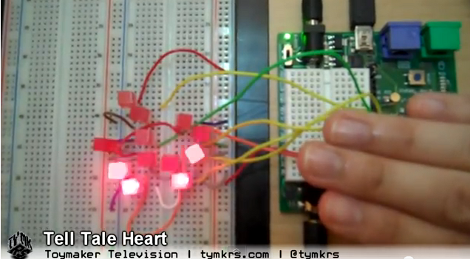
It seems that this was intended as a Halloween project, but we don’t see why it wouldn’t be interesting any time of year. The Propeller demo board is used to mimic a heartbeat with a pulsing LED. But that doesn’t seem all that awesome, so the sounds of a heartbeat were added to the program to coincide with the blinky light. Here’s where the medical training comes in: the next phase of the process was to lay out an array of LEDs on a breadboard in the shape of the human heart’s electrical system. Now you’ve got a pulsing LED, heart sounds, and a lighted animation showing how the electricity travels through the organ.

To add a little [Poe] to the project there’s also a CdS light sensor. As you approach the project you block some light from getting to the sensor and the heart rate increases.

We think the next logical step is to add a heart rate sensor, so that this can illustrate what your own heart is doing. Boom! Another project ready for the Children’s museum.

Continue reading “Mimicing A Heartbeat In Sound And Electrical Pathways”

Shutter Trigger Remote With Some Nice Design Considerations

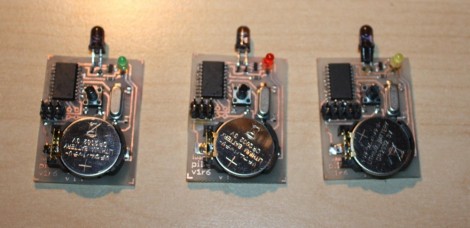
Here are the guts of [Lukasz’s] infrared camera remote control. He based it off of an existing design, but looked for places where improvements could be made. He felt the ATtiny2313 was a bit wasteful in this case. But further investigation led him to see why it was chosen. If you were to drop down to an ATtiny13 the ability to connect a crystal oscillator is lost (that chip only offers a 1-pin clock signal input) and the internal RC oscillator isn’t quite up to his standards for reliable IR communications.

Instead of driving the IR LED directly from an AVR pin he used a transistor in hopes that it will allow the maximum current to flow through the diode when in use. We’re not sure if it’s necessary, but we can see how it makes sense. Power is received from an unregulated 3 volt coin cell, so maybe as that voltage drops over time this will come into play.

Speaking of that coin cell, battery life is a concern here. [Lukasz] is using the sleep functions of the AVR after three seconds of use. This should keep the cell alive for quite a long time. But his 0 volt measurement is an anomaly with the multimeter he’s using. To get a precise measurement for tiny current flow you need extra equipment, like [Dave Jones’] uCurrent adapter.

The schematic for this Canon camera compatible project is only provided in Eagle format so we’ve embedded an image of it after the break for your convenience. You should have no problem making this work with a Nikon if you swap out some of the code from the TV-B-Gone shutter release we saw on Thursday.

Continue reading “Shutter Trigger Remote With Some Nice Design Considerations”

Camping Light Retrofitted As A Solar Recharging Station

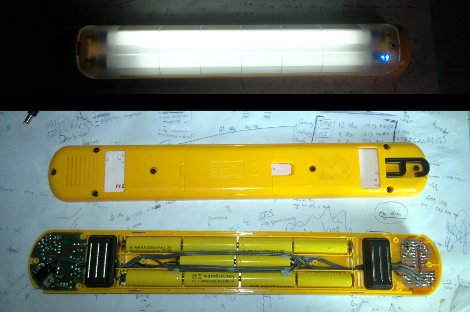
With grand plans of tenting out for several days at a music festival [Josh] needed a way recharge his portable devices. In the past he’s lugged around a 12V battery with him, but this year he wanted to make things easier. He ended retrofitting a camping light to do the job with the help of the summer sun.

The first step of the project was to source some rechargeable batteries. He toyed with the idea of Li-Ion cells but ended up going with NiMH because the charging is more forgiving and he got them at a great price. Because of the lower operating voltage (1.2V versus Alkaline’s 1.5V) he needed to squeeze two more into the lamp housing. Here you can see that he just managed to get them to fit in the wire-run area down the middle of the case.

Next comes the recharging circuit. He based his design around an ATmega44, using a voltage divider and the ADC to detect when the batteries are topped off. During the day this is connected to an external solar panel and it’s ready to charge his phone when he gets back at night.