Smile, Your Face Is On The Internet

[Kyle McDonald] is up to a bit of no-good with a little piece of software he wrote. He’s been installing it on public computers all over New York City. It uses the webcam found in pretty much every new computer out there to detect when a face is in frame, then takes a picture and uploads it to the Internet.

We’ve embedded a video after the break that describes the process. From [Kyle’s] comments about the video it seems that he asked a security guard at the Apple store if it was okay to take pictures and he encouraged it. We guess it could be worse, if this were a key logger you’d be sorry for checking your email (or, god forbid, banking) on a public machine. Instead of being malicious, [Kyle] took a string of the images, adjusted them so that the faces were all aligned and the same size, and then rolled them into the latter half of his video.
Continue reading “Smile, Your Face Is On The Internet”

Driving Game Steering Wheel Controller Without The Wheel

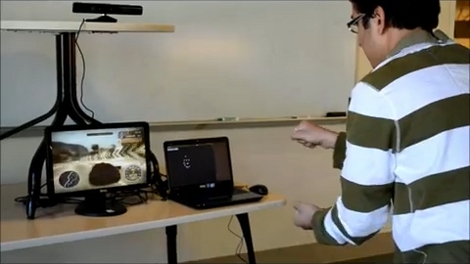
For some reason this project makes us think of the Light Cycles in Tron. You know, the bike forms around the rider after they grab onto the wand that makes up its controls? Certainly you’re not going to see a car form out of thin air, but this driving controller let you grab onto nothing to control a racing game.

You can see that it uses a Kinect to map the body of the player and convert your movements into motion control. The demo video embedded below the fold shows the calibration step, followed by the available control options. Pushing the steering wheel forward turns on the nitrous, leaning forward or back accelerates and brakes, and a few arm signals let you navigate the game menus.

This works by mapping gestures to keystrokes. [Rajarshi Roy] tells us that there’s a very raw code package available in their repository but the plan is to clean it up this weekend. They will also work on a Wiki, documentation, and a tutorial on teaching the software new gestures.

We just don’t know what we like better, seeing the kinect extended as a gaming controller like this one, or using it in robotics like that quadcopter.

Continue reading “Driving Game Steering Wheel Controller Without The Wheel”

MB LED Is Next Generation Of LED Video Block Puzzles

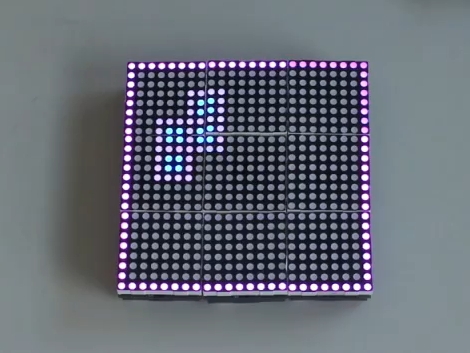
Meet MBLed, a set of interactive 8×8 LED tiles. Put them next to each other and they will orient themselves into a video screen which is the sum of the parts. If this sounds familiar it’s because we’ve seen the concept before in the GLiP project. [Guillaume] tells us that MB Led is the new version of GLiP and from what we’ve seen they’ve made a lot of progress.

The hardware is well designed. A PCB hosts the STM32 microcontroller and a pair of pin headers which receive the RGB LED matrix module. A pair of AA battery holders make up the legs for the device. Each has infrared receiver/emitter pairs on each of the four edges and constantly polls for its neighbors.

What really impresses us is the algorithms they’re using for communications. FreeRTOS runs on the ARM processors, and a series of messages was developed which allow the blocks to elect a leader, and follow its commands via the distributed system. Check out more about those algorithms on the page linked above, and join us after the break to see the demo video.

Continue reading “MB LED Is Next Generation Of LED Video Block Puzzles”

Your Snapshot On A Thermal Printed Receipt, Instantly!

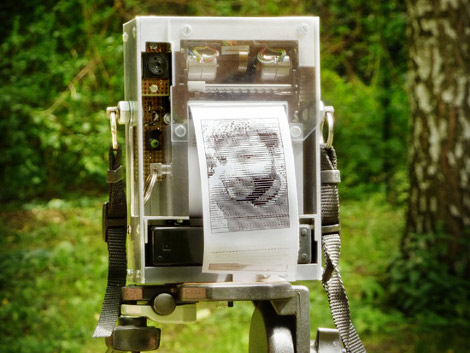
What could be better than a low-res black and white photograph printed instantly on paper that will yellow and crumple over time? Wow, we really need to work on our sales pitch. But all kidding aside, we love the idea that [Niklas Roy] came up with in order to build this thermal printing camera.

His Picasa album has two snapshots of the hardware. He’s using an LM1881 for video sync separation just like he did with his PING project. From there an ATmega8 microcontroller grabs each column from the image and prints it using the thermal printer. It looks like everything runs on a 9V battery which is nice for portability (although we still never got our hands on that rechargeable 9V we’ve been meaning to pick up). Perhaps just as impressive is that [Niklas] got this up and running with about 400 lines of code. Nice!

Of course you’ll want to see this in action so we’ve placed a video clip after the break. Just like old-timey cameras it looks like you’re going to need to sit still until the image is done printing.

Continue reading “Your Snapshot On A Thermal Printed Receipt, Instantly!”

Retro-radio: Building On Another WiFi Radio Hack

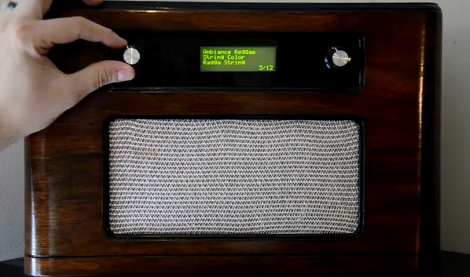
[Jay Collett] likes listening to Internet radio stations and decided to build his own standalone hardware that lets him listen without being at his computer. But he wasn’t starting from square one on this project. [Jay] built on the epic instruction set that [Mighty Ohm] published when he first built his own WiFi radio.

Both of these radios used the same method of getting onto the internet; a hacked router. We kind of like this because it means you should be able to use the radio as a bridge for wired Ethernet devices. But we digress. [Jay] departs from the instructions by using an Arduino and its IDE to interface an LCD screen with a different line/column orientation than the original, and to implement a different control scheme. This makes the project a bit more approachable if you prefer not to roll your own electronics.

Take a look at the video after the break. The router takes quite a while to boot, but once it does it seems that the controls are both intuitive and responsive.

Continue reading “Retro-radio: Building On Another WiFi Radio Hack”

Paper Craft Claw

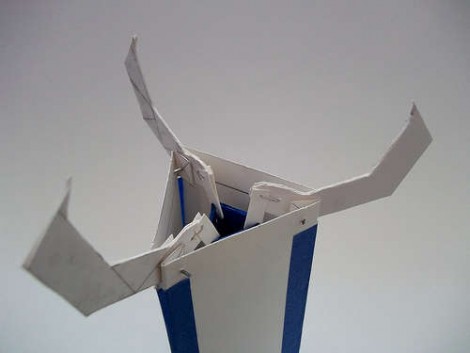
Grab some stiff paper and get to work building your own paper claw. [Dombeef] posted the instructions to recreate the claw above because he was unsatisfied with his previous design which was flimsy and unable to pick up just about anything. This version is a bit larger and it internalizes all of the parts.

Being paper craft, you don’t need much in the way of materials or tools. A push-pin makes holes for the paperclip and wire which serve as the pivot points. Glue and some tape hold the rest of assembly together. You can see a video of the final product after the break. A shaft at the center closes the claw when pulled, and opens it when pushed to opposite way. This makes it perfect for that home-made crane game (or was that a claw game?)… as long as you’re not trying to pick up anything too heavy.

Continue reading “Paper Craft Claw”

Electro-active Polymers

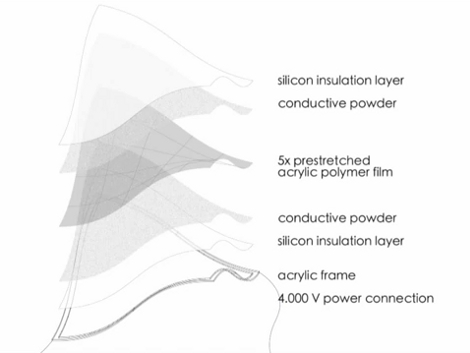
What’s that you say? You’ve got rigid materials that change their shape when exposed to electric current? Sign us up for some! Although the fabrication process looks a bit daunting, we love the results of working with electro-active polymers. These are sheets of plastic that can flex by contracting in one direction when the juice is turned on. It has an effect very similar to muscle wire but distributed over a larger area.

From what we saw in the video after the break it looks like this is not the most resilient of materials. Several of the test shots have broken panes, but we’re sure that will improve with time. It looks like there is some info out there about fabricating your own EAP but the processes seem no easier than what’s going on at the research level. We might stick to building our own air muscles until EAP is easier to source for projects.

Continue reading “Electro-active Polymers”