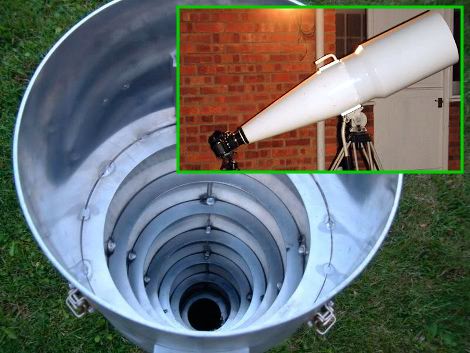
You Know That They Say About Guys With Big Lenses?

[Tony Lovell] and [dkpeterborough] built a sizable camera lens using optics from a flight simulator projector. What they ended up with is a 900mm lens that can make a beautiful photo of the moon, or capture distant landscapes in great detail. The body of the lens was designed in CAD and sent off for fabrication out of aluminum, as seen above. The concentric baffles help to prevent lens flare but it can’t be used in its bare-aluminum condition. The internals were coated using a stippling finish that leaves a sandy texture. That was covered with matte black barbecue paint, doing a great job of preventing optical interference, and the outside received a glossy white coat. Finished weight: 59 pounds, but once you see the pictures you’ll agree it’s worth lugging the bulky instrument around to grab that killer shot.

[via Make]

Developing An Animatronics Platform

This Predator costume has an animatronic element in the shoulder cannon. It tracks the movement of the mask, aiming wherever the Predator gazes. [Jerome Kelty] was asked by a friend to help develop the costume and he ended up with an animatronics platform which can be adapted for many different uses.

Starting with an Arduino Pro Mini [Jerome] designed a host board which would breakout the pins of the Arduino and make it easy to connect and drive multiple servo motors. The board is powered by a 3.3v Lithium Polymer battery with charging handled by a MAX1555 that was included in the design. Check out the video after the break which shows off the Predator suit. Looks like [Jerome] got it right, and he’s also put the platform to use with an Ironman suit that has an arm-mounted missle feature.

Need some inspiration for you next costume build? Take a look at this animatronic collection to get you started.

Continue reading “Developing An Animatronics Platform”

Fake Christmas Tree Makes It Fake Snow

Let it snow inside your house this Christmas by building your own snow making tree. [Trey] was inspired by a snowing lamp-post he came across in a story. He looked around the house and came up with all the stuff necessary to make this happen with a Christmas tree. The snow is loose Styrofoam like you’d find in a bean bag chair. At the bottom of the tree there’s an inverted umbrella to collect the snowfall and funnel it into a blower salvaged from an inflatable Halloween yard ornament. The blower shoots the Styrofoam up through a PVC pipe, which also serves as the trunk of the fake tree, and it erupts from the top bringing Christmas cheer to an otherwise quiet room. See for yourself.

Single LED Ultraviolet Exposure Box

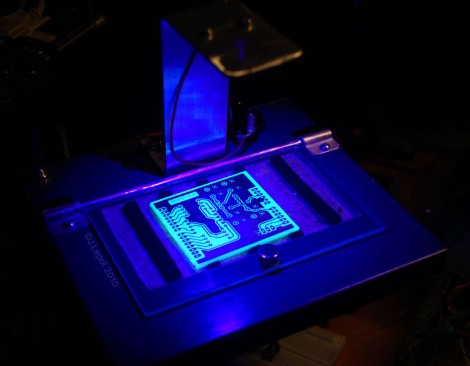
[Jacques Lebrac] built a UV exposure box for printed circuit boards using just one LED. He usually makes boards that are just a few square inches and didn’t think building a box that had upwards of 80 LEDs was worth his time. He passed by the low power LEDs for a single 5W unit. Pumping 1.5A through this LED makes for some quick exposures, but causes heat issues. To solve this, an aluminum arm was used to mount the LED, acting as mechanical support and heat sink at the same time. The voltage regulator was glued directly to the chassis, providing at least some heat dissipation.

[Jacques] came up with an eloquent solution for holding the transparency and copper clad in place. A piece of acrylic is hinged on the back using a piece of aluminum tubing. The front has a magnet glued to it, with another one in the base to hold the cover tight to the work surface during operation.

Time-lapse Camera Dolly

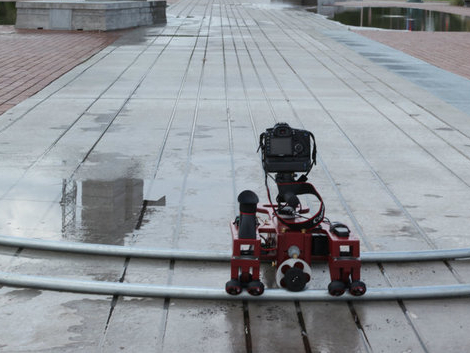
[Brian Grabski] was asked by a friend to design and build a dolly that would move a camera during a time-lapse sequence. Above you can see the product of his toils, and the videos after the break show off the parts that went into the design and showcase effectiveness of the build.

The dolly is designed to ride on a pair of tubular rails. These can be bent to match any desired path and the dolly will have no problem following it thanks to two features. First, the triad of skateboard wheels on each of the three corners are mounted on a swivel bearing that allows them to rotate without binding. The other piece of the puzzle is a set of drawer slides that let the third support move perpendicular to the other two sets of rollers. A motor drives a geared wheel to move the dolly along the track with speed adjustments courtesy of the motor controller. There’s also a failsafe that will shut the system down when it runs out of track, protecting that fancy piece of hardware taking the pictures.

We’ve seen timelapse equipment that moves the camera in the past, but those hacks usually involve rotating the camera along and axis. This track-based setup is a well executed tool useful at all levels of photography. We can’t wait to see the arch-based dolly that is teased at the end of the demo video.

Continue reading “Time-lapse Camera Dolly”

Pencil Balancer A Bit Noisy For Desk Use

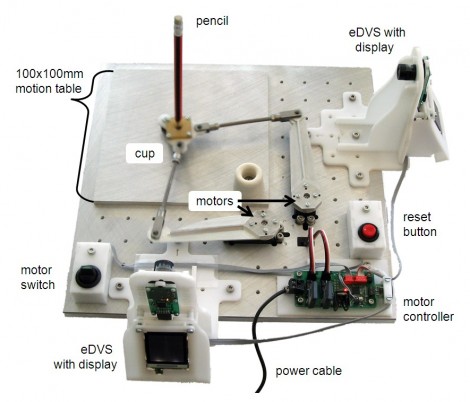
Who wouldn’t want to install this little bot as your newest pencil holder? Place a pencil tip-down and it will keep it from falling using two motors. There is a Dynamic Vision Sensor for each axis that provides feedback, but it’s not the same as using a camera. These sensors pick up changes in pixel contrast, outputting a positive or negative number based on the direction the pencil is beginning to fall. An NXP2103 running at 64 MHz reads in the values and drives the pair of servo motors accordingly.

If you’re interested in the nitty-gritty the full paper is available from the page linked above. It goes into great detail about the algorithm used, and includes plots and histograms showing the data capture during a balancing session. Or you can skip the eggheaded exercises and watch the video after the break.

Continue reading “Pencil Balancer A Bit Noisy For Desk Use”

Unlocking RS232 Serial Comm On A Multimeter

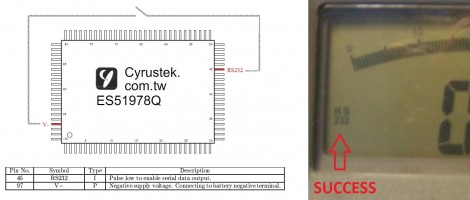
[Craig] cracked open a multimeter to unlock RS232 serial communications that can be used for data logging. There’s a couple of things that make this possible. First of all, the multimeter’s processor is not covered in a black epoxy blob, leaving the pins exposed for hacking. Second, the chip model is known and [Craig] was able to get his hands on the datasheet. One of the pins enables serial output when pulsed low. Touching it to V- even turns on an RS232 icon on the display, as seen above. To make this accessible without opening the case a momentary push button can be added, as well as connector for signal output, and a bit of parsing on the PC side to handle incoming data.