Body Heat Sensing PC Security System

lockifnothot

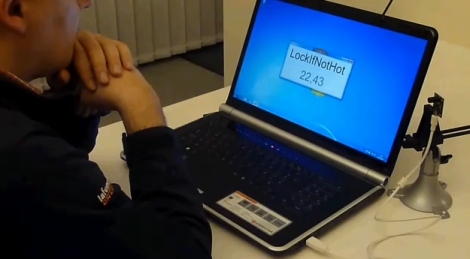
[Didier Stevens] wrote in to tell us about a little piece of PC security software he put together recently. His application, LockIfNotHot, works in conjunction with your PC as well as an IR temperature sensor in order to lock your computer the moment you step away.

The theory behind the system is pretty simple. Basically, the IR temp sensor monitors when you are at your desk, sensing your presence by the heat your body gives off. As soon as you step away however, it locks the computer since the temperature of the surrounding area immediately drops. It’s pretty simple, but as you can see in the video below, it works quite well.

The software has configurable set points and timeout values, which make it flexible enough to adapt to your specific situation. He happens to use an off-the-shelf IR sensor, but we assume any USB temperature module will do the trick. If you happen to work with sensitive information but often forget to lock your workstation, this is the program for you!

Continue reading to see a quick demonstration of his software in action.
Continue reading “Body Heat Sensing PC Security System”

One-eyed, One-armed Metal Rolling Roomba Robot

roomba_robot

[Erik] was looking for a sturdy robotics platform and was initially considering the iRobot Create, until he found that he could score a Roomba Discovery series for a fraction of the price. The Discovery includes a battery, which is missing from the iCreate, though it also has all of the standard vacuum bits included as well.

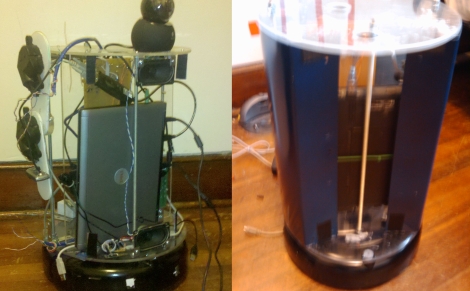
He immediately removed all of the vacuum parts once he got his hands on the Roomba, and began adding the support structure to house the rest of his robot’s components. The robot is controlled via a small laptop which sits on top of the Roomba’s base, and features a panning and telescoping webcam to provide feedback to the operator.

The robot has been under construction for a little over a year now, and has had a few upgrades over that time. The original laptop was swapped out for a newer dual-core model, and the webcam was upgraded to a model featuring motion tracking. The whole thing has been skinned in thin sheet metal for a sleek look, and he has added a servo-driven arm as well.

The project is not quite complete, and he hasn’t really stated what he plans on using the robot for, but it looks good so far – we can’t wait to see it when it’s finished.

Sticky Sweet Animatronic Peep Show

peeps_peep_show

With Easter quickly approaching, [Kyle] decided to finally build a project that is as tasty as it is wrong.

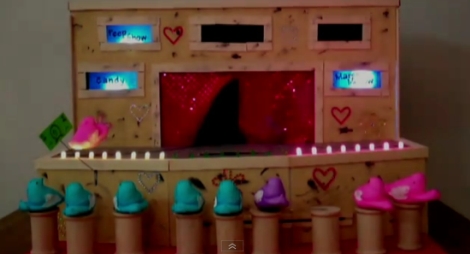
Behold, the Animatronic “Peep” show! Using nearly a dozen marshmallow Peeps, he constructed a stage for his “performers” and a seating area for their “clients”. The structure was built mostly from balsa wood and foamboard, featuring a retractable curtain, stage lighting, and music.

Once triggered, the embedded Arduino gets to work animating the stage lights and blaring “Cherry Pie” while the sugar-coated onlookers await their entertainment. The curtain is drawn back and a trio of winged dancers emerge one by one, ready to entertain the crowd.  The onlookers even offer up dollar bills to the dancers via a servo-mounted arm.

The project uses a total of 10 servos driven by the Arduino, along with an audio decoder chip to provide the proper ambiance for the marshmallow debauchery. [Kyle] says that he put together about 650 lines of code to get the whole thing running, but there doesn’t seem to be any way to download it at the moment – hopefully we’ll see something posted soon.

It might not be high-brow, but it sure beats blowing up old, stale Peeps in the microwave!

Stick around for a trio of videos demonstrating the Peep show as well as revealing some of the stage’s inner workings.

Continue reading “Sticky Sweet Animatronic Peep Show”

Art Installation Lets You Be Your Own Souvenir

3d_souvenir_printer

The team at [blablabLAB] have been hard at work on their latest project, which they unleashed on the streets of Barcelona in the La Rambla pedestrian mall. Their art installation allows you to pose in the middle of the mall and receive a plastic statue of yourself as a souvenir.

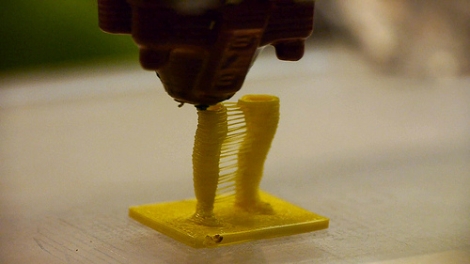
Not unlike the “Fabricate Yourself” installation we saw a short time ago, this project also uses the Kinect to create a 3D representation of the subject, though it uses three separate sensors rather than just one. Each sensor is positioned around a centralized platform, creating a complete 3D model, which is then sent to a RapMan 3D printer stationed nearby.

Each user is then gifted a plastic representation of themselves to take home – it’s almost like an interactive human Mold-A-Rama. While the figures are neat, it would be great to see what sorts of plastic statues could be made using a higher resolution 3D printer like the one we featured a week ago.

Check out the video below to see the souvenir printer in action.

Continue reading “Art Installation Lets You Be Your Own Souvenir”

PIC-based Ham Radio Autotuner

cw_autotuner

A few years back, [Floyd, K8AC] built a high frequency autotuner as an addition to his Ham radio setup. Based off a design he saw in QST magazine back in the early ’90s, he has been using the tuner almost daily for the last few years, on both the 3.5 MHz and 7 MHz bands.

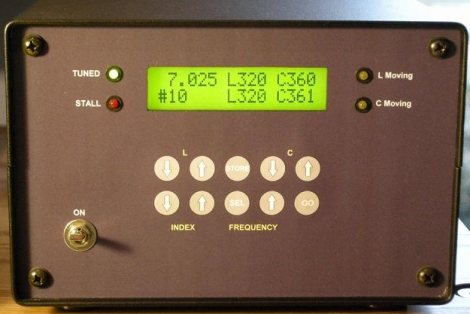
Built into the wall in his radio room, it is a pretty impressive sight. His “L” circuit is controlled by a pair of mechanically coupled inductors which are driven in concert by a pair of two-way motors. The positioning of the C and L components are monitored by a PIC controller which stores the tuning data for up to 30 predefined frequencies. A couple of button presses on his controller’s front end sends the tuner into action, dialing in his unit’s inductors and capacitor to their proper settings. The PIC monitors the tuner’s progress, informing him when the proper frequency has been tuned in, or if the frequency can not be set, indicating issues with the equipment.

His setup has undergone several revisions over the years, with the most recent iteration being the most automated of the bunch. Check out his site for plenty more details, or keep an ear out for [K8AC] on 40 or 80 meters.

[Thanks, Rich V]

Circuit Building With A Hammer And Nails

real_breadboarding

[Collin Cunningham] over at Make recently wrapped up another edition of “Collin’s Lab” – this time around, the subject is breadboards. He starts off by discussing a common solderless breadboard, something you are no doubt familiar with. What you might not know however is how breadboards got their name.

Way back when, before there was a RadioShack in every strip mall across the country, fancy prototyping supplies like your solderless breadboard did not exist. Amateur radio operators would prototype circuits on wooden boards, often using whatever was around as a substrate. Many times, this meant that the family’s cutting board ended up as a makeshift prototyping station.

One popular method of building circuits was to drive small nails into the breadboard, using wire wrapping to connect things together. [Collin] demonstrates this technique in the video, constructing a simple LED flasher circuit.

He says that the process works decently enough, and was kind of fun to do. He does mention however that building any sort of circuit requiring an IC would likely be out of the question.

If you have a few minutes to spare, check out the video embedded below – [Collin’s] take on technology is quirky and entertaining as always.

Continue reading “Circuit Building With A Hammer And Nails”

Building An Augmented Reality Display Using Obsolete Technology

slideprojector_augmented_reality

Augmented reality might be all the rage these days, but when you take a closer look at the technology, you will find that these sorts of optical illusions are not new at all.

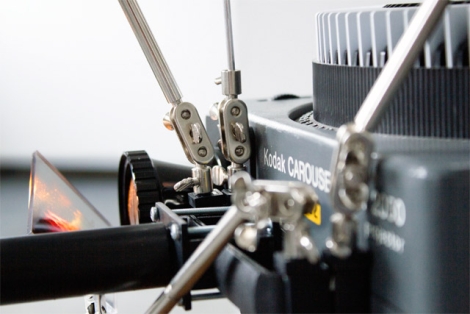
Artist [Sebastian Schmieg] was pondering augmented reality for a bit and decided he could replicate the effect using old and obsolete technology. His creation, called “81 Points of View”, uses an old Kodak slide projector and an elaborate mechanical setup to simulate the effect.

The slide projector resides on a platform that can be rotated around its center in 81 steps. After each movement, the mechanism swaps out the current slide, selecting the next image depending on which direction the user turns. The resulting effect is similar to the implementations of augmented reality you might see today, with a 3d visualization superimposed on the surrounding room.

The concept dates back all the way to the 1860’s, when [John Pepper] first demonstrated the technique. Using mirrors and panes of glass, he was able to project translucent images in front of his audience, which is the same idea [Sebastian] uses in his project. You are likely quite familiar with the effect, if you have ever visited the Haunted Mansion at a Disney theme park.

It’s a neat project, though the resultant augmented reality display is obviously not quite as smooth as you would see from a smartphone. Either way, it is definitely worth checking out. Keep reading to see a video of the project in action.

Continue reading “Building An Augmented Reality Display Using Obsolete Technology”