CNC-built R2-D2 Brings Childhood Dreams To Life

r2d2_build

As a kid, [Wes] always dreamed of building a full-size, functional R2-D2 droid from Star Wars. While most youthful aspirations such as this fall to the wayside amid adult responsibilities and commitments, he did not allow his dreams to disappear along with his childhood.

He began his droid-building journey armed only with his dreams and some assistance from the friendly folks over at R2Builders. The entire replica was built using MDF, wood, and styrene sheeting, along with just one tool: a CNC machine. He walks you through the every step of the construction, stopping to give recommendations on CNC hardware, software, etc. along the way. He also provides Gcode files for each of the pieces he has constructed, which should be a huge help to anyone looking to build a R2-D2 clone of their own.

It looks like he is just getting around to fitting motors into the leg housings of his R2-D2 replica, but we can’t wait to see what it looks like once he has all of the electronics and other details finished.

If you are interested in more R2-D2 coverage, look no further than right here.
Laptop BIOS Password Recovery Using A Simple Dongle

laptop_bios_reset

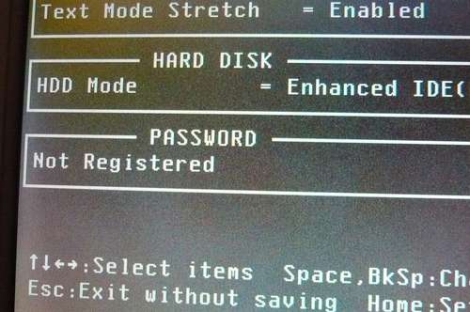
In his line of work, Instructables user [Harrymatic] sees a lot of Toshiba laptops come across his desk, some of which are protected with a BIOS password. Typically, in order to make it past the BIOS lockout and get access to the computer,  he would have to open the laptop case and short the CMOS reset pins or pull the CMOS battery. The process is quite tedious, so he prefers to use a simpler method, a parallel loopback plug.

The plug itself is pretty easy to build. After soldering a handful of wires to the back of a standard male D-sub 25 connector in the arrangement shown in his tutorial, he was good to go. When a laptop is powered on with the plug inserted, the BIOS password is cleared, and the computer can be used as normal.

It should be said that he is only positive that this works with the specific Toshiba laptop models he lists in his writeup. It would be interesting to see this tried with other laptop brands to see if they respond in the same way.
Since no laptops are manufactured with parallel ports these days, do you have some tips or tricks for recovering laptop BIOS passwords? Be sure to share them with us in the comments.

Twittering Wall Switch Lets Dutch Hackers Know When It’s Time To Play

hackerspace_open_switch

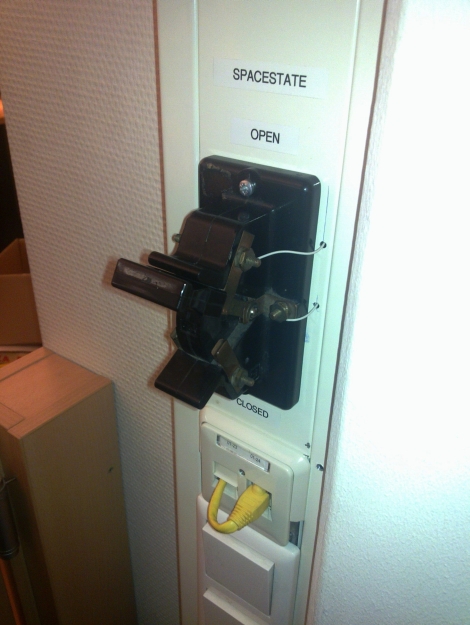
Hack42, a hackerspace in Arnhem, Netherlands recently moved into some new digs, and they wanted an easy way to let their members know whether they were open or not. Fixed hours of operation typically do not fit this sort of organization, so that was out of the question. Instead, they built a switch into the wall** that will let their members know when they are open for business.

The switch separates the TX and RX pins of two Ethernet ports that reside in an old access point embedded in the wall. When the hackerspace is open, the switch is thrown and the circuit is closed. A cron job checks the state of the eth1 port once a minute, sending the “Open” status message to Twitter and IRC once it notices the status change. When the switch is thrown again and the eth1 port goes down, a “Closed” message is broadcast.

It is a simple but cool hack, and quite befitting of a hackerspace.

**No direct Google Translate link is available, though Chrome will translate it for you without issue.

[Thanks, _Danny_]

Shedding Some Light On Your Kitchen Chores

led_light_bar

[Garret] over at Macetech wanted to supplement the lighting over his kitchen sink, which is always too dark at night. He says his house is a “geek house”, so a standard light socket just wouldn’t do – he would have to construct a LED bar for over the sink instead.

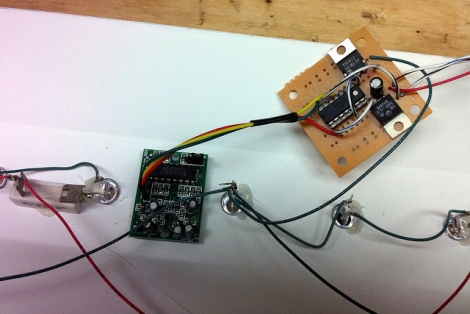
Since nobody wants to use a light switch with wet or messy hands, he did what anyone would do and rigged up a motion detection circuit to automatically turn the lights on and off for him. 16 bright white 10mm LEDs were mounted in some foam core board, along with a PIR motion sensor. He used an ATiny84 to handle the PWM fade-in and fade-out of the lights, as well as to keep track of the activity (or lack thereof) at the sink.

He does admit that the ATiny84 is way overpowered for this project, but he lacked anything smaller, and says that 555 timers wouldn’t give him the smooth light fading that he desired. Regardless, it works as advertised, and now nobody has to peel potatoes in the dark any more.

Continue reading to check out a quick video demo of the motion-sensing light system.

Continue reading “Shedding Some Light On Your Kitchen Chores”

Coming Soon To A Store Near You: Remote-control Cockroaches

roboroach

Given a box full of cockroaches, the first thing most of us would do is try to locate the nearest source of fire. Lucky for the roaches, the team over at Backyard Brains look at things a bit differently than we do.

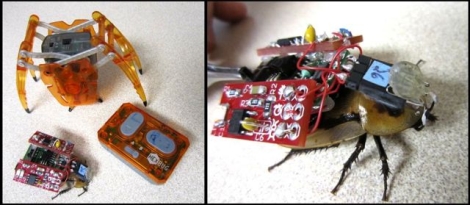
Their latest effort combines cockroaches and electronics to create a bio-electrical hybrid known as the RoboRoach. Using control circuitry donated from a HexBug inchworm and some 555 timers to create properly timed pulses, they have been able to control the gross movement of cockroaches. Stimulation is directly delivered to the antennae nerves of the cockroaches, enabling them to tell the roach which direction to turn and when.

Currently there are some ahem, bugs in the system, which they are working diligently to resolve. Only about 25% of the roaches they wire up can be controlled at present. Once that ratio improves however, they will be looking to offer RoboRoach as a beta product. If you are aiming to add a beetle air force to supplement your remote-controlled cockroach army, be sure to check this out.

Continue reading to see a video of the RoboRoach in action.

Continue reading “Coming Soon To A Store Near You: Remote-control Cockroaches”

Hacker Classifieds Featured Find: Free Sony Video Wall Projectors

projectors

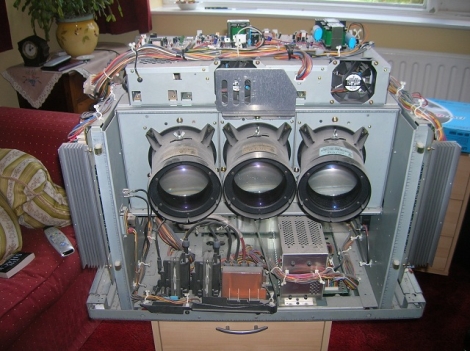
[paulgeering] has a set of 10 video projectors, usually found inside Sony’s RVP 4010Q 40″ rear projection system that he must get rid of.  He is offering them up for free to any Hack-a-Day reader that is interested. He doesn’t have the room to store them any longer, but he can’t bear to see them go into the trash. These projectors can still be found for sale online to the tune of $3500 apiece, making this an incredible bargain!

All he requests is that you either pick them up or pay for shipping from the UK. He is willing to part out the projectors and ship individual parts if requested.

If you do end up having one of these shipped to you, be sure to keep us posted on what you do with it. We would love to see some giant video wall hacks in the near future.

If you have something lying around that needs to go, be sure to post it in our classifieds.

Wiimote-based Whiteboard Lets You Write On Any Surface

propeller_whiteboard

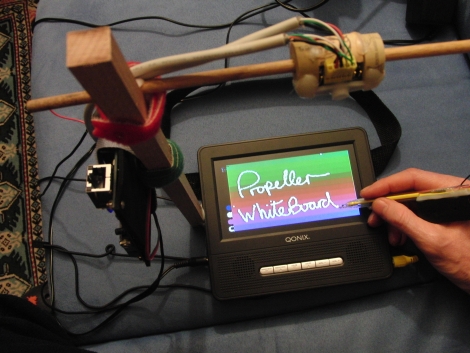
The Wiimote is a fantastic tool for hackers, given their affordability and how easy they are to work with. [Gareth] had a “eureka” moment while working on another Wiimote-based project, and with some alterations, converted it into an electronic whiteboard.

The whiteboard was built using the IR sensor he extracted from a Wiimote, which is wired to an EasyProp board to process the input. The Wiimote is aimed at a LCD screen, which can be “drawn” upon using a light pen he constructed from an IR led and a few batteries. Any movement of the pen is tracked by the Wiimote’s IR sensor and converted to an XY coordinate, which is then painted on the screen. The sensor has the ability to track up to four points at a time, so you can theoretically use up to four pens simultaneously.

[Gareth] points out that the sensor is not limited to tracking small displays, as the white board can be easily scaled up in size using any kind of rear projection device.

Continue reading to see a video of his whiteboard in action.

Continue reading “Wiimote-based Whiteboard Lets You Write On Any Surface”