Kinect Home Theater Control

kinect_home_theater

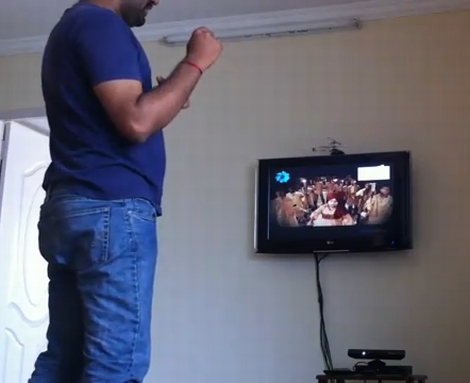
[Harishankar] has posted a video on his blog demonstrating the ability to control devices using the Microsoft Kinect sensor via IR. While controlling devices with Kinect is nothing new, he is doing something a little different than you have seen before. The Kinect directly interfaces with his Mac Mini and tracks his movements via OpenNI. These movements are then compared to a list of predefined gestures, which have been mapped to specific IR functions for controlling his home theater.

Once the gestures have been acknowledged, they are then relayed from the Mac via a USB-UIRT to various home theater components. While there are not a lot of details fleshed out in the blog post, [Harishankar] says he will gladly forward his code to you if you request it via email.

Thanks to [Peter] for the tip.
Pedal Powered EL Wire Bike

el_wire_bike

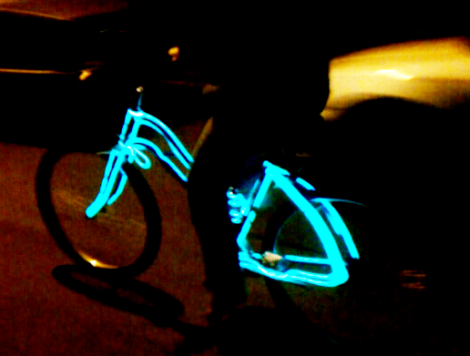
Instructables user [samsmith17] wanted to cover his bike with EL wire for this year’s Burning Man, but he didn’t want to mess with the hassle of using batteries as a power source. Instead, he decided that his EL wire bike would be powered solely by the rider. In the interest of keeping things green, the entire build is made up of re-purposed parts, aside from the EL wire itself.

If you are not familiar, EL wire only lights up when AC current is supplied, so he decided to use a stepper motor to generate the current required. The stepper motor was mounted against his bike’s wheel, and wired backwards through the AC transformer portion of an old cell phone charger in order to step up to the required voltage. A rheostat was also added to the circuit in order to help prevent an over voltage condition, which could potentially damage or destroy the EL wire.

The end result is pretty cool to watch, and costs very little to boot. It would be nice to see someone expand on his project, adding additional wire colors and perhaps a few capacitors to keep the wire from going dark immediately after the wheels stop turning.

Continue reading to see a quick video of the completed project.

Continue reading “Pedal Powered EL Wire Bike”

Valentine’s Day Love Song Machine

tellart_bell_ensemble

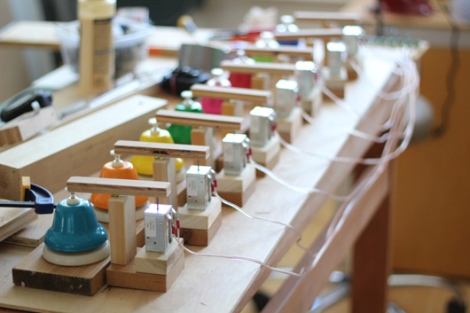
Just in time for Valentine’s day, [Adam Meyer] and the folks over at tellart.com have put together a little project they call the “Love Song Machine“. Using a web-based form, anyone can submit a song, which will then be played on a system of bells that they have set up in their office. You can choose from several pre-defined love songs, or you can create your own unique arrangement with which to serenade them. Once you are ready to go, your song will be queued up, and you can watch a video of your creation as it is being played.

The system is comprised of 8 solenoid-actuated bells which are all controlled by the Arduino they have hooked up to their web server. It’s a pretty fun idea, and there are sure to be plenty of people submitting songs, so get yours in before things get too busy!

Keep reading to see a video preview of their system in action.

Continue reading “Valentine’s Day Love Song Machine”

Batman Inspired Hidden Light Switch

hidden_switch

[Chris] over at the New Hobbyist sent in his latest creation, a wireless light switch hidden within a statue bust. While shopping around for another project, he came across a wireless relay that can can be used to switch a standard 120v AC load. He bought the part without a project in mind, but inspiration quickly struck. Some of you young’uns might not remember the original Batman television series, but [Chris] certainly does. To access the Bat Cave, Bruce Wayne had to flip a secret switch located inside a bust of William Shakespeare that adorned his desk. While he doesn’t have a secret door to activate, [Chris] couldn’t think of any better way to switch on the lights in his man cave. He found a similar-looking bust of Beethoven and got to chopping his head off.

He fabricated a small mount for a push button, hiding the battery powered remote underneath, and an old 12v wall wart was repurposed to drive the wireless receiver. While not overly complicated, this is definitely a fun project and could make for a neat light switch in a kid’s room. Interested in some more Batman inspired hacks? Be sure to check out this Bat Cave-style entrance switch from a few years back.

Keep reading to see a video of his hidden light switch in action.

Continue reading “Batman Inspired Hidden Light Switch”

Radio-controlled LED Light Show

HL1606_radio_controlled_light_show

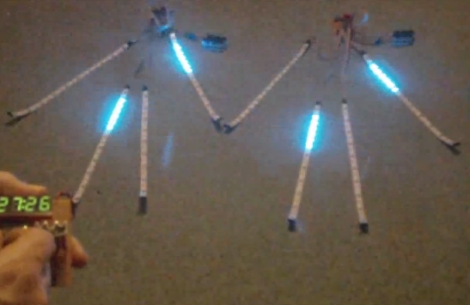
[Alan] was commissioned to make some wearable, radio-controlled LED strips for the Travelling Light Circus. It has taken some time, but he has recently finished some prototypes, and thought it was a good time to do a writeup on the project. The system is managed by a single controller unit, which communicates with any number of LED driver units, each controlling 4 HL1606 LED strips. The light displays are synchronized across all of the LED driver units via a 2.4 GHz radio, with each driver falling into synch almost immediately after being powered on. While some might be turned off to the fact that he uses Arduino Pro Minis to control the LEDs, this is far from a simple project.

[Alan’s] blog contains several posts about this project, with everything documented in detail. He spends quite a bit of time talking about the project’s software, as well as hardware issues he ran into along the way.

His blog is a must read, but even more so, it is a must see. The lighting effects are mesmerizing, as there are a ton of different light patterns these units can generate, so be sure to check out the following video of the lights in action.

Continue reading “Radio-controlled LED Light Show”

Recordable SNES Belt Buckle

recordable_snes_controller

[Andrew] recently offered to help out a friend who was looking to get her husband a SNES controller belt buckle. Rather than simply slap one together, he decided that it would be far cooler if the belt buckle played audio as well. He gutted a broken SNES controller, removing most everything inside, leaving just the buttons and a few wires.

To allow for the belt buckle to record sounds, he pulled apart a recordable balloon that would play a 10-second audio clip when shaken. He moved around a few wires, allowing for the audio board to be triggered by a button press rather than motion. Once that was done, he went about fitting it into the SNES controller, drilling speaker and microphone holes in the process. With the electronics components all set, he reassembled the controller shell and mounted it to an old belt buckle he had sitting around.

The final product looks extremely fun, and would make any die hard Nintendo fan’s day.

Nixie Tube Thermometer

nixie_therm

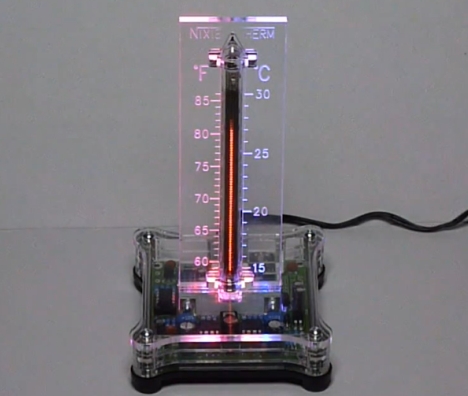
After seeing a picture of a thermometer using a bargraph style nixie tube in place of a mercury column, [Juergen Grau] decided he wanted to build his own. Dubbed the “Nixietherm”, his replica looks even better than the original. He used an IN-9 Nixie tube mounted on top of a custom plastic case, all powered by a 5v USB connection. He points out that his version does not use a PIC or any other sort of processor – it is built entirely from analog circuits. There are some RGB LEDs embedded in the plastic case that make for a cool effect, but they seem to simply cycle through the colors rather than represent how warm or cold the temperature is at any given time.

[Juergen] does not give a lot of details regarding the build as far as PCB layout or a parts list is concernred, but most of that can be extrapolated from the wiring schematic he provided. He also mentions that he will be making kits available in the near future. Be sure to keep reading to see the thermometer in action.

Thanks [Brian]

Continue reading “Nixie Tube Thermometer”