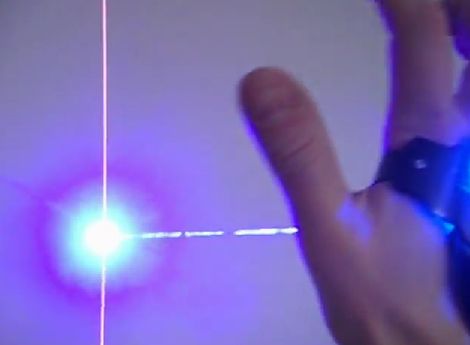
Incredible 1000 MW Iron Man Repulsor Beam

awesome_hand_mounted_repulsor_laser

German lab technician by day, hacker by night [Patrick Priebe] has done it again, this time strapping a ridiculously high-powered laser to the palm of his hand. Earlier this year, we showed you an awesome Neodymium:YAG pulse laser pistol he built, and it seems he never takes a rest from constructing crazy laser projects.

[Patrick] is a huge Iron Man fan, and his palm-mounted laser unit was built as an ode to his all-time favorite super hero. Crafted to invoke images of Iron Man’s repulsor beam, his laser uses a 1000 mw 445 nm laser diode to get the job done. if you happen to be keeping track, that makes his DIY laser just as powerful as the WickedLasers Spyder 3 Arctic – THE benchmark in portable handheld lasers.

Like his previous builds, we can’t seem to find a whole lot of information about the laser’s construction process. We do know however, that the unit was crafted from a 2mm thick sheet of brass, which fits nicely on his hand while simultaneously acting as a very large heat sink. This large surface area allows him to run the laser continuously for three minutes before requiring a cool down, which is no small feat.

We think it’s an awesome project, and as you can see by the videos of the three separate revisions it has undergone, [Patrick] is quite serious when it comes to perfecting his wares.

Continue reading “Incredible 1000 MW Iron Man Repulsor Beam”
Replacing Non-standard USB Charging Ports

htc_charging_port_replacement

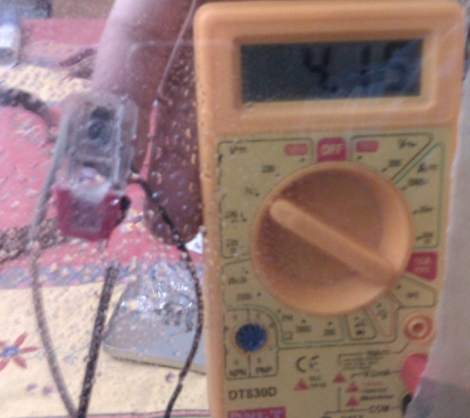
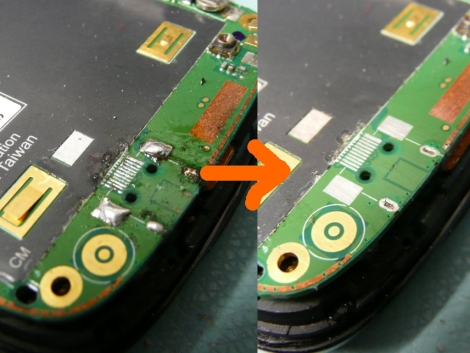
While many mobile phone manufacturers are moving towards the micro-USB interface as a standard, others such as Apple and HTC are still bucking the trend. Part of [arto’s] job includes repairing mobile phones, and last month he found himself faced with a pair of broken HTC handsets that needed their charging ports replaced.

Replacements for HTC’s proprietary connectors are apparently quite hard to find, and [arto] says he had to source them from an HTC repair center. With the proper parts in hand, he could finally get down to work.

The HTC Hermes handset he repaired was a breeze, as it had plenty of space available around the charging port. He said that this allowed him to replace the jack pretty easily, but the HTC Touch Dual was a mess in comparison. He started by removing the old adapter, which was done by cutting it out bit by bit. He says that he did it this way rather than desoldering, due to its proximity to other heat-sensitive components. After some careful soldering under a microscope, everything was back in working order.

While his repairs are not necessarily the things that hacks are made of, the information is still quite helpful. Broken charging ports are extremely common among smart phones, and with plenty of these older models still floating around, his pointers just might help someone save a few bucks on a replacement phone.

DIY Wiper Speed Control And Collision Avoidance

ir_sensor_rain_detection

On many new cars, automatic wiper speed control can be had as an upgrade, though most cars do not offer front-end collision prevention at all. [Rishi Hora] and [Diwakar Labh], students at the Guru Tegh Bahadur Institute of Technology in New Delhi, developed their own version of these features, (PDF warning, skip to page 20) which they entered into last year’s Texas Instruments Analog Design Contest. Under the guidance of professors [Gurmeet Singh] and [Pawan Kumar], the pair built the systems using easily obtainable parts, including of course, an MSP430 microcontroller from TI.

The collision prevention system uses a laser emitter and an optical detector to estimate the distance between your car and the vehicle in front of you, sounding an alarm if you are getting too close. In a somewhat similar fashion, the wiper speed control system uses an IR emitter and detector pair to estimate the amount of water built up on the windshield, triggering the wipers when necessary.

While not groundbreaking, the systems would be quite handy during monsoon season in India, and seem easy enough to install in an older vehicle. The only thing we’re not so sure about is pointing lasers at cars in traffic, but there are quite a few available alternatives that can be used to measure distance.

Continue reading to see a video walkthrough and demonstration of both systems.

Continue reading “DIY Wiper Speed Control And Collision Avoidance”

Automotive Battery Voltage Monitor

car_battery_voltage_monitor

[Rajendra’s] car had just about all the bells, whistles, and gauges he could dream of, but he thought it was missing one important item. In an age where cars are heavily reliant on intricate electrical systems, he felt that he should have some way of monitoring the car’s battery and charging system.

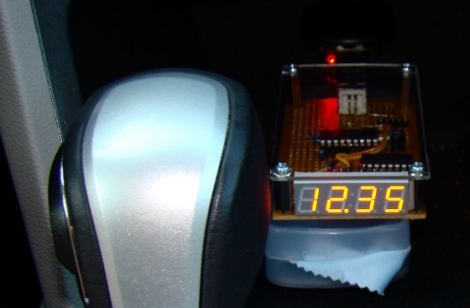
To keep tabs on his car’s electrical system, he built a simple device that allows him to monitor the battery’s instantaneous voltage when the car is powered off, as well as the charging voltage across the battery when the car is running. A PIC16F1827 runs the show, using a simple voltage divider network to step the input voltage down to an acceptable level for use with the PIC’s A/D conversion channel. The resultant measurements are output to a four digit 7 segment display, mounted on the front of the device.

He says that the voltage monitor works quite well, and we’re sure he feels a lot better about the health of his car’s charging system. For anyone interested in keeping closer tabs on their car, he has a circuit diagram as well as code available on his site.

Faux LED Scroller Using Phosphorescence

poor_mans_phosphorescent_led_scroller

Hackaday reader [BGR] wrote in to share a video he put together showing off a cool “poor man’s LED scroller” that he built. Rather than build a huge array of LEDs, spending tons of time time wiring and programming, he decided to use only a handful of LEDs on a moving display instead.

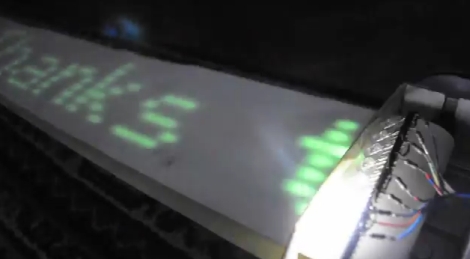
The scroller is built upon a PIC16F887 microcontroller which resides on an EasyPIC6 dev board he borrowed for the project. The PIC controls a strip of eight bright white LEDs, which are used to write text on a long strip of phosphorescent paper that can be found at many printing supply outfits. The paper’s dispensing mechanism was cobbled together with parts from several sources, including  a laser printer and VCR.

When he wants to display a message, he inputs text into a flash application he wrote. The app sends the LED byte values to his scroller via a separate serial proxy that talks to the pic over his computer’s COM port.

The effect is pretty slick, looking similar to a slow-moving diffused LED scroller. The messages disappear after about 5 minutes in a pitch black room, which is perfect, since he originally intended to use the device for displaying Twitter updates. He is already considering a second revision of the project, which he wants to mount on the wall – sounds great to us!

Be sure to swing by YouTube to see the video, or continue reading to watch it here.

Continue reading “Faux LED Scroller Using Phosphorescence”

Xbox 360 DVD Changer Is The Ultimate In Gaming Laziness

ben_heck_xbox_360_disc_changer

Let’s face it – gamers have a reputation for being pretty lazy. In the most recent episode of his web series, [Ben Heck] takes on the stereotypical gamer role and cranks the laziness factor to 11, lamenting the fact that he needs to get up off the couch to swap discs in his Xbox 360 console. Never allowing laziness get in the way of his hacking, he springs into action, hauling off to his shop in order to construct an Xbox DVD changer system.

He grabbed a pair of CD changers and popped them open to see how they operated. After choosing the best candidate based on its CD loading method, he got to work disassembling the changer. The old CD player and its guts were removed, which he replaced with DVD drive components ripped from his Xbox. Quite a bit of trimming and tweaking was required to swap out the components, but it seems that [Ben] got things working just fine.

With the mechanical portion of the project out of the way, he dug into the electronics. The CD changer had no way of knowing how to interface with the Xbox and vice versa, so [Ben] had to devise a way for the two devices to communicate. He used an Arduino Uno to control the systems, triggering the CD carousel only when the Xbox thought it had its drive slot opened.

While the system looks a bit unpolished, and the controller quite bulky, we love this thing!  No matter if you are lazy or not, jamming these two devices together is exactly what hacking is all about.

Shoulder Surfing With OpenCV

shoulder_surfing_with_shoulder_pad

While it seems that many people are wise to shoulder surfing, keeping a lookout for anyone spying on their passwords, [Haroon] wrote in to remind us that the threat is just as real today as it ever was.

The subjects of his research are touch screen phones and tablets, which utilize on-screen keyboards for data entry. He says that while nearly all password entry boxes on these devices are obscured with the traditional line of asterisks, the keyboards themselves are quite an interesting vulnerability.

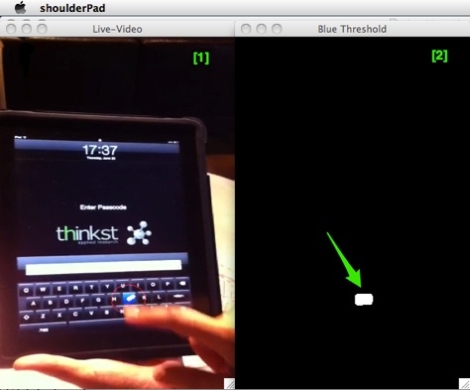
Since touch screen technology can be finicky at times, most vendors ship their devices with some sort of key press verification system. On the iPhone and iPad, for instance, each key is highlighted in blue following a button press. This functionality makes it quite easy for shoulder surfers to casually steal your password if you’re not paying attention.

But what if you are well aware of your surroundings? [Haroon] has developed a piece of software he calls shoulderPad, which is based on openCV that does the surfing for him. The application can monitor a video stream, live or recorded, extracting the user’s password from the highlighted button presses. His demonstrations show the recording taking place at a relatively close distance, but he says that it would be quite easy to use surveillance footage or zoom lenses to capture key presses from afar.

He does say that the button highlighting can be easily disabled in the iPhone’s options pane, which should negate this sort of attack for the most part.

Continue reading to see a quick video of shoulderPad in action.

Continue reading “Shoulder Surfing With OpenCV”