Ask Hackaday: What If You Did Have A Room Temperature Superconductor?

The news doesn’t go long without some kind of superconductor announcement these days. Unfortunately, these come in several categories: materials that require warmer temperatures than previous materials but still require cryogenic cooling, materials that require very high pressures, or materials that, on closer examination, aren’t really superconductors. But it is clear the holy grail is a superconducting material that works at reasonable temperatures in ambient temperature. Most people call that a room-temperature superconductor, but the reality is you really want an “ordinary temperature and pressure superconductor,” but that’s a mouthful.

In the Hackaday bunker, we’ve been kicking around what we will do when the day comes that someone nails it. It isn’t like we have a bunch of unfinished projects that we need superconductors to complete. Other than making it easier to float magnets, what are we going to do with a room-temperature superconductor? Continue reading “Ask Hackaday: What If You Did Have A Room Temperature Superconductor?”


What Is X86-64-v3?

You may have heard Linux pundits discussing x86-64-v3. Can recompiling Linux code to use this bring benefits? To answer that question, you probably need to know what x86-64-v3 is, and [Gary Explains]… well… explains it in a recent video.

If you’d rather digest text, RedHat has a recent article about their experiments using the instructions set in RHEL10. From that article, you can see that most of the new instructions support some enhancements for vectors and bit manipulation. It also allows for more flexible instructions that leave their results in an explicit destination register instead of one of the operand registers.

Of course, none of this matters for high-level code unless the compiler supports it. However, gcc version 12 will automatically vectorize code when using the -O2 optimization flags.

Continue reading “What Is X86-64-v3?”

Tetris Goes Round And Round

You’ve probably played some version of Tetris, but [the Center for Creative Learning] has a different take on it. Their latest version features a cylindrical playing field. While it wouldn’t be simple to wire up all those LEDs, it is a little easier, thanks to LED strips. You can find the code for the game on GitHub.

In all, there are 5 LED strips for a display and 13 strips for the playing area, although you can adjust this as long as there are at least 10 rows. The exact number of LEDs will depend on the diameter of the PVC pipe you build it on.

Continue reading “Tetris Goes Round And Round”

Your Scope, Armed And Ready

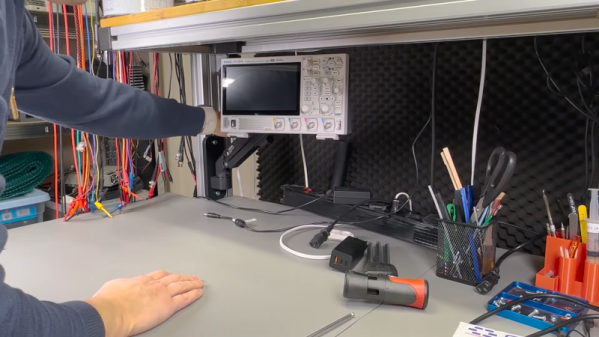
[VoltLog] never has enough space on his bench. We know the feeling and liked his idea of mounting his oscilloscope on an articulated arm. This is easy now because many new scopes have VESA mounts like monitors or TVs. However, watching the video below, we discovered there was a bit more to it than you might imagine.

First, there are many choices of arms. [VoltLog] went for a cheap one with springs that didn’t have a lot of motion range. You may want something different. But we didn’t realize that many of these arms have a minimum weight requirement, and modern scopes may be too light for some of these arms. Most arms require at least 2 kg of weight to balance the tensions in their springs or hydraulics. Of course, you could add a little weight to the mounting plate of the arm if you needed it. The only downside we see is that it makes it hard to remove the scope if you want to use it somewhere else.

Assuming you have a mount you like, the rest is easy. Of course, your scope might not have VESA mounting holes. No problem. You can probably find a 3D printed design for an adapter or make (or adapt) your own. You might want to print a cable holder at the same time.

Honestly, we’ve thought of mounting a scope to the wall, but this seems nicer. We might still think about 3D printing some kind of adapter that would let you easily remove the scope without tools.

Of course, there is another obvious place to mount your scope. Monitor arms can also mount microscopes.

Continue reading “Your Scope, Armed And Ready”

Mirror, Mirror, Electron Mirror…

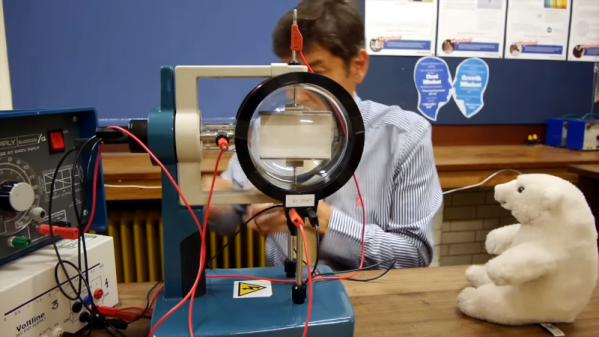
If you look into an electron mirror, you don’t expect to see your reflection. As [Anthony Francis-Jones] points out, what you do see is hard to explain. The key to an electron mirror is that the electric and magnetic fields are 90 degrees apart, and the electrons are 90 degrees from both.

You need a few strange items to make it all work, including an electron gun with a scintillating screen in a low-pressure tube. Once he sets an electric field going, the blue line representing the electrons goes from straight to curved.

Continue reading “Mirror, Mirror, Electron Mirror…”

Ask Hackaday: What’s In Your Garage?

No matter what your hack of choice is, most of us harbor a secret fantasy that one day, we will create something world-changing, right? For most of us, that isn’t likely, but it does happen. A recent post from [Rohit Krishnan] points out that a lot of innovation happens in garages by people who are more or less like us.

He points out that Apple, Google, and HP all started in garages. So did Harley Davidson. While it wasn’t technically a garage, the Wright brothers were in a bicycle workshop, which is sort of a garage for bikes. Even Philo Farnsworth started out in a garage. Of course, all of those were a few years ago, too. Is it too late to change the world from your workbench?

Basement

We’d argue basements are at least as important (although in southern Texas, they call garages Lone Star basements since no one has proper basements). The real point of the article, though, isn’t the power of the garage. Rather, it is the common drive and spirit of innovators to do whatever it takes to make their vision a reality. A few hundred bucks and an oddball space has given birth to many innovations.

Continue reading “Ask Hackaday: What’s In Your Garage?”

Hackaday Podcast Episode 259: Twin-T, Three-D, And Driving To A Tee

Hackaday Editors Elliot Williams and Al Williams sat down to compare notes on their favorite Hackaday posts of the week. You can listen in on this week’s podcast. The guys talked about the latest Hackaday contest and plans for Hackaday Europe. Plus, there’s a what’s that sound to try. Your guess can’t be worse than Al’s, so take a shot. You could win a limited-edition T-shirt.

In technical articles, Elliot spent the week reading about brushless motor design, twin-t oscillators, and a truly wondrous hack to reverse map a Nintendo Switch PCB. Al was more nostalgic, looking at the 555 and an old Radio Shack kit renewed. He also talked about a method to use SQL to retrieve information from Web APIs.

Quick hacks were a decided mix with everything from homemade potentiometers to waterproof 3D printing. Finally, the guys talked about Hackaday originals. Why don’t we teach teens to drive with simulators? And why would you want to run CP/M — the decades-old operating system — under Linux?

Download the file suitable for listening, burning on CDs, or pressing on vinyl.

Continue reading “Hackaday Podcast Episode 259: Twin-T, Three-D, And Driving To A Tee”