Linux Kernel From First Principles

Want to learn the internals of the Linux kernel? Version 6.5-rc5 has about 36 million lines of code in it, so good luck! [Seiya] has a different approach. Go back to the beginning and examine the 0.01 version of the kernel. Now you are talking about 10,000 lines and, removing comments and blanks, way less.

Sure, some things have changed, but the core ideas are the same. [Seiya] reports, “Reading V0.01 was really for me. It was like visiting Computer History Museum in Mountainview…”

Continue reading “Linux Kernel From First Principles”

Inside A Cordless Soldering Station

There was a time when soldering stations were unusual in hobby labs. These days, inexpensive stations are everywhere. [Kerry Wong] looks at the TS1C station, which is tiny and cordless. As he points out, cordless irons are not new, but modern battery technology has made them much more practical. However, this iron doesn’t actually have a battery.

The iron has a large 750 Farad supercapacitor. This has advantages and disadvantages. On the plus side, a supercapacitor charges quickly and doesn’t get weaker with each charging cycle like a conventional battery. On the minus side, the large capacitor makes the unit bulky compared to normal irons. [Kerry] notes that it is ergonomic, though, and he felt comfortable holding it. Also, the supercapacitor limits the amount of charge available while soldering.

It is somewhat of a balance, though. If you want to take the iron and climb a tower, you might be very interested in a longer running time. But if you return the unit to the base every few minutes, the fast charging of the cap will compensate for the lower capacity, and you’ll probably never notice it go flat.

The iron itself doesn’t display any data. The display is on the base, meaning the devices must be paired via Bluetooth. It also requires a PD-enabled USB-C connection, so you can’t just wire it to a battery. You can plug a power supply right into the iron if you prefer, but you still can’t use a simple power connection.

Of course, you assume it does an adequate job of soldering. We wanted to see inside! And [Kerry] didn’t disappoint. If you want to see soldering, skip to about the 10-minute marker. The teardown starts at around 16 minutes.

Honestly, for the bench, we’d probably stick with a wired iron. You don’t always want a base and a PD power supply for a portable iron. But if you absolutely hate cords, this could be a reasonable answer. We’ve seen another review of this iron that didn’t like the plastic casings. Maybe it is like Jedi and lightsabers: you should just build your own.

Continue reading “Inside A Cordless Soldering Station”

Arbitrary Waveforms On The Cheap

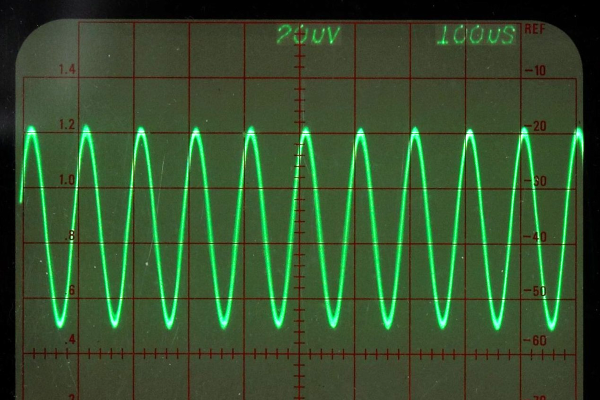
A signal generator that can produce the usual sine, square, and triangle waves is handy and has been a staple of electronic benches for decades. Being able to craft custom signals opens up new horizons, but historically, these instruments were expensive. The price has come down, though, and [Rishin Goswami] made a 5 MHz 8-bit signal generator with 131K data points of arbitrary waveform for a low price: about $20. If you want to spend a bit more, you can improve the output DAC and op amps, but even that should cost well under $100, all in.

This is one of those projects that seems easy until you start digging into it. For example, storing some points and generating signals using any microcontroller isn’t a big deal. But minimizing jitter and maximizing speed with a conventional processor is difficult. That’s why [Rishin] uses a Raspberry Pi Pico. The programmable I/O units are perfect for generating waveform data fast and reliably. You can see the project go through its paces in the video below.

The Pi streams data to an 8-bit DAC. However, it would be easy to improve resolution with a different converter. The DAC0808 also limits the instrument’s sample rate. The processor could likely go much faster if it had a DAC accommodating higher speeds.

This is just a proof-of-concept, so don’t expect fancy GUIs or the ability to import spreadsheets. You control the device from a command-line-like interface. Still, a good example of how to take advantage of the Pi’s hardware. We took a shot at a similar device nearly a decade ago. Those programmable I/O blocks are finding uses in some surprising applications.

Continue reading “Arbitrary Waveforms On The Cheap”

Throw FreeCAD Some Curves

[Mango Jelly] got a question from someone trying to model a phone box with a complex curved roof. We have to admit that when we saw it, we knew it would be hard to model well. Naturally, there are several ways it could be one, but [Mango Jelly] used the curves workbench in FreeCAD to produce a wireframe of the shape, and you can see how that works in the video below.

The curve bench didn’t sound familiar to us, and that’s because it is an add-on workbench. He starts with a sketch of a curve, constrained to be symmetrical. Then the draft workbench allowed a rotation to convert the curve into a nice skeleton of the curved roof.

The curves workbench can create a Gordon surface over that skeleton. You can extrude that into a solid object. There are still some details to add, though, and you’ll see how each part of the roof takes shape.

Watching videos like this reminds us that we use a small fraction of what FreeCAD can do. You’ll probably pick up at least one tip from this video. If you need a quick basic tutorial, try the one from [NovaSpirit]. Or, try a longer one.

Continue reading “Throw FreeCAD Some Curves”

A Little Bit Of Science History Repeating Itself: Boyle’s List

In a recent blog post, [Benjamin Breen] makes an interesting case that 2023 might go down in history as the start of a scientific revolution, and that’s even if LK-99 turns out to be a dud. He points to several biomedical, quantum computing, and nuclear fusion news items this year as proof.

However, we aren’t as convinced that these things are here to stay. Sure, LK-99 was debunked pretty quickly, but we swim in press releases about new battery technologies, and new computer advances that we never hear about again. He does mention that we aren’t alone in thinking that as [Tyler Cowen] coined the phrase “Great Stagnation” to refer to the decline in disruptive tech since 1945. Still, [Benjamin] argues that people never know when they live through a scientific revolution and that the rate of science isn’t as important as the impact of it.

Continue reading “A Little Bit Of Science History Repeating Itself: Boyle’s List”

Ku-Go: The World War II Death Ray

Historians may note that World War II was the last great “movie war.” In those days, you could do many things that are impossible today, yet make for great movie drama. You can’t sneak a fleet of ships across the oceans anymore. Nor could you dig tunnels right under your captor’s nose. Another defining factor is that it doesn’t seem we seek out superweapons anymore.

A Churchill Bullshorn plough for clearning minefields — one of Hobart’s “Funnies”

Sure, we develop better planes, tanks, submarines, and guns. But we aren’t working on anything — that we know of — as revolutionary as a rocket, an atomic bomb, or even radar was back in the 1940s. The Germans worked on Wunderwaffe, including guided missiles, jets, suborbital rocket bombers, and a solar-powered space mirror to burn terrestrial targets. Everyone was working on a nuclear bomb, of course. The British had Hobart’s Funnies as well as less successful entries like the Panjandrum — a ten-foot rocket-driven wheel of explosives.

Death Ray

Perhaps the holy grail of all the super weapons — both realized and dreamed of was the “death ray.” Of course, Tesla claimed to have one that didn’t use rays, but particles, but no one ever successfully built one and there was debate if it would work. Tesla didn’t like the term death ray, partly because it wasn’t a ray at all, but also because it required a huge power plant and, therefore, wasn’t mobile. He envisioned it as a peacekeeping defensive weapon, rendering attacks so futile that no one would dare attempt them.

Continue reading “Ku-Go: The World War II Death Ray”

Hackaday Podcast 231: Harnessing Sparks, Hacking Food, And Leaving Breadcrumbs

Editor-in-Chief Elliot Williams and Al Williams don’t always agree on the best text editor to use, but they do — usually — agree on what makes a great hack. This week, they found plenty of Hackaday posts to discuss, ranging from exotic eavesdropping on keyboards, oscilloscopes, and several posts of interest to anyone who wants to build good-looking prototypes. If you are like mechanics, you’ll hear about an escapement-like mechanism and a Hobson’s coupler. If you crave more traditional hacks, you can learn more about maximizing battery life and etching PCBs.

In addition to a flurry of hacks, Elliot and Al also share their picks for the best original posts from Hackaday’s staff. This week, we find out how Arya Voronova documents projects and hear what Tom Nardi thinks of his Beepy — a ready-made display and Blackberry keyboard waiting for a Raspberry Pi.

Did you miss anything? Check out the links below. Be sure to send your favorite hacks our way, and let us know in the comments how you liked this episode. Hear it here:

Or download it yourself and listen while testing room-temperature superconductors!

Continue reading “Hackaday Podcast 231: Harnessing Sparks, Hacking Food, And Leaving Breadcrumbs”