Inside A Fake LM358

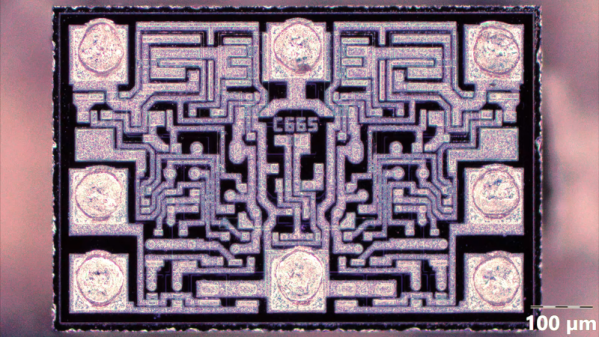
[IMSAI Guy] got some fake LM358 op-amps. Uncharacteristically, these chips actually performed well even though they didn’t act like LM358s. [IMSAI Guy] did a video about the fake chips and someone who saw it offered to analyze the part compared to a real LM358 to see what was going on. You can see it too in the video below.

A visual inspection made it obvious that the chip was probably a fake. X-ray analysis was a little less obvious but still showed poor quality and different internals. But the fun was when they actually decapsulated the part.

Continue reading “Inside A Fake LM358” →

Bell Labs Is Leaving The Building

If you ever had the occasion to visit Bell Labs at Murray Hill, New Jersey, or any of the nearby satellite sites, but you didn’t work there, you were probably envious. For one thing, some of the most brilliant people in the world worked there. Plus, there is the weight of history — Bell Labs had a hand in ten Nobel prizes, five Turing awards, 22 IEEE Medals of Honor, and over 20,000 patents, including several that have literally changed the world. They developed, among other things, the transistor, Unix, and a host of other high-tech inventions. Of course, Bell Labs hasn’t been Bell for a while — Nokia now owns it. And Nokia has plans to move the headquarters lab from its historic Murray Hill campus to nearby New Brunswick. (That’s New Jersey, not Canada.)

If your friends aren’t impressed by Nobels, it is worth mentioning the lab has also won five Emmy awards, a Grammy, and an Academy award. Not bad for a bunch of engineers and scientists. Nokia bought Alcatel-Lucent, who had wound up with Bell Labs after the phone company was split up and AT&T spun off Lucent.

Continue reading “Bell Labs Is Leaving The Building” →

3D Printed Screw Compressor Revisited

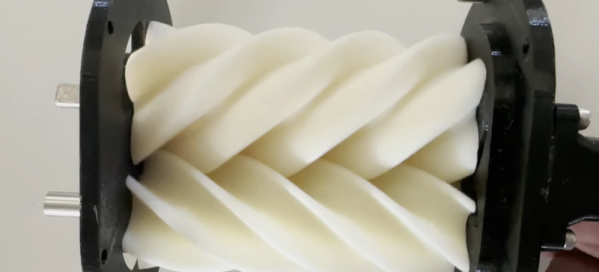
[Indeterminate Design] tried to 3D print a screw compressor some time ago but wasn’t satisfied with the result. He’s trying it again, and you can check it out in the video below. You can also download the 3D printable files.

This isn’t a 3D-printed keychain. The screw threads have to mesh with a small space between them, and the design is not trivial. Even if you don’t want to build your own, the look inside the engineering behind these devices is interesting, and there is quite a bit of background about how the rotor’s shapes are optimized.

Continue reading “3D Printed Screw Compressor Revisited” →

FM Radio Is Discriminating

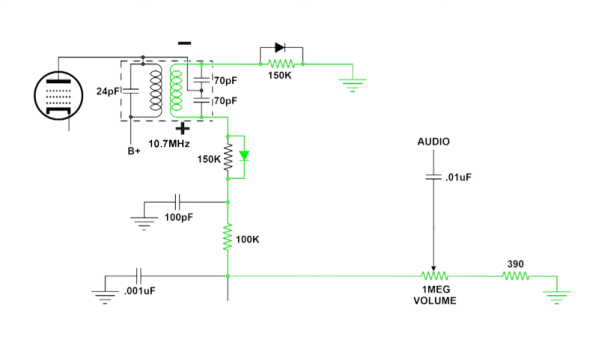
AM radios were easy to understand. The strength of the signal goes up and down, and the audio follows. FM radio is a little more difficult. [AllAmericanFiveRadio] has an old tube FM set and takes us on a tour of how the FM discriminator works. You can see the video below.

The first step is to look at the IF signal on the scope. It is hard to see, but the frequency is changing, and that’s the basis of modulation that the discriminator has to resolve.

Continue reading “FM Radio Is Discriminating” →

Simulating Cellular Biology In The Browser

[Technistuff] read a paper about simulating a “minimal” cell — apparently a cell with only 493 genes. This led to a goal: reproduce the simulation in TypeScript so it can run in a web browser. Why? We don’t know, but it is an interesting look at both in-depth biology and how to handle complex simulations. The code is available on GitHub.

For a point of reference, E. Coli has over 4,500 genes. The cell in question — JCVI-syn3A — actually has seven more genes than truly necessary. The data for this bacteria is available from a research lab, again, using GitHub.

Continue reading “Simulating Cellular Biology In The Browser” →

Computer Logic Spins With No Electricity

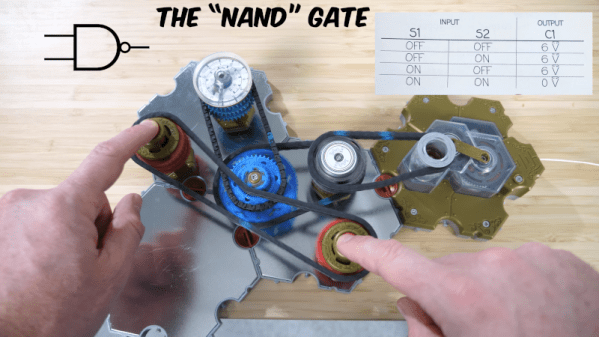
We’ve often said you can make a logic gate out of darn near anything. [The Action Lab] agrees and just released a video showing how he made some logic gates from chains and gears. Along the way, he makes the case that the moving chain is an analog for electric current. The demonstration uses a commercial toy known as Spintronics, but if you are mechanically handy, you could probably devise your own setup using 3D printing or gears.

A spring wound motor is a “battery.” Gears act like resistors and junctions to distribute “current” in multiple directions. Seeing series and parallel resistance as moving chains is pretty entertaining and might help someone new learn those concepts.

Continue reading “Computer Logic Spins With No Electricity” →

Z80 I/O Madness

While the 8080 started the personal computer revolution, the Z80 was quickly a winner because it was easier to use and had more capabilities. [Noel] found out though that the Z80 OUT instruction is a little odd and, in fact, some of the period documentation was incorrect.

Many CPUs used memory-mapped I/O, but the 8080 and Z80 had dedicated I/O addressing pins and instructions so you could fill up the memory map with actual memory and still have some I/O devices. A quick look in the famous Zak’s book on Z80 programming indicates that an instruction like OUT (C),A would write the A register to the output device indicated by the BC register pair (even though the instruction only mentions C. However, [Noel] missed the note about the B register and saw in the Zilog documentation that it did. Since he didn’t read the note in the Zak’s book until later, he assumed it was a discrepancy. Therefore, he went to the silicon to get the correct answer.

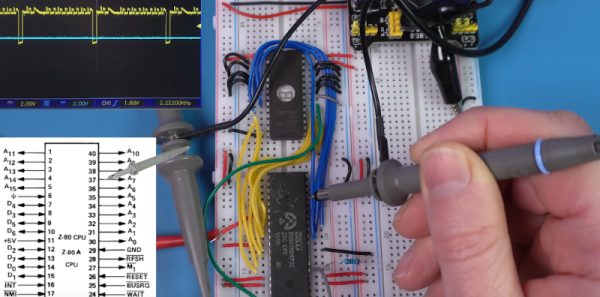
Breadboarding a little Z80 system allowed him to look at the actual behavior of the instruction. However, he also didn’t appreciate the syntax of the assembly language statements. We’ve done enough Z80 assembly that none of it struck us as particularly crazy, especially since odd instruction mnemonics were the norm in those days.

Still, it was interesting to see him work through all the instructions. He then looks at how Amstrad used or abused the instructions to do something even stranger.

If you want to breadboard a minimal Z80 system, consider this one. If you enjoy abuse of the Z80 I/O system, you don’t want to miss this Z80 hack for “protected mode.”

Continue reading “Z80 I/O Madness” →