3D Printing Gets Small In A Big Way

If you have a 3D printer in your workshop, you probably fret more about how to get bigger objects out of it. However, the University of Amsterdam has a new technique that allows for fast large-scale printing with sub-micron resolution. The technique is a hybrid of photolithography and stereolithography.

One of the problems with printing with fine detail is that print times become very long. However, the new technique claims to have “acceptable production time.” Apparently, bioprinting applications are very much of interest to the technology’s first licensee. There is talk of printing, for example, a kidney scaffold in several hours or a full-sized heart scaffold in less than a day.

Another example application is the production of a chromatography instrument with 200 micron channels and 20 micron restrictions. This requires a printer capable of very fine detail. There are also applications in semiconductors and mechanical metamaterials. Of course, we always take note of photolithography processes because we use them to make PC boards and even integrated circuits. A desktop printer that could do photolithography might open up new ideas for producing electronic circuitry.

If you want to play with photolithography today, [Ben Krasnow] has some advice. Of course, there are several ways to produce PC boards, even with a garden-variety 3D printer.

The $300,000 3D Printed Car

We’ve noticed an uptick in cars–especially pricey ones–using 3D-printed parts. However, these are usually small and nonstructural parts with a few exceptions. This isn’t the case with the 2024 Cadillac Celestiq. The $300,000 luxury electric vehicle boasts 115 3D-printed parts, according to a post on [TheDrive].

It appears part of the drive–no pun intended–is to allow ultra customizations for people who need more than a car that costs more than a quarter of a million dollars. For example, if you buy an Escalade — another Cadilac vehicle — you have to tolerate that the switches that operate the window are the same as Joe Sixpack has in his Tahoe. Not so, the Celestiq since it has 3D printed switches that could even be customized for a specific owner. The post mentions that the large steering wheel trim is all printed so having, for example, your name, family crest, or company logo embedded in it would be feasible.

Continue reading “The $300,000 3D Printed Car”

Less Is More When It Comes To Sensor Power

It used to be the cost of a microcontroller was a big inhibitor to putting brains in everything, but those days are long gone. Even 32-bit CPUs are now cheap enough that you can throw them into anything. The biggest factor now is probably power. Do you really want to charge your electric toilet seat or change batteries every few weeks? A company called Everactive wants you to ditch your battery using their sensor platform they claim harvests energy from a variety of sources and they are about to deliver their first developer’s kit.

The sensor can measure temperature, humidity, pressure, magnetic field, and acceleration on three axes. The device claims to harvest energy from radio frequencies, vibrations, small temperature differentials or light, even indoors. Our guess is that the sensor package runs on very little and when you poll the device wirelessly, the incoming radio signal supplies power for communication. The company claims its device uses 1000 times less power than competing solutions.

Continue reading “Less Is More When It Comes To Sensor Power”

Build Your Own Concrete 3D Printer

We didn’t notice [Nikita]’s post about building a concrete 3D printer, a few months ago, but the idea seems sound: build a basic CNC XY axis and then add a mortar pump and hose to deposit concrete. The video, below, shows the machine in operation.

While it looks interesting, there is essentially no real Z-axis, so this would be limited to some sort of relatively thin forms unless you, perhaps, did a few layers and then further lifted the machine. We also assume wet concrete won’t bridge at all. Still, this might be an interesting project, especially if you have a spare CNC XY axis floating around.

If you buy everything, though, you are looking at an estimated cost of around $7,000 USD. We presume there is enough weight in the concrete that a conventional 3D printer probably isn’t going to cut it. We did wonder, though, if there would be any merit to connecting a conventional plastic-extruding nozzle to be able to lay down support for the concrete.

This might be a good jumping-off point for a more sophisticated machine. In particular, [Nikita] points out that a progressive cavity pump with a variable frequency drive is ideal, because it allows you to vary the extrusion rate and provides a steady flow of concrete. Armed with that knowledge, you could probably figure out the rest pretty easily if you’ve ever built a 3D printer or CNC machine.

Not the first concrete printer we’ve seen, of course. The one we saw before was capable of some pretty amazing things.

Continue reading “Build Your Own Concrete 3D Printer”

HP-41C, The Forth Edition

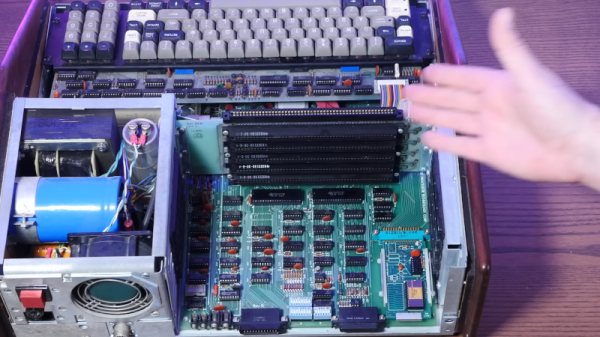
If you have an HP-41 — arguably the best calculator ever made, you might not have noticed that there’s a version of Forth for it. The code was written a while back in assembly and will work on anything that actually emulates the device properly, such as a SwissMicros DM41X. [Calculator Clique] shows you how it works in a recent video that you can watch below.

The original code dates back to 1984, but some recent detective work by [Angel Margin] has the code running again. If you know about synthetic programming on the 41C and the oddities of its internal architecture, you can’t help but be impressed.

Of course, Forth is meant to be easy to port over, but if you read about some of the architectural challenges, you start to realize this could be one of the more difficult implementations you’ve ever seen. Don’t forget you have what is, by today’s standards, an extremely limited amount of resources.

That being said, calling the HP41C a calculator is almost a crime. It is really a tiny computer hiding inside a calculator case. Then again, the best calculators always are.

We wonder if the code would run on an emulated 41C? Were you part of the TI calculator gang? No problem.

Continue reading “HP-41C, The Forth Edition”

Retrotechtacular: The Original Weather Channel

The Weather Channel has decided to pull the plug on its automated weather display, a favorite experience for weather geeks everywhere. However, it wasn’t the original weather nerd TV station.  Early cable TV networks had their own low-tech versions of this much longer ago than you might expect. For example, check out the video below which shows one of these weather stations back in 1975.

The audio was from a local FM station and you can enjoy handwritten public service announcements, as well.

Continue reading “Retrotechtacular: The Original Weather Channel”

Hydraulic Press Channel Puts Nuts To The Test

Have you ever wondered how many threads a nut needs to be secure? [Hydraulic Press Channel] decided to find out, using some large hardware and a hydraulic press. The method was simple. He took a standard nut and cut the center out of it to have nuts with fewer threads than the full nut. Then it was on to the hydraulic press.

As you might expect, a single-thread nut gave way pretty quickly at about 10,000 kg. Adding threads, of course, helps. No real surprise, but it is nice to see actual characterization with real numbers. It is also interesting to watch metal hardware bend like cardboard at these enormous pressures.

In the end, he removed threads from the bolts to get a better test and got some surprising results. Examining the failure modes is also interesting.

Honestly, we aren’t sure how valid some of the results were, but it was interesting watching the thread stripping and the catastrophic failures of the samples in the press. It seems like to do this right, you need to try a variety of assemblies and maybe even use different materials to see if all the data fit with the change in the number of threads. We expect the shape of the threads also makes a difference.

Still, an interesting video. We always enjoy seeing data generated to test theories and assumptions. We think of bolts and things as pretty simple, but there’s a surprising amount of technology that goes into their design and construction.

Continue reading Hydraulic Press Channel Puts Nuts To The Test”