Retro Gadgets: Make Your Scope Dual Channel

We live in a time when having an oscilloscope is only a minor luxury. But for many decades, a good scope was a major expense, and almost no hobbyist had a brand new one unless it was of very poor quality. Scopes were big and heavy and, at the price most people were willing to pay, only had a single channel. Granted, having one channel is better than having nothing. But if the relative benefit of having a single channel scope is 10 points, the benefit of having two channels is easily at least 100 points. So what was a poor hacker to do when a dual-trace or higher scope cost too much? Why, hack, of course. There were many designs that would convert a single trace scope into a poor-quality multichannel scope. Heathkit made several of these over the years like the ID-22, the ID-101, and the ID-4101. They called them “electronic switches.” The S-2 and S-3 were even earlier models, but the idea wasn’t unique to Heathkit and had been around for some time.
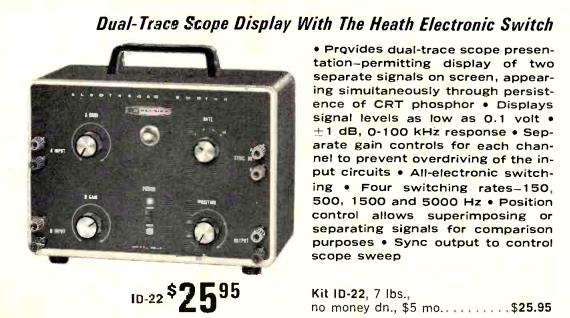
For $25, you could change your scope to dual trace!

There were two common approaches. With alternative or alt mode, you could trigger a sync pulse and draw one trace. Then trigger again and draw the second trace with a fixed voltage offset. If you do this fast enough, it looks like there are two traces on the screen at one time. The other way is to rapidly switch between voltages during the sweep and use the scope’s Z input to blank the trace when it is between signals. This requires a Z input, of course, and a fast switching clock. This is sometimes called “chopper mode” or, simply, chop. This wasn’t just the realm of adapters, though. Even “real” analog scopes that did dual channels used the same methods, although generally with the benefit of being integrated with the scope’s electronics.

Continue reading “Retro Gadgets: Make Your Scope Dual Channel”
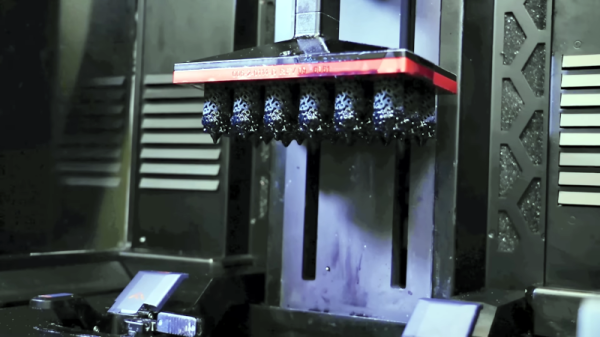
3D Printing Antennas With Dielectric Resin

[Machining and Microwaves] has long wanted to use a 3D printer to print RF components for antennas and microwave lenses. He heard that Rogers — the company known for making PCB substrates, among other things — had a dielectric resin available and asked them if he could try some. They agreed, with some stipulations, including that he had to visit their facility and show his designs in a video. Because of that, the video seems a little bit like a commercial, but we think he is genuinely excited about the possibility of the resin.

Since he was in their facility, he was able to interview several of the people behind the resin, and they had some interesting observations about keeping resin consistent during printing and how the moonbounce feed he wanted to print would work.

Some of the exotic RF test equipment was interesting to see, too. The microwave lenses look like some kind of modern art. According to the Roger’s website:

Radix Printable Dielectric materials are a ceramic-filled, UV-curable polymer designed for use with photopolymer 3D-printing processes like sterolithography (SLA) and digital light processing (DLP) printing. These materials and printing processes enable the use of high-resolution, scalable 3D-printing for complex RF dielectric components such as gradient index (GRIN) lenses or three-dimensional circuits. The 2.8Dk printable dielectric is designed to have low loss characteristics through millimeter wave (mmWave) frequencies and low moisture absorption for end-use applications.

It isn’t clear to us that you could use this resin in your own printers, but they did look pretty similar to what we have hanging around except, perhaps, for the continuous circulation of the resin pool. We figured the resin wasn’t inexpensive. In fact, we found a liter online for $1,863. We don’t know if that’s the suggested retail price or not, but we also suppose if you need this material, you won’t be that surprised at the cost.

If you don’t need microwave frequencies, you might be able to get by with some easier techniques. Or, you can even do something slightly more difficult but probably a lot cheaper.

Continue reading “3D Printing Antennas With Dielectric Resin”

Digital Library Of Amateur Radio And Communications Is A Treasure Trove

Having a big bookshelf of ham radio books and magazines used to be a point of bragging right for hams. These days, you are more likely to just browse the internet for information. But you can still have, virtually, that big shelf of old ham books, thanks to the DLARC — the digital library of Amateur Radio and Communications.

A grant from a private foundation has enable the Internet Archive to scan and index a trove of ham radio publications, including the old Callbooks, 73 Magazine, several ham radio group’s newsletters from around the globe, Radio Craft, and manuals from Icom, Kenwood, Yaesu, and others.

Continue reading “Digital Library Of Amateur Radio And Communications Is A Treasure Trove”

Clear PLA Diffuses LEDs

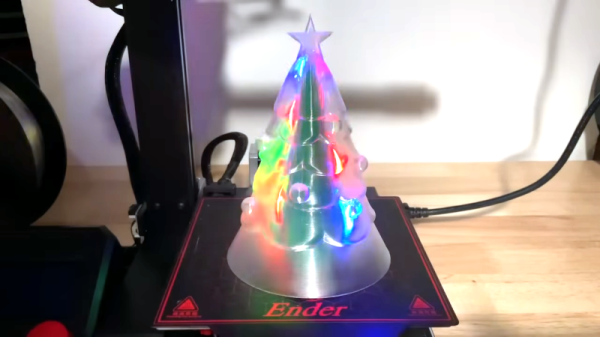
[Chuck] often prints up interesting 3D prints. But we enjoyed his enhancement to a cheap LED Christmas tree kit. The original kit was simply a few green PCBs in the shape of a tree. Cute, but not really something a non-nerd would appreciate. What [Chuck] did, though, is printed a clear PLA overcoat for it and it came out great. You can see how great in the video below.

You might think transparent PLA would be really clear, but because of the layers, it is more translucent than transparent. For an LED diffuser, though, it works great. There are a few things to consider when printing for this purpose. First, you’d think vase mode would be perfect for this, but he found out it didn’t work well — possibly due to something in the model, which was a download from Thingiverse.

Continue reading “Clear PLA Diffuses LEDs”

Quantum Interconnects Get Faster

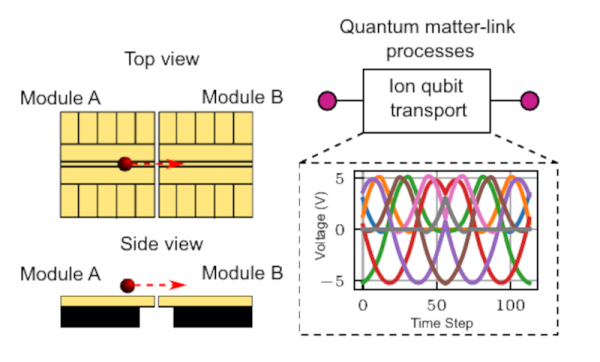
If you are a retrocomputer fan, you might remember when serial ports were a few hundred baud and busses ran at a few megahertz at the most. Today, of course, we have buses and fabric that can run at tremendous speeds. Quantum computing, though, has to start from scratch. One major problem is that jockeying quantum states around for any distance is difficult and slow. Part of it is that qubits decay rapidly, so you don’t have much time. They are also generally susceptible to noise and perturbation by outside forces. So many quantum machines today are limited by how much they can cram on one chip since there isn’t a good way to connect to another chip. The University of Sussex thinks it has improved the outlook for quantum interconnects with a technique they claim can move qubits around at nearly 2,500 links per second.

The technique, called UQ Connect, uses electric field links to connect multiple chips using trapped ions for qubits. If you want to read the actual paper, you can find it in Nature Communications.

Continue reading “Quantum Interconnects Get Faster”

3D Printing With Rice Might Be Nice

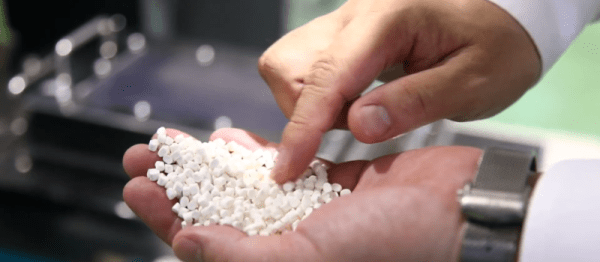
The United Nations Industrial Development Organization recently pointed out a possible replacement for petrochemical-based polymers: rice resin. A Japanese company makes the material from inedible rice and also makes a biodegradable polymer known as Neoryza, which seems to contain some amount of rice as well. The rice resin contains 10 to 70% rice waste. You can see a video with English subtitles about the material below.

According to the video, there is plenty of waste rice. The resulting resin isn’t as toxic as petrochemical-based plastics and doesn’t consume food crops like other plant-based polymers. The video shows the rice resin being extruded like a normal polymer, so it should work like any other thermoplastic.

The video says the properties are similar to petrochemical-based plastics and no special equipment is required to handle it. They also claim that production is easier because, unlike other bioplastics, they don’t generate ethanol as the first part of the process. Waste rice should be cheap to obtain since it is essentially trash today. We aren’t sure what polymers are used in the 90 to 30% of the plastic that isn’t rice, but presumably, that is being brought in as a raw material.

We’ll be interested to see if anyone tries to make 3D printing filament from the stuff. We know that it is being used to replace polyethylene in furniture. We couldn’t help but think about using waste coffee grounds in 3D printing. If you want to compare this to PLA, we’ve talked quite a bit about the corny polymer.

Continue reading “3D Printing With Rice Might Be Nice”

MIT Spins Qubits Round And Round

Quantum computers are coming, but there are still many problems with realizing practical machines. One is finding a reliable and affordable way to encode qubits — the basic unit for quantum computers. MIT researchers have a proposal. By using two slightly different colored lasers, they can manipulate nuclear spin. This isn’t the first time someone’s tried to use light to impact spin, but according to MIT, the other methods use an indirect coupling which is more prone to noise, something that limits the viability of quantum computers. They published a recent paper on the process if you want to read more.

Nuclear spin has weak interactions, but the new method doesn’t require intermediate steps, so it may be much more practical than previous methods. MIT mentions that typical quantum elements have coherence time limits, which means data stored in them becomes useless in less than a second. The new method promises to have coherence times measured in hours.

The method is known as the optonuclear quadrupolar effect or ONQ. From the paper:

[The ONQ effect] is second order in the electric field and nuclear spin I, as mediated by the quadrupole electric coupling, and is thus one of the nonlinear optical (NLO) responses of materials present in perfect crystals. Via the ONQ effect, nuclear spins can be coherently controlled by two-color photons, without electron spins as the media.

If you understood that, you should probably head over and read the rest of the paper. Meanwhile, the rest of us are waiting for our quantum Arduino.