Logic Via DNA

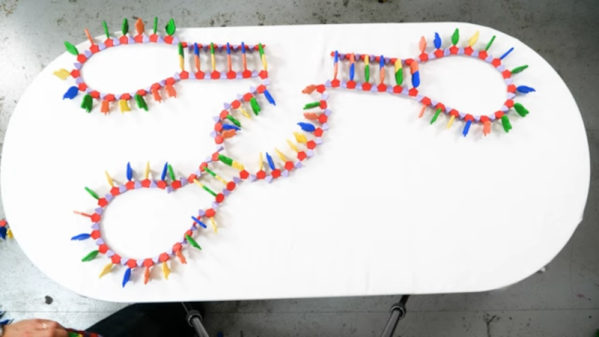
We often say you can make logic gates out of nearly anything. [Steve Mould] would agree as he just finished playing naughts and crosses (tic tac toe if you are an American) with a tray full of DNA. You can see the resulting game and how it works in the video below.

The use of DNA isn’t really significant as it simply implements a logic equation for each of the nine cells. So, for example, each cell is taken by an X (the DNA) only when certain other squares have been taken by O or not taken by O. So you essentially create an AND/OR gate using the state of each cell and its inverse.

Continue reading “Logic Via DNA”

Madness Or Genius? FDM Printing With Resin

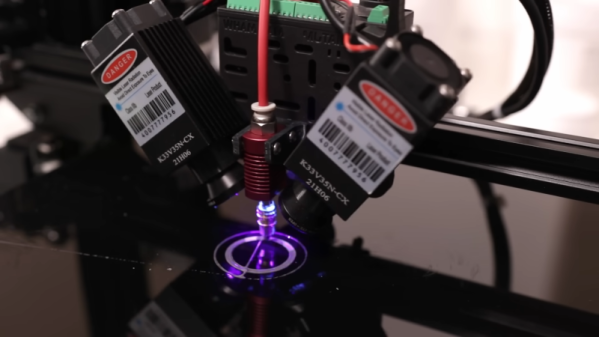
We aren’t sure what made him think of it, but [Proper Printing] decided to make an FDM printer lay down resin instead of filament. Why? We still aren’t sure, but we admire the effort nonetheless. In principle, extruding resin shouldn’t be much different than other liquid things you print like icing or concrete. Then you’d need to UV-cure the viscous liquid quickly. In fact, they wound up making up a paste-like resin using several chemicals and a filler.

Armed with the paste, it would seem like the big obstacles would be over. Instead of part cooling fans, the printer now has two laser heads focused on the print area. Printing in vase mode avoids some problems, but the first few attempts were not very successful.

With a bit of perseverance, the setup did work — for a while. More fine tuning got acceptable results. However, he eventually changed the filler material and got a passable Benchy to print. Nothing to be proud of, but recognizable. Honestly, we were surprised that the laser’s didn’t cure the material still inside the nozzle and cause terrible clogs.

Why put this much effort into doing this? We have no idea. Should you try it? Probably not. Of course, being able to print a paste has its own value. Perhaps delivering glue or solder paste, for example. But you generally won’t need to make tall prints with that kind of material. Then again, we’ve never been opposed to doing something “just because.”

After all, why make a musical instrument out of a Game Boy? Why make a modem with tin cans? You might as well extrude resin.

Continue reading “Madness Or Genius? FDM Printing With Resin”

TV Repair By Mail

I don’t think there was ever a correspondence school called the “Close Cover Before Striking School” but since book matches — which used to be a thing when most people smoked — always had that text on them anyway perhaps there should have been. There was a time when electronic magazines, billboards, and even book matches were constantly bombarding us with ads to have a career in electronics. Or computers. Or TV repair. So while we think of distance learning as a new idea, really it is just the evolution of these old correspondence schools which date back quite some time.

How far exactly? Hard to say. There’s evidence of some distance learning going back as far as 1728. In 1837, there was a correspondence course to learn shorthand. By 1858, the University of London started its external program for correspondence work and the University of Chicago had a home study division in 1892.  Radio was an early choice of topic, too. In the United States, the United Wireless Telegraph company started a training school — later the Marconi Institute — in 1909. However, it is doubtful that there was any correspondence training going on there until much later.

Continue reading “TV Repair By Mail”

Number Stations Gone Wild

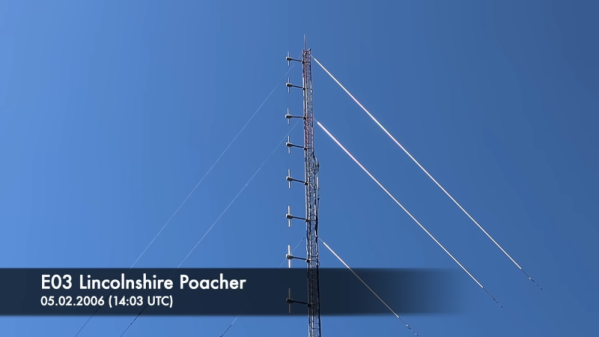
[Ringway Manchester] has an interest in numbers stations. These mysterious stations send presumably coded numbers or other coded information. However, it is rare that anyone claims credit for these stations. Normally they operate with military-like precision, adhering to strict operating schedules and sending out their messages error-free. [Ringway] looks at five times when things didn’t go as planned for these spy stations.

Perhaps it isn’t surprising, however, as machines have likely replaced human operators. That makes them prone to errors when the computers go awry. Many of the errors are ones of frequency, where two number stations wind up transmitting at once. We suppose spies all use the same few frequencies. Some, however, also had computers go haywire and start going through the alphabet which, of course, could have been part of some secret message protocol, but appeared more likely to be a simple mistake.

We were amused, though, to hear the story of a Czech spy station that not only had a licensed call sign but would send QSL cards to people who reported reception. Perhaps they didn’t get the memo about secrecy!

We’ve listened to a few number stations in our time. If you don’t have a suitable antenna, you can always try hunting them online. But don’t expect to catch them making any mistakes.

Continue reading “Number Stations Gone Wild”

Better Sheet Metal Parts With Chemistry

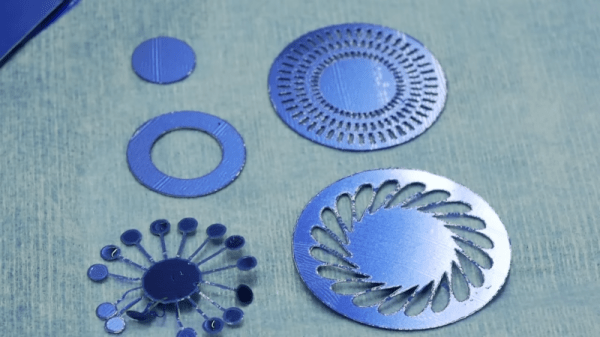
[Applied Science] wanted to make some metal parts with a lot of holes. A service provider charged high tooling costs, so he decided to create his own parts using photochemical machining. The process is a lot like creating PC boards, but, of course, there are some differences. You can see the video of the results, below.

Some of the parts could be made in different ways like water jet cutting or even stamping. However, some things — like custom screens — are only really feasible to do with a chemical process like this.

Continue reading “Better Sheet Metal Parts With Chemistry”

Listen To 64 MHz At Once

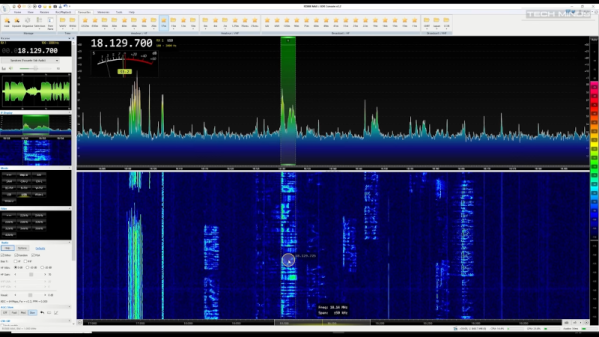
We imagine that if [Tech Minds] told us he was listening to the HF bands, we might ask him which one? His reply might just be “All of them.” That’s thanks to the RX-888 MKII SDR he reviewed which delivers a 64 MHz window on the radio spectrum. You can catch the video review, below.

These are not especially inexpensive, but with that bandwidth and 16-bit resolution, it is worth it if you need that kind of horsepower. There is a separate input for VHF signals 64-1700 MHz where the bandwidth is only 10 MHz, but still.

Of course, making a very wideband front end for something like this is non-trivial, so we wonder how the performance is compared to similar-priced units with less bandwidth. On the other hand, it does seem to work well enough in the video. The software used limited the test to a 32 MHz bandwidth, which is still plenty.

Speaking of software, we noticed that the developers of SatDump and SDR++ are not happy with the state of the software for the RX-888. We aren’t sure if this remains a problem, but the device seemed to work well on the video, at least.

There are many options now when it comes to higher-end SDRs. We like the Pluto for both transmitting and receiving. Of course, the RTL-SDR kind of started everything with hobby SDR, but you can’t expect that much bandwidth with one of those.

Continue reading “Listen To 64 MHz At Once”

Pretty Petite Picolibc Powers Processors

Many times when someone tells you that language X is “better” at something they really mean that it has better built-in libraries for that task. Java is a great example. The language isn’t all that different from C++ outside of garbage collection and multiple inheritance, but the standard libraries are super powerful, especially for networking.  Even C relies on a library to provide a lot of functions people think of as part of the language — printf, for example. That’s not really part of the C language, but just part of the standard library. When you are writing for a tiny processor, the choice of library is critical and [Keith Packard] offers you one choice: picolibc.

The library has its genesis from two other diminutive libraries: Newlib and the AVR version of libc. It provides support for ARC, ARM, i386, m68k, MIPS, MSP430, Nios II, PPC, RISC-V, Sparc64, x86_64, and the ESP8266/ESP32.

Continue reading “Pretty Petite Picolibc Powers Processors”