Yes We Have Random Bananas

If you ask a normal person to pick a random number, they’ll usually just blurt out a number. But if you ask a math-savvy person for a random number, you’ll probably get a lecture about how hard it is to pick a truly random number. But if you ask [Valerio Nappi], you might just get a banana.

His post, which is in two parts, details how what computers generate are actually pseudo-random numbers. You can easily make sure that every number has the same probability of selection as any other number. The problem is that you have to start with something — usually called a seed. For the purposes of playing games, for example, you can grab some source of entropy like how many microseconds since a hardware timer last rolled over, the number of input pulses you’ve received from a mouse lately, or how long you had to wait for the enter key to depress after asking the user to press it. But if you know that seed and the algorithm you can perfectly predict what number the computer will generate next so it isn’t truly random.


Continue reading “Yes We Have Random Bananas”

Safety Not Guaranteed: Flying Motorcycle Might Be Coming Soon

According to [Victor Tangermann] over at Futurism, JetPack Aviation is showing a prototype of its P2 Speeder flying motorcycle and it looks both awesome and — to quote Ralph Nader — unsafe at any speed. The prototype can lift 1,000 pounds, travel at up to 500 miles per hour, and cover up to 400 miles. We assume those things are not at the same time, of course.

As you might expect, the thing isn’t FAA-approved yet and we wonder if it ever will be. The company plans remote control flights later this year and, even later, actual piloted flights. You can see more from Mayman Aerospace which is related to JetPack (which, of course, makes jet packs).

Continue reading “Safety Not Guaranteed: Flying Motorcycle Might Be Coming Soon”

Glass: Classic, But Mysterious

For a large part of human history, people made things from what they could find. Some stones make arrowheads. Others make sparks. Trees can turn into lumber. But the real power is when you can take those same materials and make them into something with very different properties. For example, plant fibers turning into cloth, or rocks giving up the metals inside. One of the oldest engineered materials is glass. You’d think as old as glass is (dating back at least 4,500 years), we’d understand all there is to know about it by now. According to an interesting post by [Jon Cartwright] writing in Physics World, we don’t. Not by a long shot.

According to [Jon] there are at least five “glassy mysteries” that we still don’t understand. Sure, it is easy to just melt sand, soda, and lime — something we’ve talked about before — but, in fact, many materials can turn glassy when cooled quickly from liquid to solid. The problem is, we don’t really understand why that happens. Continue reading “Glass: Classic, But Mysterious”

STEM Award Goes To Accessible 3D Printing Project

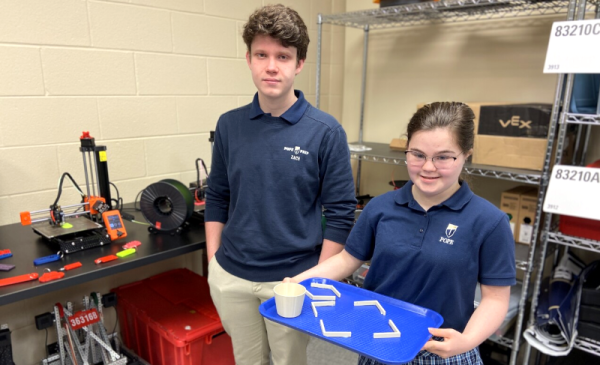
When you are a 15-year old and you see a disabled student drop the contents of their lunch tray while walking to a table, what do you do? If you are [Adaline Hamlin], you design a 3D printed attachment for the trays to stop it from happening again.

The work was part of “Genius Hour” where [Hamlin’s] teacher encouraged students to find things that could be created to benefit others. An initial prototype used straws to form stops to fit plates, cups, and whatever else fit on the tray. [Zach Lance], a senior at the school’s 3D printing club, helped produce the actual 3D printed pieces.

Continue reading “STEM Award Goes To Accessible 3D Printing Project”

PyScript: Python In The Web Browser

A chainsaw can make short work of clearing out the back forty. It can also make a good horror movie. So while some people will say we don’t need another tool to allow more malicious scripting in the browser, we also know that, like any tool, you can use it or abuse it. That tool? PyScript, which is, of course, Python in the browser.

The tool is in the early experimental phase, so the project doesn’t suggest using it in a production environment yet. However, if it works well, the promise is not just that you can write browser-based applications in Python — you’ll have a handy way to reuse existing Python code and even be able to run the same code on the browser that currently runs on the server. This has a lot of implications for improved client/server applications, or cases where you want to be able to run against a local backend when disconnected and a remote backend when you do have a connection. Of course, you can interoperate with JavaScript, too.

Continue reading “PyScript: Python In The Web Browser”

Injekto Injection Machine Reaches 2.0

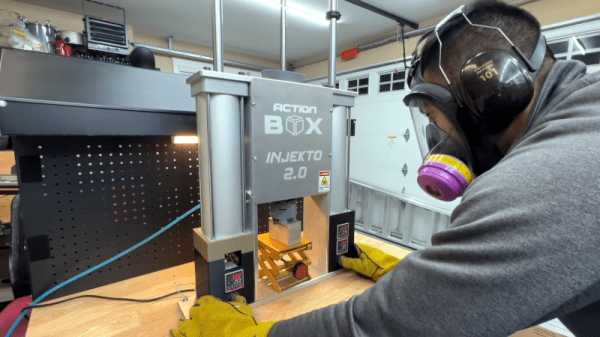
Last time we looked in on Injekto — a homemade plastic injection machine — it was at version 1.0. A recent video from the team that you can see below shows version 2 which is much improved and can work with 3D printed molds. Injection molding takes a lot of pressure and the machine certainly looks stout with lots of machined aluminum.

If you want to skip the build process, you can skip up to around the 9-minute mark. That’s where they show a machined mold and a 3D printed mold being used with the machine.

Continue reading “Injekto Injection Machine Reaches 2.0”

LTSpice Tips And A Long Tutorial

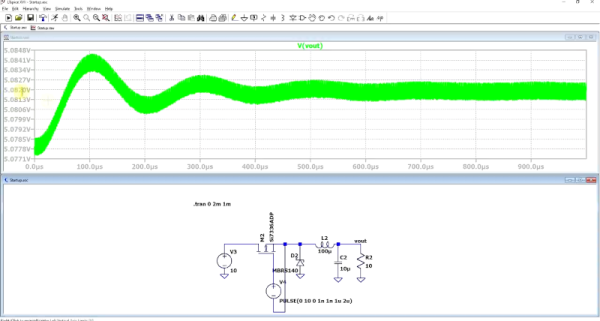
We always enjoy videos from [FesZ], so when we saw his latest about tips and tricks for LTSpice, we decided to put the 20 minutes in to watch it. But we noticed in the text that he has an entire series of video tutorials about LTSpice and that this is actually episode 30. So there’s plenty to watch.

Like any tips and tricks video, you might know some of them and you may not care about some of them — for example, the first one talks about setting the colors which is a highly personal preference.  But it is a good bet you’ll find something to like in the video.

Continue reading “LTSpice Tips And A Long Tutorial”