The (Sodium Chloride) Crystal Method

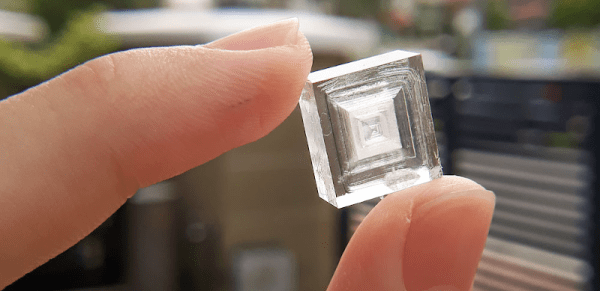
[Chase’s] post titled “How to Grow Sodium Chloride Crystals at Home” might as well be called “Everything You Always Wanted to Know about Salt Crystals (but Were Afraid to Ask).” We aren’t sure what the purpose of having transparent NaCl crystals are, but we have to admit, they look awfully cool.

Sodium chloride, of course, is just ordinary table salt. If the post were simply about growing random ugly crystals, we’d probably have passed over it. But these crystals — some of them pretty large — look like artisan pieces of glasswork. [Chase] reports that growing crystals looks easy, but growing attractive crystals can be hard because of temperature, dust, and other factors.

You probably have most of what you need. Table salt that doesn’t include iodine, a post, a spoon, a funnel, filter paper, and some containers. You’ll probably want tweezers, too. The cooling rate seems to be very important. There are pictures of what perfect seed crystals look like and what happens when the crystals form too fast. Quite a difference! Once you find a perfectly square and transparent seed crystal, you can use it to make bigger ones.

After the initial instructions, there is roughly half the post devoted to topics like the effect growth rate has on the crystal along with many pictures. There are also notes on how to form the crystals into interesting shapes like stars and pyramids. You can also see what happens if you use iodized salt.

If salt is too tame for you, try tin. Or opt for copper, if you prefer that.
PinePhone Speed Up Takes Soldering

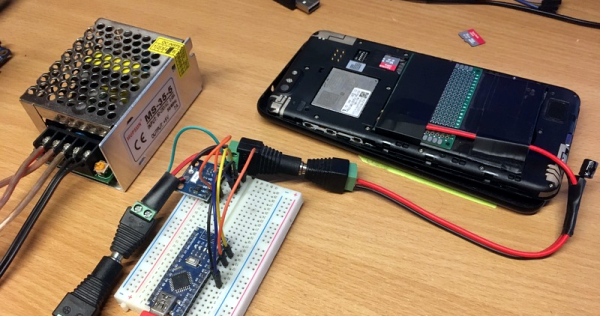
It is no secret that we like a good hack and [Federico Amedeo Izzo] explains a hack for the PinePhone that can double the speed used for the device’s memory chips. Like many good hacks, it all started with a question. [Federico] was reading a review of the PinePhone Pro (the source of the image for this post) and apparently, the eMMC memory in that phone clocks in at about 150 MB/s. The original phone gets about 50-80 MB/s.

Reading some datasheets, it looked like the same chips are in both phones and should support not only DDR52 mode — the mode the original phone uses — but also HS200 and HS400 modes which top out at 200 and 400 MB/s, respectively. But there was one problem.

Continue reading “PinePhone Speed Up Takes Soldering” →

Arduino + Ham Radio = Texting

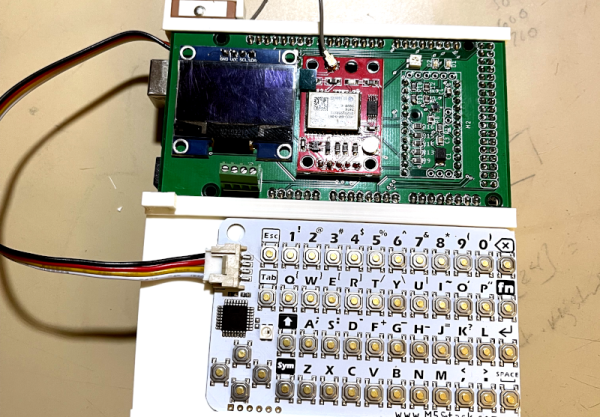
Over on the Spectrum web site, [Dale] — a relatively new ham radio operator — talks about his system for sending text messaging over VHF radios called HamMessenger. Of course, hams send messages all the time using a variety of protocols, but [Dale] wanted a self-contained and portable unit with a keyboard, screen, and a GPS receiver. So he built one. You can find his work on GitHub.

At the heart of the project is MicroAPRS, an Arduino firmware for packet radio. Instead of using a bigger computer, he decided to dedicate another Arduino to do everything but the modem function.

Continue reading “Arduino + Ham Radio = Texting” →

There Were Almost Jet Packs On The Moon

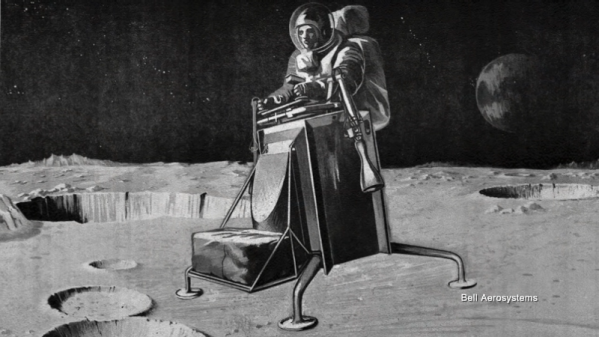
Here it is almost 2022 and we still don’t have our jet packs. But don’t feel bad. NASA astronauts wanted a lunar jetpack, but they didn’t get one either. [Amy] at The Vintage Space has an interesting video about what almost was, and you can see it below.

Of course, a jet pack on the moon would be easier than an Earthbound one. The goal was to allow the crew to range further from their lander since they couldn’t carry very much and the lander didn’t have a lot of consumables, either. In addition, if you lost sight of the lander, getting back could be a problem since navigating on the moon was an unknown skill.

In 1969 awarded exploratory contracts for lunar personal flying vehicles including one to Bell who had their Earth-bound jet pack that shows up every so often for example in Bond movies.

Continue reading “There Were Almost Jet Packs On The Moon” →

Hacking Multiplication With Karatsuba’s Algorithm

People tend to obsess over making computer software faster. You can, of course, just crank up the clock speed and add more processors, but often the most powerful way to make something faster is to find a better way to do it. Sometimes those methods are very different from how a human being would do the same task, but it suits the computer’s capabilities. [Nemean] has a video explaining a better multiplication algorithm known as Karatsuba’s algorithm and it is actually quite clever. You can see the video below.

To help you understand the algorithm, the video shows a simple two-digit by two-digit multiplication. You can see that the first and last digits are essentially the result of one multiplication. It is all the intermediate digits that add together. The only thing that might change the first digit is a carry.

Continue reading “Hacking Multiplication With Karatsuba’s Algorithm” →

Binaural Hearing Modeled With An Arduino

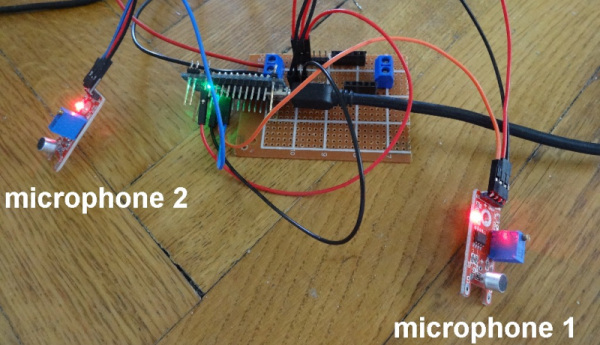
You don’t have two ears by accident. [Stoppi] has a great post about this, along with a video you can see below. (The text is in German, but that’s what translation is for.) The point to having two ears is that you receive audio information from slightly different angles and distances in each ear and your amazing brain can deduce a lot of spatial information from that data.

For the Arduino demonstration, cheap microphone boards take the place of your ears. A servo motor points to the direction of sound. This would be a good gimmick for a Halloween prop or a noise-sensitive security camera.

Continue reading “Binaural Hearing Modeled With An Arduino” →

Tech In Plain Sight: Eyeglasses

Glasses wearers, try a little experiment. Take off your glasses and look at this page or, at least, at something you can’t see well without your glasses. Now imagine if you lived in a time where there was nothing to be done about your vision. If you wear contacts or you have good vision — perhaps you had surgery — then congratulations. But for most of us, vision changes with age are a fact of life. Even many young people need glasses or some other intervention to get good eyesight. At first glance, you might think eyeglasses are an obvious invention, but it turns out we didn’t get real glasses for quite some time and modern glasses are truly a piece of high tech that hides — quite literally — right in front of your face.

Continue reading “Tech In Plain Sight: Eyeglasses” →