Abraham Wald’s Problem Solving Lesson Is To Seek What’s Not There

You may not know the name Abraham Wald, but he has a very valuable lesson you can apply to problem solving, engineering, and many other parts of life. Wald worked for the Statistical Research Group (SRG) during World War II. This was part of a top secret organization in the United States that applied elite mathematical talent to help the allies win the war. Near Columbia University, mathematicians and computers — the human kind — worked on problems ranging from how to keep an enemy plane under fire longer to optimal bombing patterns.

One of Wald’s ways to approach problem was to look beyond the data in front of him. He was looking for things that weren’t there, using their absence as an additional data point. It is easy to critique things that are present but incorrect. It is harder to see things that are missing. But the end results of this technique were profound and present an object lesson we can still draw from today.

Continue reading “Abraham Wald’s Problem Solving Lesson Is To Seek What’s Not There”
Ping-Pong Ball Makes Great PID Example

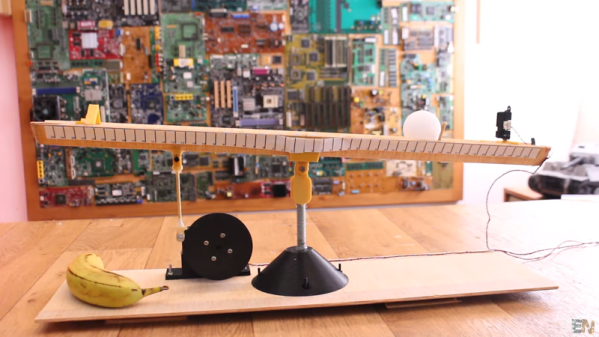
It is a common situation in electronics to have a control loop, that is some sort of feedback that drives the input to a system such as a motor or a heater based upon a sensor to measure something like position or temperature. You’ll have a set point — whatever you want the sensor to read — and your job is to adjust the driving thing to make the sensor read the set point value. This seems easy, right? It does seem that way, but in realitythere’s a lot of nuance to doing it well and that usually involves at least some part of a PID (proportional, integral, derivative) controller. You can bog down in math trying to understand the PID but [Electronoobs] recent video shows a very simple test setup that clearly demonstrates what’s going on with an Arduino, a motor, a distance sensor, and a ping-pong ball. You can see the video below.

Imagine for a moment heating a tank of water as an example. The simple approach would be to turn on the heater and when the water reaches the setpoint, turn the heater off. The problem there is though that you will probably overshoot the target. The proportional part of a PID controller will only turn the heater fully on when the water is way under the target temperature. As the water gets closer to the right temperature, the controller will turn down the input — in this case using PWM. The closer the sensor reads to the setpoint, the lower the system will turn the heater.

Continue reading “Ping-Pong Ball Makes Great PID Example”

BootBasic Fits Your Favorite Language In The Boot Sector

Humans seem to have a need to do things that aren’t practical. Make the biggest ball of twine. Engrave the Declaration of Independence on a grain of rice. We want to make things bigger, smaller, faster, or whatever. That might explain why [nanochess] put out bootBASIC.

The 8088 (or later) assembly code gives you a very restricted BASIC interpreter that you can boot up. That means it has to fit in the 512-byte boot block that the hardware loads to get an operating system running. How restricted? Keep in mind it fits in 512 bytes. Each line can only have 19 characters or less. Backspace works, but doesn’t update the screen. Line numbers range from 1 to 999 and there are only 26 integer variables named a through z that hold 16 bits. All statements are in lower case.

Continue reading “BootBasic Fits Your Favorite Language In The Boot Sector”

Add Scripting To Your C++ Programs With ChaiScript

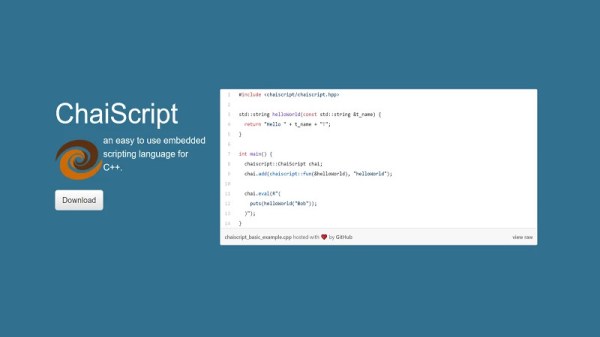
If you are writing a program that has a technical user base, it is a nice touch to make the program scriptable. In fact, you might want to do the hard work in a programming language and then use your scripting language to build out features. In theory, this should be easy. There are plenty of embedded scripting libraries and they provide some way for your code to access script resources and for script resources to access selected host variables and functions. If you use C++, one of the easier ways to do this is with ChaiScript.

ChaiScript is BSD licensed and — assuming your compiler supports C++ 14 — it is as easy as including a header file and making a few calls. There are no special tools or libraries required. The code is portable between operating systems, including both 32-bit and 64-bit Windows. It is also threadsafe unless you turn that feature off.
Continue reading “Add Scripting To Your C++ Programs With ChaiScript”

Deducing Stepper Motor Wiring

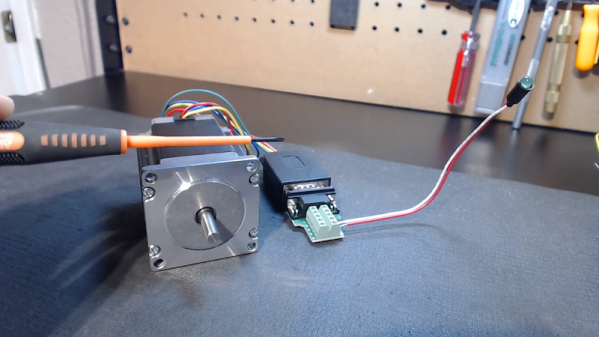
There are a lot of fun projects you can do with stepper motors salvaged from old printers or disk drives. However, it isn’t always clear how to connect to some strange motor with no markings or schematics. [Corvetteguy50] has a video showing his trick for working out the connections easily, and you can see it below.

The basic idea is simple. Using a special jig, he connects an LED across two random pins and spins the motor. If the LED lights, you’ve found a coil. You just don’t know which coil, yet. You can also short two wires and note when you feel resistance when you spin the shaft.

Continue reading “Deducing Stepper Motor Wiring”

MQTT Deep Dive

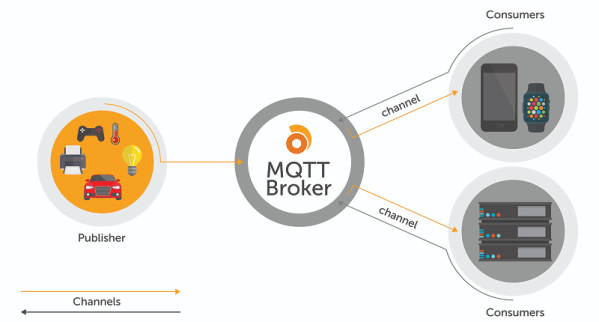
If you read Hackaday, it is a good bet you’ve heard of MQTT — Message Queueing Telemetry Transport. If you’ve not used MQTT before, you should check out Ably’s [Kayla Matthews’] post entitled  MQTT: A Conceptual Deep Dive paper. She does mention their MQTT protocol connector at the end, and has a few notes about Ably’s products, but most of the post is a normal white paper and has a lot of good info.

MQTT’s claim to fame, of course, is that it is very tiny and is made to minimize power consumption compared to heavier-weight protocols. When you are trying to provide or consume data from a device that has to last a year on a coin cell, MQTT is your friend.

Continue reading “MQTT Deep Dive”

Tea Bot Solves Another First World Problem

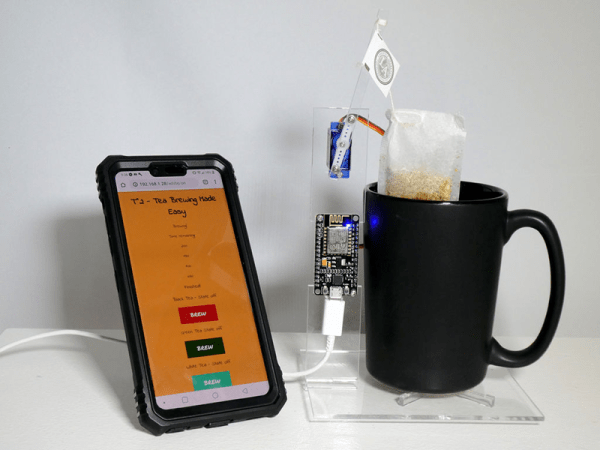
In the movie Wall-E, future humans live in floating chairs and have everything done for them. Today, we grumble if we have to go to physically find a light switch or a remote control. How far away can floating chairs with screens be? T2, the Tea Bot, gets us one step closer to that. Using a laser-cut frame, an ESP8266, and a servo motor, the T2 brews your tea for exactly the right amount of time.

We were kind of hoping the robot would at least dunk the tea bag in and out, but it does provide a web interface that lets you select the brew. Of course, the code is available, so you could make modifications — maybe turn on a hotplate underneath the cup.

Continue reading “Tea Bot Solves Another First World Problem”