CB Radio + Arduino = 6 Meter Ham Band

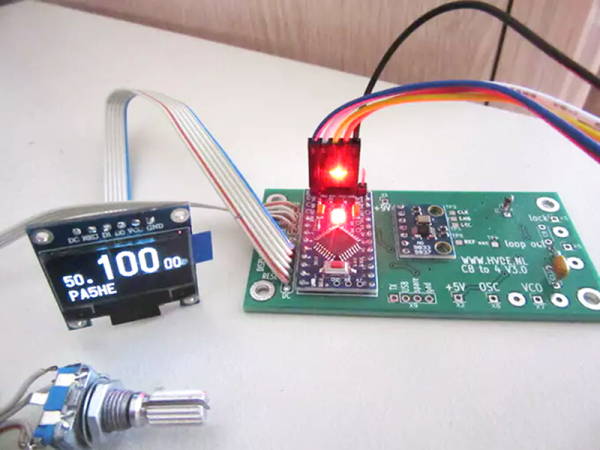
Somehow [hvde] wound up with a CB radio that does AM and SSB on the 11 meter band. The problem was that the radio isn’t legal where he lives. So he decided to change the radio over to work on the 6 meter band, instead.

We were a little surprised to hear this at first. Most radio circuits are tuned to pretty close tolerances and going from 27 MHz to 50 MHz seemed like quite a leap. The answer? An Arduino and a few other choice pieces of circuitry.

Continue reading “CB Radio + Arduino = 6 Meter Ham Band”

Resin Printers Are Now Cheaper, Still Kind Of A Hassle

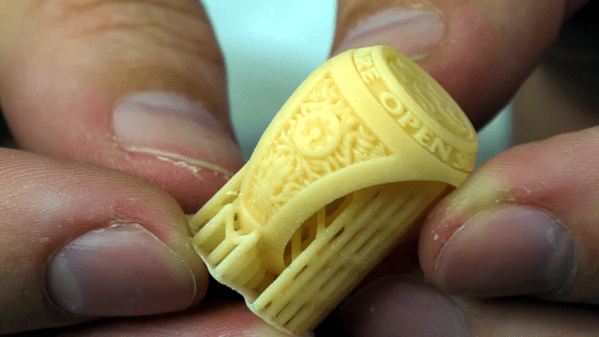
Your run-of-the-mill desktop 3D printer is based on a technology known as Fused Deposition Modeling (FDM), where the machine squirts out layers of hot plastic that stick to each other. But that’s not the only way to print a Benchy. One of the more exotic alternative techniques uses a photosensitive resin that gets hardened layer by layer. The results are impressive, but historically the printers have been very expensive.

But it looks like that’s finally about to change. The [3D Printing Nerd] recently did a review of the Longer3D Orange 10 which costs about $230, less than many FDM printers. It isn’t alone, either. Monoprice has a $200 resin printer, assuming you can find it in stock.

The resin isn’t cheap and it’s harder to handle than filament. Why is it harder to handle? For one is smells, but more importantly, you aren’t supposed to get it on your skin. The trade off is that the resulting printed parts look fantastic, with fine detail that isn’t readily possible with traditional 3D printing techniques.

Some resin printers use a laser to cure resin at particular coordinates. This printer uses an LCD to produce an image that creates each layer. Because the LCD exposes all the resin at one time, each layer takes a fixed amount of time no matter how big or detailed the layer is. Unfortunately, using these displays means the build area isn’t very large: the manufacturer says it’s 98 by 55 millimeters with a height of up to 140mm. The claimed resolution, though, is 10 microns on the Z-axis and 115 microns on the LCD surface.

Getting the prints out of the printer requires you to remove the uncured resin. In the video, they used a playing card and two alcohol baths. After you remove the uncured resin, you’ll want to do a final curing step. More expensive printers have dedicated curing stations but on this budget printer, you have to cure the parts separately. How? By leaving them out in the sun. Presumably, you could use any suitable UV light source.

There are a few other similar-priced options out there. Sparkmaker, Wanhao (resold by Monoprice). If you’re willing to spend more, Prusa has even thrown their orange hat into the ring. If you were wondering if you could use the LCD in your phone to do this, the answer is sort of.

Continue reading “Resin Printers Are Now Cheaper, Still Kind Of A Hassle”

L Band Satellite Antennas Revealed

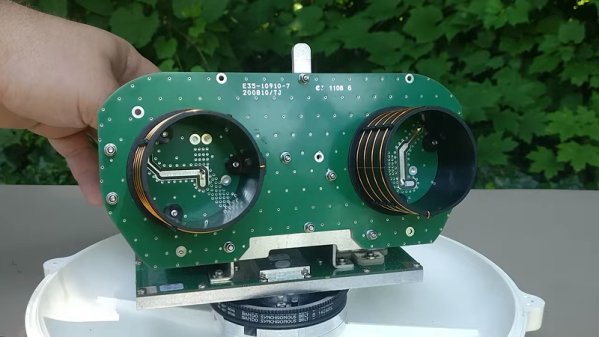
[SignalsEverywhere] has a lot of satellite antennas and he’s willing to show them off — inside and out — in his latest video that you can see below. Using software-defined radio techniques, you can use these antennas to pull off weather satellite images and other space signals.

A lot of these antennas are actually made for some commercial purpose like keeping ships connected to Inmarsat. In fact, the shipborne antenna has a nice motorized system for pointing the antenna that [SignalsEverywhere] is hoping to modify for his own purposes.

With what appears to be standard NEMA 17 steppers onboard, it should be relatively easy to supplant the original controller with an Arduino and CNC shield. Though considering the resale value these particular units seem to have on eBay, we might be inclined to just roll our own positioner.

The QHF QFH antenna is another interesting teardown. The antenna makes a helix shape and looks like it would be interesting to build from scratch. There isn’t a lot of details about the antenna designs, but it is interesting to see the variety and range of antennas and how they appear internally.

L band is from 1 GHz to 2 GHz, so signals and antennas get very strange at these frequencies. The wavelength of a 2GHz signal is only 15cm, so small antennas can work quite well and are often as much mechanical designs as electrical. The L band contains everything from GPS to phone calls to ADS-B.

We’ve seen radiosonde antennas reborn before. Dish antenna repurposing is also popular.

Continue reading “L Band Satellite Antennas Revealed”

Maybe The Oldest Computer, Probably The Oddest

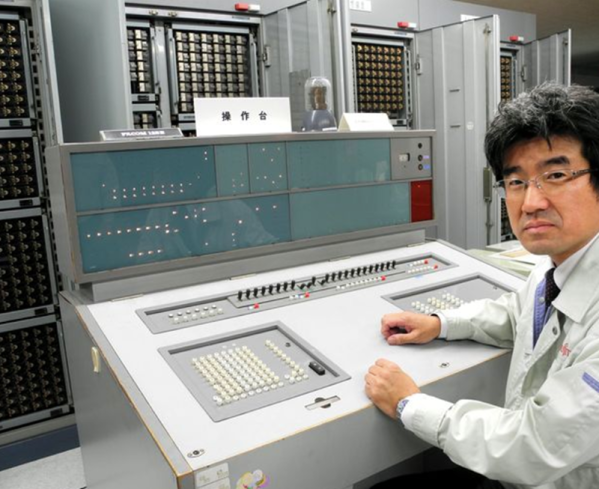
[Tadao Hamada] works for Fujitsu Tokki, a subsidiary of the more famous Fujitsu. In 1956, Fujitsu decided to compete with IBM and built a relay-based computer, the FACOM128. The computer takes up 70 square meters and weighs about 3 tons. By 1959, they’d learned enough to make a FACOM128B model that was improved. [Hamada’s] job is to keep one of these beasts operational at Fujitsu’s Numazu plant. According to the Japanese Computer Museum, it may be the oldest working computer.

Continue reading “Maybe The Oldest Computer, Probably The Oddest”

Memristor Computing On A Chip

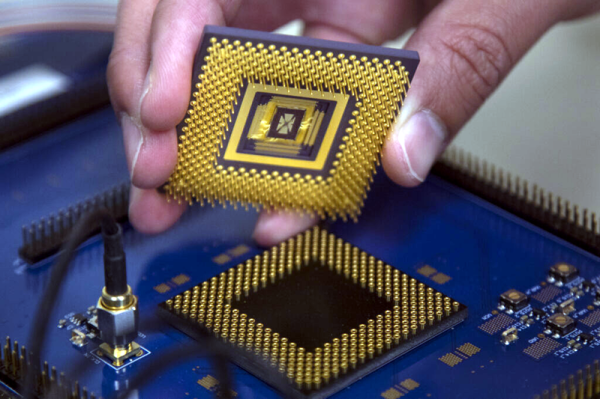
Memristors have been — so far — mostly a solution looking for a problem. However, researchers at the University of Michigan are claiming the first memristor-based programmable computer that has the potential to make AI applications more efficient and faster.

Because memristors have a memory, they can accumulate data in a way that is common for — among other things — neural networks. The chip has both an array of nearly 6,000 memristors, a crossbar array, along with analog to digital and digital to analog converters. In fact, there are 486 DACs and 162 ADCs along with an OpenRISC processor.

Continue reading “Memristor Computing On A Chip”

How To Build A CubeSat

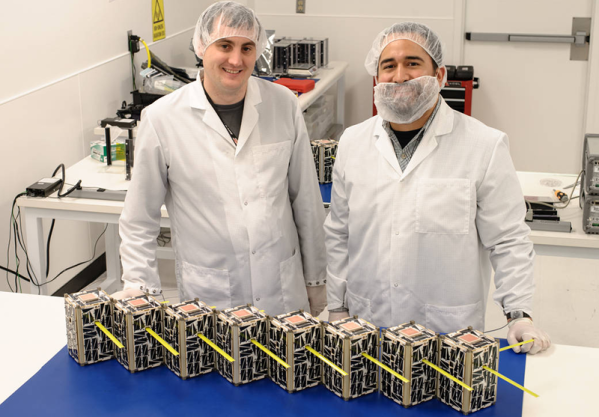
There was a time when building your own satellite and having it placed into orbit would have been a wild dream. Now it is extremely possible, but still not trivial. A CubeSat is a very small satellite that can hitch a ride with a bigger satellite or get tossed out of a friendly space station. This week’s issue of The Orbital Index has a very good overview of what all is required. It also contains a great selection of links to get more information.

At first glance, it seems like it would be pretty simple. A computer, a battery, and some solar cells. Well, you probably want to hear back from it, so then you need a radio. Oh, and an antenna. But the antenna can’t stick out during launch so you need a way to deploy it. If you want the satellite to point somewhere, you’ll need things for that, too. Some CubeSats even have tiny thrusters to affect their orbit.

Continue reading “How To Build A CubeSat”

Computer Optimized 3D Printed Bookshelves

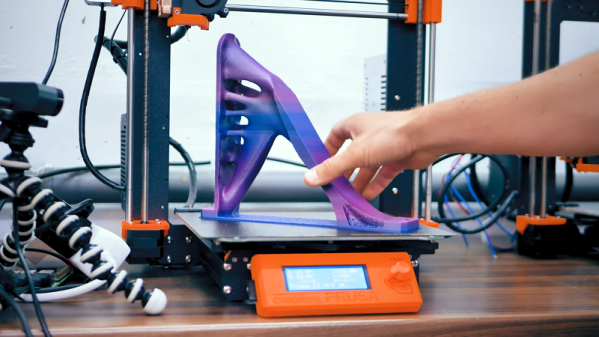
[Thomas] does a lot of interesting experiments with 3D printing and lately, he’s been using the free version of Fusion 360 to do topology optimization. He started with a blocky bookshelf bracket and let the software analyze the loads so it can remove pieces that don’t contribute a lot to the bracket’s strength. This uses less material, prints faster, and — [Thomas’] biggest goal — looks cool.

If you know [Thomas] you know he didn’t just hope the brackets would be strong enough. He made prototypes and destroyed them in testing. Despite being printed in a poor orientation for strength, the models held a good bit of weight.

Continue reading “Computer Optimized 3D Printed Bookshelves”