Braille Keyboard Finds Its Voice

If you have a serious visual impairment, using a computer isn’t easy. [Dhiraj] has a project that allows people fluent in Braille to use that language for input. In addition to having a set position for fingers, the device also reads the key pressed as you type. With some third party software it is possible to even create Word documents, according to [Dhiraj].

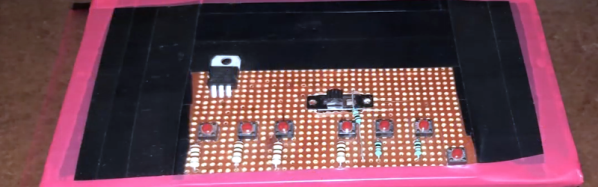
You can see the finished product in the video below. This is one of those projects where the idea is the hardest part. Reading six buttons and converting them into characters is fairly simple. Each Braille character uses a cell of six bumps and the buttons mimic those bumps (although laid out for your fingers).

Continue reading “Braille Keyboard Finds Its Voice”

Reverse Engineering Dropbox

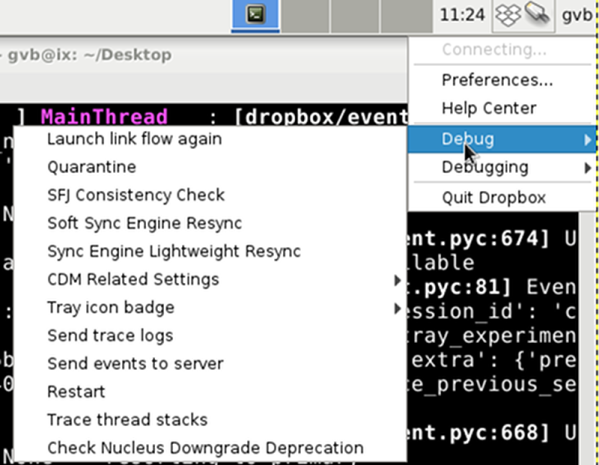
These days everyone talks about data “in the cloud.” However, before that phrase was fashionable, there were a few pioneers and one of the most famous of these is Dropbox — a service that let you store files on a remote server that dates back to 2007. [Vincent Berg] first noticed some odd network traffic on a hotel network, and figured out that it was a feature of Dropbox that allows computers on the same network to update each other. This led him to start investigating the undocumented Dropbox protocol and reverse engineering the Linux client.

We won’t ask why [Vincent] was poking around the hotel network to start with. However, a cursory glance at the Dropbox client gave away that it was using Python. The byte-compiled classes were — at the time — in a ZIP file added to the executable (which was nothing but a modified copy of Python). The files were encrypted, but [Vincent] used a clever technique. He built a shared object using normal Python and put a backdoor in it that gave him access to the Dropbox Python interpreter.

Continue reading “Reverse Engineering Dropbox”

The Kalman Filter Exposed

If we are hiring someone such as a carpenter or an auto mechanic, we always look for two things: what kind of tools they have and what they do when things go wrong. For many types of embedded systems, one important tool that serious developers use is the Kalman filter. It is also something you use when things go “wrong.” [Carcano] recently posted a tutorial on Kalman filter equations that tries to demystify the topic. His example — a case of things going wrong — is when you have a robot that knows how far it is supposed to move and also has GPS coordinates of its positions. Since the positions probably don’t agree, you can consider that a problem with the system.

The obvious answer is to average the two positions. That’s fine if the error is small. But a Kalman filter is much more robust in more situations. [Carcano] does a good job of taking you through the math, but we will warn you it is plenty of math. If you don’t know what a Gaussian distribution is or the word covariance makes you think of sailboats, you are going to have to do some reading to get through the post.

Continue reading “The Kalman Filter Exposed”

Robot Hummingbird Imitates Nature

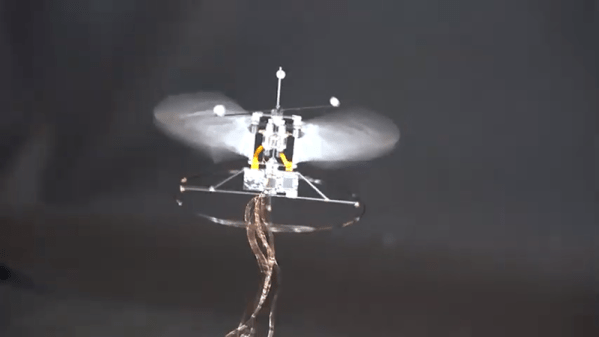
Purdue’s Bio-Robotics lab has been working on a robotic hummingbird and, as you can see in the videos below, have had a lot of success. What’s more, is they’ve shared that success on GitHub. If you want to make a flapping-winged robot, this is definitely where you start.

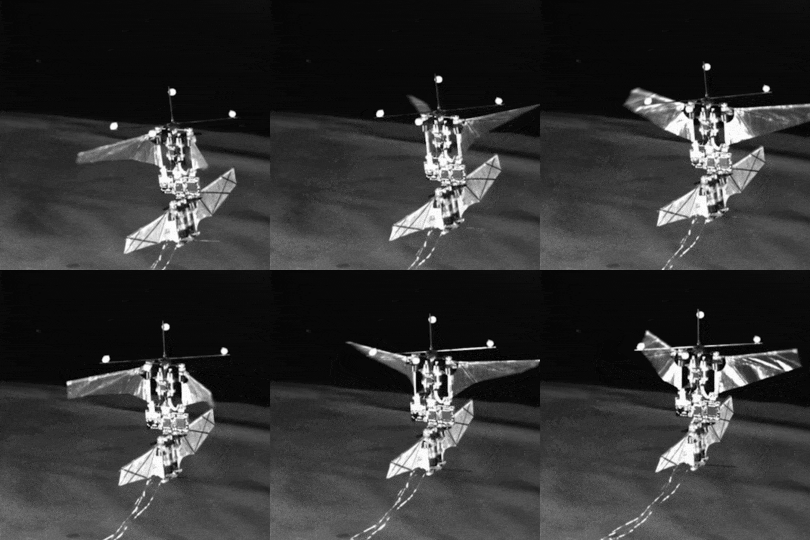
If you’ve ever watched a hummingbird, you know their flight capability is nothing short of spectacular. The Purdue robot flies in a similar fashion (although on a tether to get both power and control information) and relies on each wing having its own motor. The motors not only propel the wings but also act as sensors. For example, they can detect if a wing is damaged, has made contact with something, or has changed performance due to atmospheric conditions.

In addition to the tethered control system, the hummingbird requires a motion capture sensor external to itself and some machine learning. Researchers note that there is sufficient payload capacity to put batteries onboard and they would also need additional sensors to accomplish totally free flight. It is amazing when you realize that a real hummingbird manages all this with a little bitty brain.

The published code is in Python and is part of three presentations later this month at a technical conference (the IEEE International Conference on Robotics and Automation).  If you don’t want to wait on the paper, there’s a post on IEEE Spectrum about the robotic beast, available now and that article contains preprint versions of the papers. The Python code does require a bit to run, so expect a significant flight computer.

The last hummingbird bot we saw was a spy. We’ve also seen robots that were like bees — sort of.

Continue reading “Robot Hummingbird Imitates Nature”

Mathics: How To Do Hard Math When You’re Not An MIT Janitor

Algebra is the bane of many a student, but it is surprisingly useful when it comes to electronics. Sure, you can just memorize all the permutations of things like Ohm’s law. But it is better if you can remember one form and deduce the others on the fly.

There are many occasions where you — as our old Algebra teacher used to say — need to use what you know to get what you don’t know. The gold standard, of course, is a computer program called Mathematica. For home and student use, the software is “only” about $160-$600, but commercial versions range from about $1,000 to nearly $8,000. Of course, there are free alternatives, and the one we’re looking at today is Mathics. It will run in your browser or as a desktop application powered by Python, and it’s available for free.

The program does a nice job of displaying mathematical formulae and you can get an idea of its power by visit the online version. which has examples if you click the question-mark in the upper right and look for the fourth item down. There’s also a standalone version of the online help.
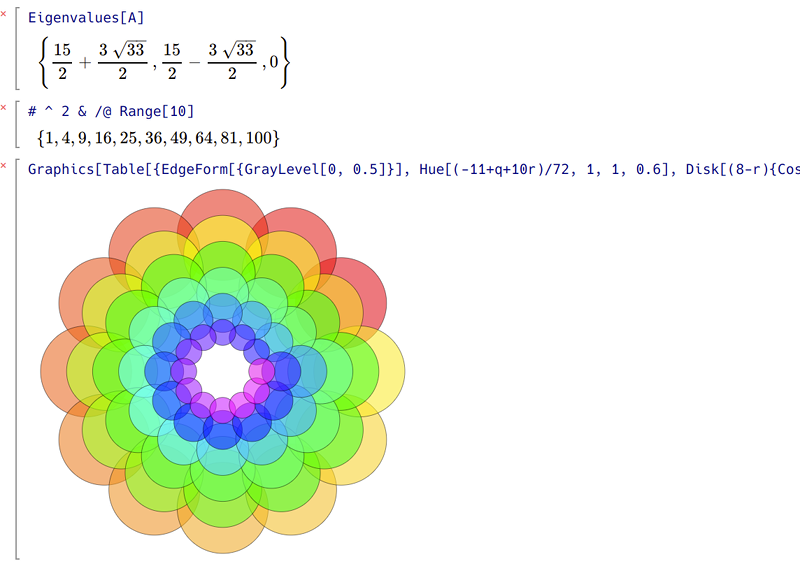
We did have a little trouble with some of the gallery examples timing out, as well as the site certificate being expired. We also had a bit of difficulty remembering the linear algebra classes we took a long time ago! If you want something easy to play with try this:

Solve[4x+3==20,x]

Don’t forget to press Shift+Enter in the browser to get the solution.

Under the hood, MathJax and SymPy do a lot of the heavy lifting. In fact, we imagine a lot of the program’s intended audience would wind up using Jupyter notebooks with Python underneath. Of course, there are copies of Wolfram software on stock Raspberry Pi’s, too.

Pluto (SDR) Goes Ethernet

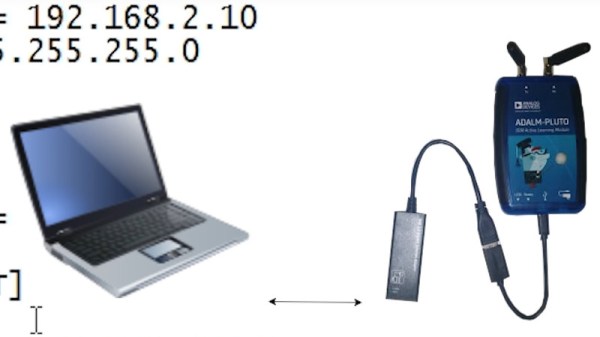
Pluto may no longer be a planet, but it is still a fun software defined radio (SDR) set up from Analog Devices. The inexpensive radio uses a USB connector and looks somewhat like a network connection to your PC. But what if you want to really use it with a network? [SignalsEverywhere] shows you how to do it using a USB network adapter and a USB connection adapter.

Just plugging a USB dongle into the box isn’t sufficient, an extra power supply is required as well as a minor bit of configuration. The IP address will be static so you might want to use an IP that your DHCP server won’t hand out, or reserve the IP on your local network.

Continue reading “Pluto (SDR) Goes Ethernet”

Dark Absorbing Diodes Are No DAD Joke

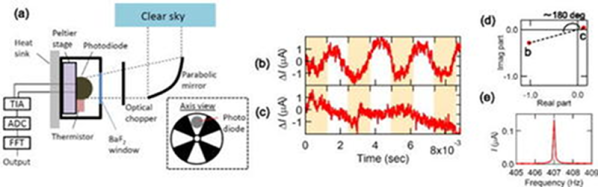
We will confess that the authors of the Applied Physics Letters article “Experimental Demonstration of Energy Harvesting from the Sky using the Negative Illumination Effect of a Semiconductor Photodiode” never used the acronym DAD or the phrase “dark absorbing diode.” But we thought it was too good to pass up. The research work uses a type of diode to generate small amounts of power from darkness. Admittedly, the amount of power is small, but it is still an important result and could result in — another coined phrase — negative solar cells providing energy by taking advantage of the temperature differential between the cell and the night sky.

In theory — and with no atmosphere — the technique could only result in about 4 watts per square meter. Not only is this low compared to a solar panel’s 100 to 200 watts per square meter, but it is also far from the prototype’s 64 nanowatts per square meter. Clearly, this technology has a ways to go to become practical.

Continue reading “Dark Absorbing Diodes Are No DAD Joke”