Swiss Cheese Metamaterial Is An Analog Computer

If you have had trouble with ordinary calculus, you may not be pleased to hear about “photonic calculus” — a recent idea from [Nader Engheta] of the University of Pennsylvania. The idea is that materials with certain properties could manipulate an electromagnetic wave in a way to solve a specific mathematical equation. [Engheta] proposed this idea back in 2014 and recently announced that he and his team have a demonstration device that proves the concept. The analog computer is about twice the size of an airplane’s tray table and made of CNC-shaped polystyrene. It solves Fredholm integral equations of the second kind.

The analog computer uses microwaves for the input and the polystyrene acts as a dielectric full of air holes. The team likens its structure to that of Swiss cheese. The shape is generated through an inverse design process which builds the shapes from known solutions to the equations. That means a particular set of shapes will do one specific equation. The equation could, for example, model the sound volume in a concert hall. You can encode certain parameters in the input wave and the output would specify the volume at different locations. However, a change to the actual equation would require a new set of plastic pieces.

The computation is very fast. Using microwaves, the answer comes out in a few hundred nanoseconds — a speed a conventional computer could not readily match. The team hopes to scale the system to use light which will speed the computation into the picosecond range. Creating a new optical analog computer could be similar to how we burn a CD or DVD today.

Analog computers predate digital ones by a lot. We really want to build one like [Bill Schweber’s]. Then again, we wouldn’t mind finding a Donner 3500 at a hamfest, either.


Fortran Goes Interactive

When you think of Fortran you probably think of punched cards and green bar paper. While it is true that Fortran isn’t the go-to language it used to be — pun unintentional — it still has a vibrant community of people who do serious number crunching. However, many members of that community have been seduced away by interactive tools that are also good at number crunching like MATLAB, Julian, and Python with special libraries. The LFortran project aims to create a Fortran environment with interactivity like Python, but retaining the speed that Fortran is known for.

The resulting tool is impressive. You can use it from Jupyter, can parse code targeting existing Fortran compilers, and supports Linux, Mac, and Windows. There is development to make the code fully interoperable with other languages like C or Python as well as take advantage of GPUs and other specialized hardware. They are also zeroing in on full Fortran 2018 support.

Continue reading “Fortran Goes Interactive”

Easter Egg Turns Nintendo Switch Into A Development Platform

Like a lot of game developers [Amir Rajan] likes to put Easter Eggs into his creations. His latest Nintendo Switch title, A Dark Room, has a very peculiar one, though. Instead of a graphic or a Tetris game, [Amir] put a code editor and a Ruby interpreter in the game.

Ruby is a language that originated in Japan and is popular with Web developers, in particular. It has dynamic typing, garbage collection, and supports several different programming styles. We aren’t sure what you’d do with it on a Nintendo Switch, but any time we can program a gadget, it makes us happy.

Continue reading “Easter Egg Turns Nintendo Switch Into A Development Platform”

Parametric Amplifiers And Varactors

It is hard to imagine a time without active amplification. However, if you go back far enough, radio communications started in an era where generating RF required something like a spark gap and reception was only possible if the signal was strong enough at the antenna — like with a crystal radio. It would be a few years before tubes allowed both transmitted and receiving signals to be electronically amplified and longer still before transistors that would work at radio frequency appeared. However, even active devices have had their limitations and the parametric oscillator and amplifier are ways around some of those problems.

These were more popular in the 1970s when it was harder to get transistors that would work at very high frequencies. They are still useful when you need very low noise amplification. In addition, the same effect is used in optical devices and you can even observe the effect in mechanical devices.

What Is It Exactly?

The phrase parametric means that the amplification or oscillation occurs because of the change in a parameter of the system. A simple example would be a variable capacitor. We know the charge in a capacitor is equal to the capacitance times the voltage across the unit. That also implies that, if charge is known, we can know the voltage by dividing the charge by the capacitance. To put it in numerical terms, if  a 0.1 farad capacitor has 12V across it, the charge is 1.2 coulombs. Suppose our input signal is 12V and we let the capacitor charge up to that value. Then we twist the capacitor’s knob to give it a value of 0.05 farad. The charge can’t change, so now we have 24 volts across the capacitor. That’s an amplification of 2 times. These values, of course, are not practical. Nor is it practical to twist a capacitor knob constantly to amplify. However, it is a good analog of how a parametric amplifier works.

Continue reading “Parametric Amplifiers And Varactors”

Scientists Create Speech From Brain Signals

One of the things that makes us human is our ability to communicate. However, a stroke or other medical impairment can take that ability away without warning. Although Stephen Hawking managed to do great things with a computer-aided voice, it took a lot of patience and technology to get there. Composing an e-mail or an utterance for a speech synthesizer using a tongue stick or by blinking can be quite frustrating since most people can only manage about ten words a minute. Conventional speech averages about 150 words per minute. However, scientists recently reported in the journal Nature that they have successfully decoded brain signals into speech directly, which could open up an entirely new world for people who need assistance communicating.

The tech is still only lab-ready, but they claim to be able to produce mostly intelligible sentences using the technique. Previous efforts have only managed to produce single syllables, not entire sentences.

Continue reading “Scientists Create Speech From Brain Signals”

Radio Piracy On The High Seas: Commercial Demand For Taboo Music

The true story of pirate radio is a complicated fight over the airwaves. Maybe you have a picture in your mind of some kid in his mom’s basement playing records, but the pirate stations we are thinking about — Radio Caroline and Radio Northsea International — were major business operations. They were perfectly ordinary radio stations except they operated from ships at sea to avoid falling under the jurisdiction of a particular government.

Back then many governments were not particularly fond of rock music. People wanted it though, and because people did, advertisers wanted to capitalize on it. When people want to spend money but can’t, entrepreneurs will find a way to deliver what is desired. That’s exactly what happened.

Of course, if that’s all there was to it, this wouldn’t be interesting. But the story is one of intrigue with armed boardings, distress calls interrupting music programs, and fire bombings. Most radio stations don’t have to deal with those events. Surprisingly, at least one of these iconic stations is still around — in a manner of speaking, anyway.

Continue reading “Radio Piracy On The High Seas: Commercial Demand For Taboo Music”

Power Measurement Oscilloscope Style

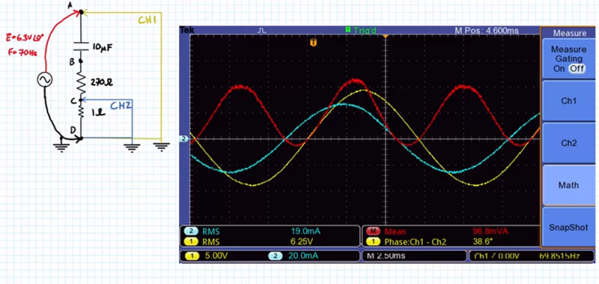
If you want to measure voltage you reach for a voltmeter. Current? An ammeter. Resistance? An ohmmeter. But what about measuring AC power? A watt meter? Usually. But if you know what to do, you could also reach for your oscilloscope. If you don’t know what to do, [Jim Pytel] has the video answers for you. Truth is, an oscilloscope can measure almost anything if you know how. [Jim] shows how to measure the voltage and current in a circuit and then it is simply a matter of doing a little math, something modern scopes can do very easily.

We like that [Jim] shows a circuit and how the math works before he verifies the math with the scope. Of course, theory doesn’t always match practice. The method uses a small current-sensing resistor that throws readings off a bit. The scope and signal generator are not perfect, either. However, the results match up pretty nicely with the computed results.

Continue reading “Power Measurement Oscilloscope Style”