Robot Hummingbird Imitates Nature

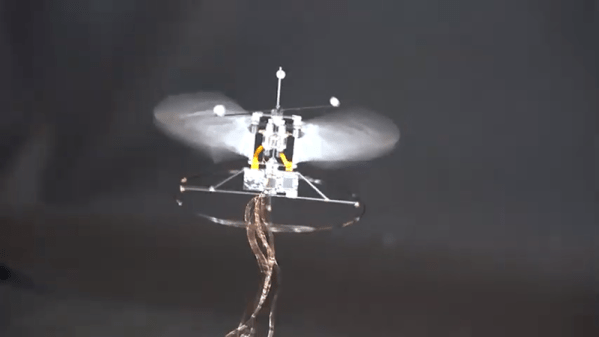
Purdue’s Bio-Robotics lab has been working on a robotic hummingbird and, as you can see in the videos below, have had a lot of success. What’s more, is they’ve shared that success on GitHub. If you want to make a flapping-winged robot, this is definitely where you start.

If you’ve ever watched a hummingbird, you know their flight capability is nothing short of spectacular. The Purdue robot flies in a similar fashion (although on a tether to get both power and control information) and relies on each wing having its own motor. The motors not only propel the wings but also act as sensors. For example, they can detect if a wing is damaged, has made contact with something, or has changed performance due to atmospheric conditions.

In addition to the tethered control system, the hummingbird requires a motion capture sensor external to itself and some machine learning. Researchers note that there is sufficient payload capacity to put batteries onboard and they would also need additional sensors to accomplish totally free flight. It is amazing when you realize that a real hummingbird manages all this with a little bitty brain.

The published code is in Python and is part of three presentations later this month at a technical conference (the IEEE International Conference on Robotics and Automation).  If you don’t want to wait on the paper, there’s a post on IEEE Spectrum about the robotic beast, available now and that article contains preprint versions of the papers. The Python code does require a bit to run, so expect a significant flight computer.

The last hummingbird bot we saw was a spy. We’ve also seen robots that were like bees — sort of.

Continue reading “Robot Hummingbird Imitates Nature”

Mathics: How To Do Hard Math When You’re Not An MIT Janitor

Algebra is the bane of many a student, but it is surprisingly useful when it comes to electronics. Sure, you can just memorize all the permutations of things like Ohm’s law. But it is better if you can remember one form and deduce the others on the fly.

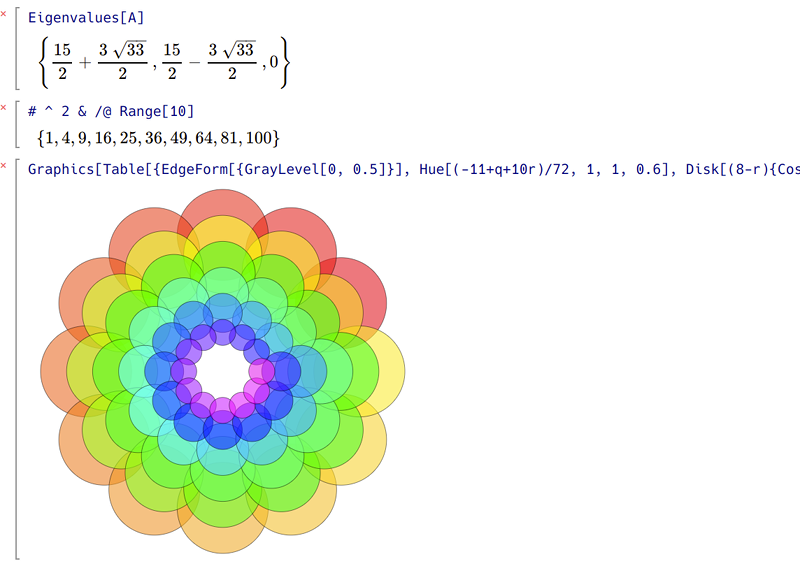
There are many occasions where you — as our old Algebra teacher used to say — need to use what you know to get what you don’t know. The gold standard, of course, is a computer program called Mathematica. For home and student use, the software is “only” about $160-$600, but commercial versions range from about $1,000 to nearly $8,000. Of course, there are free alternatives, and the one we’re looking at today is Mathics. It will run in your browser or as a desktop application powered by Python, and it’s available for free.

The program does a nice job of displaying mathematical formulae and you can get an idea of its power by visit the online version. which has examples if you click the question-mark in the upper right and look for the fourth item down. There’s also a standalone version of the online help.

We did have a little trouble with some of the gallery examples timing out, as well as the site certificate being expired. We also had a bit of difficulty remembering the linear algebra classes we took a long time ago! If you want something easy to play with try this:

Solve[4x+3==20,x]

Don’t forget to press Shift+Enter in the browser to get the solution.

Under the hood, MathJax and SymPy do a lot of the heavy lifting. In fact, we imagine a lot of the program’s intended audience would wind up using Jupyter notebooks with Python underneath. Of course, there are copies of Wolfram software on stock Raspberry Pi’s, too.

Pluto (SDR) Goes Ethernet

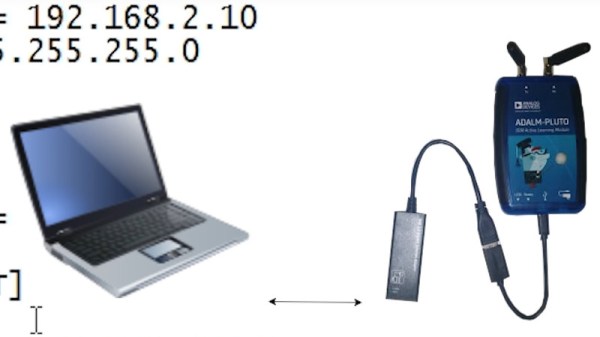
Pluto may no longer be a planet, but it is still a fun software defined radio (SDR) set up from Analog Devices. The inexpensive radio uses a USB connector and looks somewhat like a network connection to your PC. But what if you want to really use it with a network? [SignalsEverywhere] shows you how to do it using a USB network adapter and a USB connection adapter.

Just plugging a USB dongle into the box isn’t sufficient, an extra power supply is required as well as a minor bit of configuration. The IP address will be static so you might want to use an IP that your DHCP server won’t hand out, or reserve the IP on your local network.

Continue reading “Pluto (SDR) Goes Ethernet”

Dark Absorbing Diodes Are No DAD Joke

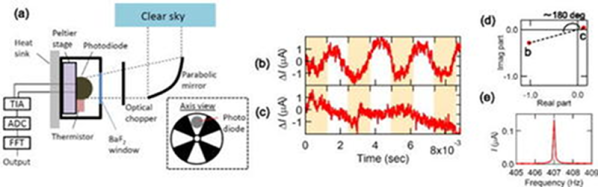
We will confess that the authors of the Applied Physics Letters article “Experimental Demonstration of Energy Harvesting from the Sky using the Negative Illumination Effect of a Semiconductor Photodiode” never used the acronym DAD or the phrase “dark absorbing diode.” But we thought it was too good to pass up. The research work uses a type of diode to generate small amounts of power from darkness. Admittedly, the amount of power is small, but it is still an important result and could result in — another coined phrase — negative solar cells providing energy by taking advantage of the temperature differential between the cell and the night sky.

In theory — and with no atmosphere — the technique could only result in about 4 watts per square meter. Not only is this low compared to a solar panel’s 100 to 200 watts per square meter, but it is also far from the prototype’s 64 nanowatts per square meter. Clearly, this technology has a ways to go to become practical.

Continue reading “Dark Absorbing Diodes Are No DAD Joke”

Swiss Cheese Metamaterial Is An Analog Computer

If you have had trouble with ordinary calculus, you may not be pleased to hear about “photonic calculus” — a recent idea from [Nader Engheta] of the University of Pennsylvania. The idea is that materials with certain properties could manipulate an electromagnetic wave in a way to solve a specific mathematical equation. [Engheta] proposed this idea back in 2014 and recently announced that he and his team have a demonstration device that proves the concept. The analog computer is about twice the size of an airplane’s tray table and made of CNC-shaped polystyrene. It solves Fredholm integral equations of the second kind.

The analog computer uses microwaves for the input and the polystyrene acts as a dielectric full of air holes. The team likens its structure to that of Swiss cheese. The shape is generated through an inverse design process which builds the shapes from known solutions to the equations. That means a particular set of shapes will do one specific equation. The equation could, for example, model the sound volume in a concert hall. You can encode certain parameters in the input wave and the output would specify the volume at different locations. However, a change to the actual equation would require a new set of plastic pieces.

The computation is very fast. Using microwaves, the answer comes out in a few hundred nanoseconds — a speed a conventional computer could not readily match. The team hopes to scale the system to use light which will speed the computation into the picosecond range. Creating a new optical analog computer could be similar to how we burn a CD or DVD today.

Analog computers predate digital ones by a lot. We really want to build one like [Bill Schweber’s]. Then again, we wouldn’t mind finding a Donner 3500 at a hamfest, either.

Fortran Goes Interactive

When you think of Fortran you probably think of punched cards and green bar paper. While it is true that Fortran isn’t the go-to language it used to be — pun unintentional — it still has a vibrant community of people who do serious number crunching. However, many members of that community have been seduced away by interactive tools that are also good at number crunching like MATLAB, Julian, and Python with special libraries. The LFortran project aims to create a Fortran environment with interactivity like Python, but retaining the speed that Fortran is known for.

The resulting tool is impressive. You can use it from Jupyter, can parse code targeting existing Fortran compilers, and supports Linux, Mac, and Windows. There is development to make the code fully interoperable with other languages like C or Python as well as take advantage of GPUs and other specialized hardware. They are also zeroing in on full Fortran 2018 support.

Continue reading “Fortran Goes Interactive”

Easter Egg Turns Nintendo Switch Into A Development Platform

Like a lot of game developers [Amir Rajan] likes to put Easter Eggs into his creations. His latest Nintendo Switch title, A Dark Room, has a very peculiar one, though. Instead of a graphic or a Tetris game, [Amir] put a code editor and a Ruby interpreter in the game.

Ruby is a language that originated in Japan and is popular with Web developers, in particular. It has dynamic typing, garbage collection, and supports several different programming styles. We aren’t sure what you’d do with it on a Nintendo Switch, but any time we can program a gadget, it makes us happy.

Continue reading “Easter Egg Turns Nintendo Switch Into A Development Platform”