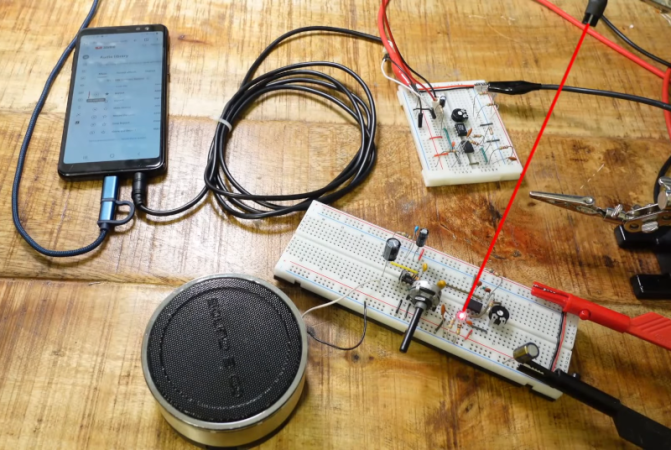
You think of op amps as amplifiers because, no kidding, it is right in the name. But just like some people say, “you could do that with a 555,” [Doctor Volt] might say, “you can do that with an op amp.” In a recent video, you can see below, he looks at simulations and breadboards for five applications that aren’t traditional amplifiers.
Of course, you can split hairs. A comparator is sort of an amplifier with some very specific parameters, but it isn’t an amplifier in the classic sense.
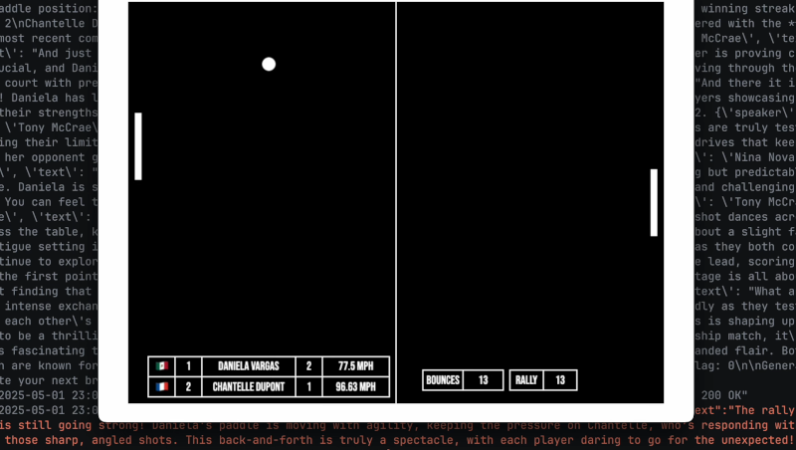
While most of us won’t ever play Wimbledon, we can play Pong. But it isn’t the same without the thrill of the sportscaster’s commentary during the game. Thanks to [Parth Parikh] and an LLM, you can now watch Pong matches with commentary during the game. You can see the very cool result in the video below — the game itself starts around the 2:50 mark. Sadly, you don’t get to play. It seems like it wouldn’t be that hard to wire yourself in with a little programming.
The game features multiple AI players and two announcers. There are 15 years of tournaments, including four majors, for a total of 60 events. In the 16th year, the two top players face off in the World Championship Final.
There are several interesting techniques here. For one, each action is logged as an event that generates metrics and is prioritized. If an important game event occurs, commentary pauses to announce that event and then picks back up where it left off.
We really want to see a one- or two-player human version of this. Please tell us if you take on that challenge. Even if you don’t write it, maybe the AI can write it for you.
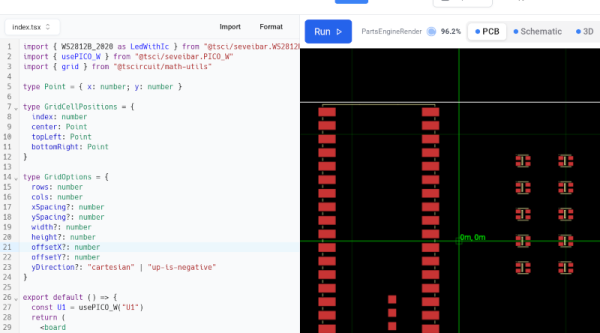
Most of us learned to design circuits with schematics. But if you get to a certain level of complexity, schematics are a pain. Modern designers — especially for digital circuits — prefer to use some kind of hardware description language.
There are a few options to do similar things with PCB layout, including tscircuit. There’s a walk-through for using it to create an LED matrix and you can even try it out online, if you like. If you’re more of a visual learner, there’s also an introductory video you can watch below.
If you’ve only been around for the Internet age, you may not realize that Hackaday is the successor of electronics magazines. In their heyday, magazines like Popular Electronics, Radio Electronics, and Elementary Electronics brought us projects to build. Hacks, if you will. Just like Hackaday, not all readers are at the same skill level. So you’d see some hat with a blinking light on it, followed by some super-advanced project like a TV typewriter or a computer. Or a picture phone.
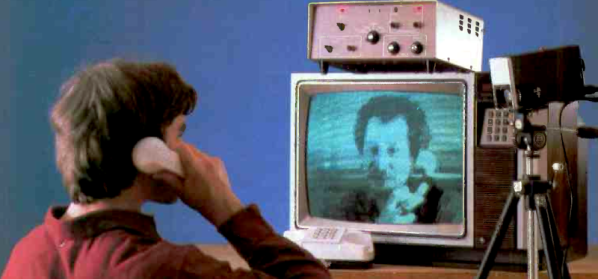
In 1982, Radio Electronics, a major magazine of the day, showed plans for building a picture phone. All you needed was a closed-circuit TV camera, a TV, a telephone, and about two shoeboxes crammed full of parts.
Like many picture phones of its day, it was stretching the definition a little. It actually used ham radio-style slow scan TV (SSTV) to send a frame of video about once every eight seconds. That’s not backwards. The frame rate was 0.125 Hz. And while the resulting 128 x 256 image would seem crude today, this was amazing high tech for 1982.
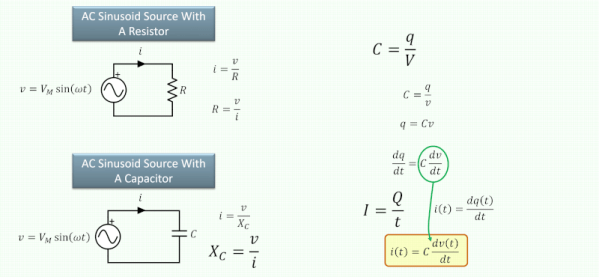
If you’ve dealt with reactance, you surely know the two equations for computing inductive and capacitive reactance. But unless you’ve really dug into it, you may only know the formula the way a school kid knows how to find the area of a circle. You have to have a bit of higher math to figure out why the equation is what it is. [Old Hack EE] wanted to figure out why the formulas are what they are, so he dug in and shared what he learned in a video you can see below.
The key to understanding this is simple. The reactance describes the voltage over the current through the element, just like resistance. The difference is that a resistance is just a single number. A reactance is a curve that gives you a different value at different frequencies. That’s because current and voltage are out of phase through a reactance, so it isn’t as easy as just dividing.
If you know calculus, the video will make a lot of sense. If you don’t know calculus, you might have a few moments of panic, but you can make it. If you think of frequency in Hertz as cycles per second, all the 2π you find in these equations convert Hz to “radian frequency” since one cycle per second is really 360 degrees of the sine wave in one second. There are 2π radians in a circle, so it makes sense.
We love developing intuition about things that seem fundamental but have a lot of depth to them that we usually ignore. If you need a refresher or a jump start on calculus, it isn’t as hard as you probably think. Engineers usually use vectors or imaginary numbers to deal with reactance, and we’ve talked about that too, if you want to learn more.
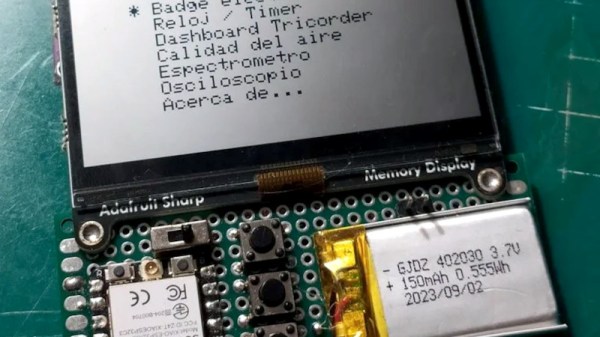
The Star Trek tricorder was a good example of a McGuffin. It did anything needed to support the plot or, in some cases, couldn’t do things also in support of the plot. We know [SirGalaxy] was thinking about the tricorder when he named the Tinycorder, but the little device has a number of well-defined features. You can see a brief video of it working below the break.
The portable device has a tiny ESP32 and a battery. The 400×240 display is handy, but has low power consumption. In addition to the sensors built into the ESP32, the Tinycorder has an AS7341 light sensor, an air quality sensor, and a weather sensor. An odd combination, but like its namesake, it can do lots of unrelated things.
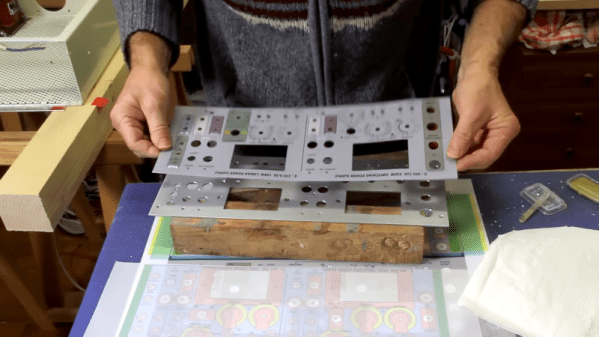
It is easier than ever to produce projects with nice enclosures thanks to 3D printing and laser cutting. However, for a polished look, you also need a labeled front panel. We’ve looked at several methods for doing that in the past, but we enjoyed [Accidental Science’s] video showing his method for making laminated panels.
His first step is to draw the panel in Inkscape, and he has some interesting tips for getting the most out of the program. He makes a few prints and laminates one of them. The other is a drill guide. You use the drill guide to make openings in the panel, which could be aluminum, steel, plastic, or whatever material you want to work in.