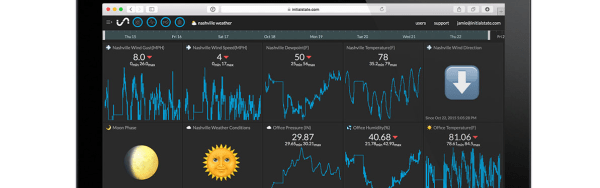
Raspberry Pi Sense HAT Super Weather Dashboard

[InitialState] posted a great multipart tutorial about building what he calls a “Hyper-local Weather Dashboard.” In plain language, he created a Raspberry Pi-based web page that fuses weather data from Wunderground along with locally sensed weather data.

The tutorial has thee parts. The first part covers reading data from Wunderground using their developer’s API (you’ll need an API key; a free one is good for 500 queries a day). The second part covers using the Pi Sense HAT to measure local temperature, humidity, and pressure. The final part ties it all together using producing the hyper-local weather dashboard (whatever that really means).

We talked about the Sensor HAT earlier (and there’s more info in the video, below). Seems like those lights could do something, although that wouldn’t do you any good over a web interface. This is a good-looking project (and tutorial) and easy enough that it would be a good place to start
experimenting with the Raspberry Pi.

Continue reading “Raspberry Pi Sense HAT Super Weather Dashboard”
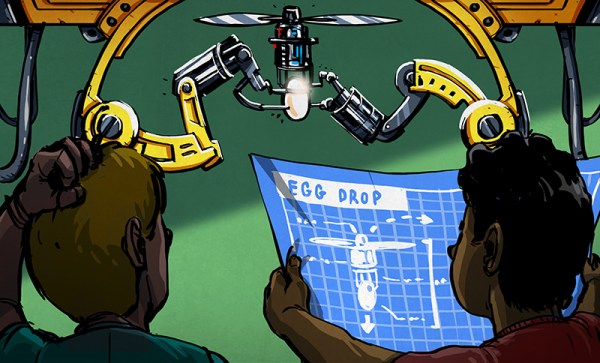
Kids And Hacking: The One Hour Egg Drop

In the last Hacking and Kids post, I talked about an activity you can do with kids when you don’t have a lot of time or resources. The key idea was to have fun and learn a little bit about open and closed loop control. One of the things I usually briefly mention when I do that is the idea of a design trade: Why, for example, a robot might use wheels instead of legs, or treads instead of wheels.

Engineers and makers perform trades like this all the time. Suppose you are building a data logging system. You want precise samples, large storage capacity, and many channels. But you also want a low cost and low power drain. You might also want high reliability. All of these requirements will lead to different trades. A hard drive would provide a lot of space, but is more expensive, less reliable, larger, and more power hungry than, say, an SD card. So there isn’t a right choice. It depends on which of the factors are most important for this particular design. A data logger in a well-powered rack might be well served to have a terrabyte hard drive, while a battery powered logger in a matchbox that will be up on the side of a mountain might be better off with an SD card.

We can all relate to that example, but it is pretty boring to a kid. You probably can’t get them to design a data logger, anyway. But if I have about an hour and a little prep time, I have a different way to get the same point across. It is a modified version of the classic “egg drop”, but it is simple enough to do in an hour with very little preparation time.

Continue reading “Kids And Hacking: The One Hour Egg Drop”

Why Should You Get A Ham Radio License?

Several of the authors you read on Hackaday are ham radio operators and we’ve often kicked around having a Hacker Chat about “Why be a ham today?” After all, you can talk to anyone in the world over the Internet or via phone, right? What’s the draw?

The Radio Society of Great Britain had the same thought, apparently, and produced a great video to answer the question. They mention the usual things: learning about technology, learning about people in other parts of the world, disaster communications, and radiosport (which seems to be more popular outside the United States; people compete to find hidden transmitters).

In addition, they talked a lot about how hams get involved with space communications, ranging from talking via satellites, to talking to people on the space station, to actually building small satellites. As the narrator says, there are “hundreds of ways to have techie fun” with ham radio.

One thing we noticed they showed but didn’t say a lot about, though, is the educational opportunities. You can learn a lot, and working with kids to help them learn is often very rewarding (and you usually learn something, too). Just to forestall the comments that this post isn’t hack related, we’ll note two things: there is a Raspberry Pi shown and just past the two-minute mark, there is a very clever hacked together Morse code key.

We talk a lot about ham radio, ranging from Arduino-based digital modes to putting together portable stations (you can see a similar one in the video, too). One other thing we noticed they don’t mention: it is generally much easier to get a license today than ever before. Most countries (including the United States) have abolished the Morse code requirements, so while some hams still enjoy CW (hamspeak for operating Morse code), it isn’t a requirement.

Video below.

Continue reading “Why Should You Get A Ham Radio License?”

Bluetooth Thermometer Minds Your Meats

The summer may have come to a close here in the USA, but any time of the year is a good time for grilling. In the colder weather, it’s a drag to have to stay near the hot grill to keep an eye on your burgers and franks. [Eric Ely] thought it would be smarter to have a meat thermometer that sent his phone the current reading via Bluetooth.

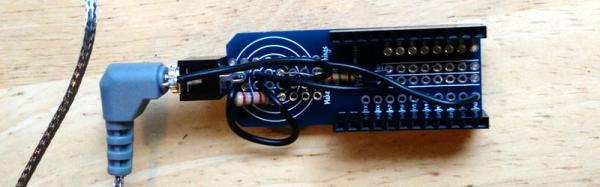
Instead of starting from scratch, [Eric] took an off the shelf electronic thermometer and removed its temperature probe (which was a thermistor). The hardware used an off the shelf Bluetooth board with a companion battery board and prototype board. If you can’t bear to cut up a good thermometer, you can get replacement probes that ought to work just as well.

In addition to the boards and the scavenged thermistor, [Eric] used a couple of resistors. One resistor is in parallel with the thermistor to improve the linearity of the device’s response curve. The second resistor forms a voltage divider that the Bluetooth board reads.

The software (using Node.js and C) is available on Github. The C program reads the temperature and pushes it out using JSON. Node.js provides a server that [Eric] can hit with his phone’s Web browser.

Sure, you can buy wireless thermometers, but what self-respecting hacker wants to carry around a store-bought box just to display meat temperature? Viewing it on your phone has much more street cred.  Of course, a real hacker isn’t going to cook on a conventional grill, either.

Continue reading “Bluetooth Thermometer Minds Your Meats”

Raspberry Pi Powers The Desk Of The Future

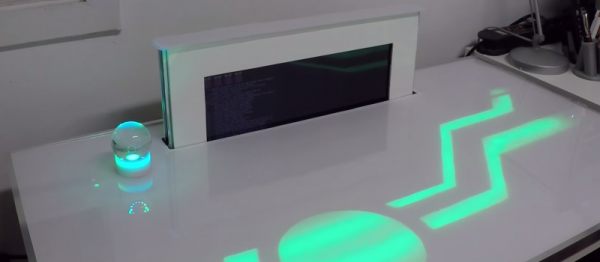
Recent science fiction movies always show people sitting at stylish semi-transparent desks that have all kinds of strange and wonderful gadgets in them. Our desks look like something your grandfather might have sat at. [Frederick Vandenbosch] must have seen those same movies so as part of contest he decided to build the desk of the future.

The desk is as much a furniture project as an electronics project, but it does have a Raspberry Pi, a scavenged laptop LCD, embedded touch sensors and LEDs, a wireless charger, and a built-in sound system. In addition, it uses a Gertbot and some stepper motors that it uses to raise and lower the screen in and out of the desk (watch the video below to see how that looks).

[Fredrick] used Python to get the major functions of the desk programmed. We couldn’t help but think of all the things you could do with an easily programmable desk surface: show stock quotes (or sports scores), notify about e-mail, or other things. Although it doesn’t look like it would be simple for a simple user to add those things, if you were a handy programmer, they look like they’d be in reach.

We’ve seen some desks before, but nothing quite like this. We couldn’t help but wonder if you could add some Minority Report-style goodness to [Frederick’s] already impressive desk.

Continue reading “Raspberry Pi Powers The Desk Of The Future”

Nurses Create In A Medical Makerspace

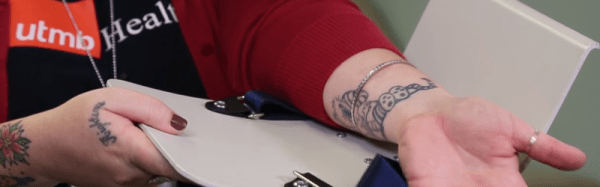
Although there are many skilled and dedicated types of health care professionals, nurses are often the main point of contact between the medical establishment and a patient. You will probably spend more time with your nurse–especially in a hospital setting–than any other health care provider. Every patient’s needs are different, so it isn’t surprising that nurses sometimes improvise unique solutions to help their patients be more comfortable or recover faster.

That’s the idea guiding an innovative program called MakerNurse–an initiative backed by MIT and the Robert W. Johnson Foundation. The idea is to encourage nurses to be makers. One of the project’s cofounders, Anna Young, had found nurses in Central America making do with what they had on hand and naturally acting as makers. “We saw a nurse repair a stethoscope diaphragm with an overhead transparency,” she said. Young noted that often nurses didn’t realize the significance of their making–it was just how they got through the day.

Continue reading “Nurses Create In A Medical Makerspace”

Bioluminescent Challenge Has Students Feeding Their Lamps

[Tom Lombardo] is an engineer and an educator. When a company sent him a Dino Pet–a bioluminescent sculpture–he found it wasn’t really usable as a practical light source. He did, however, realize it would be an interesting STEAM (science, technology, engineering, art, and math) project for students to produce bioluminescent sculptures.

The lamps (or sculptures, if you prefer) contain dinoflagellates which is a type of plankton that glows when agitated. Of course, they don’t put out a strong light and–the main problem–you have to agitate the little suckers to get them to emit light. [Tom] found that there was a mild afterglow when you stop shaking, but not much. You can get an idea of how much light they make in the video below. The idea for a school project would be to make practical ambient lighting that didn’t require much input power to agitate the plankton.

Continue reading “Bioluminescent Challenge Has Students Feeding Their Lamps”