Where Did The Japanese Computers Go?

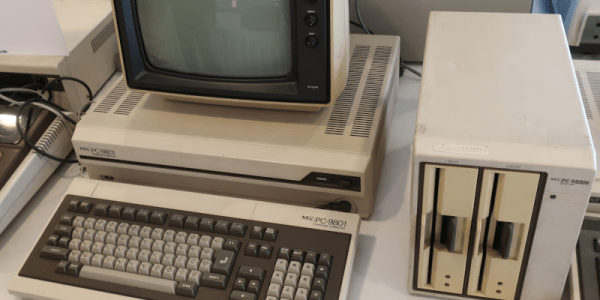
If you are a retrocomputer person, at least in North America and Europe, you probably only have a hazy idea of what computers were in the Japanese market at the time we were all buying MSDOS-based computers. You may have heard of PC-98, but there were many Japanese-only computers out there, and a recent post by [Misty De Meo] asks the question: What happened to the Japanese computers?

To answer that question, you need a history lesson on PC-98 (NEC), FM Towns (Fujitsu), and the X68000 (Sharp). The PC-98 was originally a text-only MSDOS-based computer. But eventually, Microsoft and NEC ported Windows to the machine.

The FM Towns had its own GUI operating system. However, it too had a Windows port and the machine became just another Windows platform. The X68000, as you may well have guessed, used a 68000 CPU. Arguably, this was a great choice at the time. However, history shows that it didn’t work out, and when Sharp began making x86-based Windows machines — and, of course, they did — there was no migration path.

[Misty] makes an interesting point. While we often think of software like Microsoft Office as driving Windows adoption, that wasn’t the case in Japan. It turns out that multitasking was the key feature since Office, at the time, wasn’t very friendly to the native language.

So where did the Japanese computers go? The answer for two of them is: nowhere. They just morphed into commodity Windows computers. The 68000 was the exception — it just withered away.

Japanese pocket computers were common at one time and have an interesting backstory. Japanese can be a challenge for input but, of course, hackers are up to the challenge.

The Surprising Effects Of Fast Food Kiosks

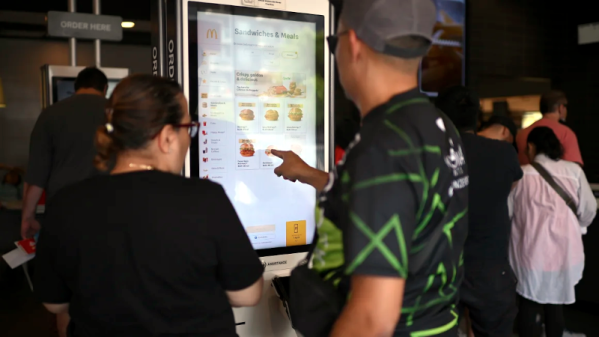
For as long as there have been machines, there have been fears of machines taking your job. One of the latest incarnations of this phenomenon is the fast-food ordering kiosk. No longer will you have some teenager asking you if you want fries with that. These days, you are more likely going to find the question on a touch screen. So, are those poor kids out of an entry-level job? Apparently not, according to a recent CNN story.

According to McDonald’s, a business that embraces the kiosks, the new technology increases sales and creates more jobs, albeit more jobs further behind the counter. Part of the reason is that while “Do you want fries with that” is a cliche, it is also a sound business practice. Cashiers should try to upsell but don’t always do so. The kiosk always remembers to offer you an apple pie or whatever else they want to move today.

Continue reading “The Surprising Effects Of Fast Food Kiosks”

Inviting The Public To Take Stereo Photos For Science

[Lynnadeng]’s team wanted to monitor the Los Angeles River over time and wanted citizen scientists — or anyone, for that matter — to help. They built a dual phone holder to allow random passersby to use their phones to take photos. A QR code lets them easily send the pictures to the team. The 3D printed holder is fixed in place and has a known gap that allows stereo reconstruction from pairs of photos.

Of course, people aren’t going to know what to do, so you need a sign with instructions along with the QR code. One advantage to this scheme is that it’s cheap. All the camera hardware is in the public’s phone. Of course, you still have to make the holder robust to the elements, but that’s not nearly as difficult as supplying power and weatherproofing cameras and radios.

The real interesting part is the software. At first, we were disappointed that the post had a dead link to GitHub, but it was easy enough to find the correct one. In some cases, people will use a single camera, so 3D reconstruction isn’t always possible.

We love citizen science around here. No matter where you live, there are many opportunities to contribute.

Inside A Portable Satellite Dish

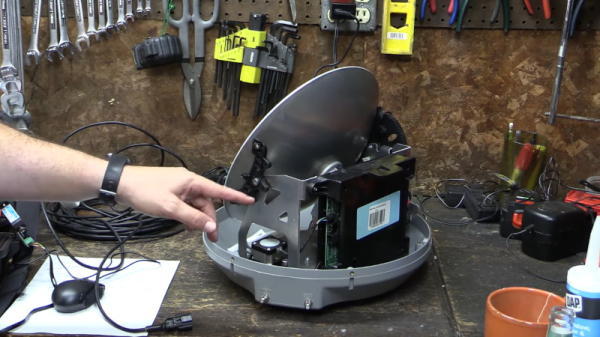
Like many of us, [Gabe] has things he just can’t stop buying. In his case, it is portable satellite dishes. You’ve seen these. They look like a dome or maybe a hard hat on some kind of motorized base. What’s in them? What can you do with them? Watch the video below and find out.

As [Gabe] points out, you can often find these on the surplus market for very little money. You can sometimes find them on the side of the road for free, too. Although we’ve never been that lucky.

The video shows three generations of Winegard antennas. It shows what’s inside and how to command them. Of course, the obvious use for these is as an antenna. But we also were thinking they’d make a fair motion base for something, too.

Some of the antennas lack any limit switches. On startup, the system spins until it grinds the plastic gears to find its travel limits. We expect that’s not good for the gears, but it does work. [Gabe] mentions it might be a bit of planned obsolescence, but we imagine it is more of a cost-saving measure.

Junkyards are a frequent source for satellite gear, apparently. Dishes have lots of other uses, too.

Continue reading “Inside A Portable Satellite Dish”

Design And The Golden Rule

You often learn the golden rule or some variation of it as early as kindergarten. There are several ways to phrase it, but you most often hear: “Do unto others as you would have them do unto you.” While that’s catchy, it is really an aphorism that encourages us to consider the viewpoints of others. As people who design things, this can be tricky. Sometimes, what you want isn’t necessarily what most people want, and — conversely — you might not appreciate what most people want or need.

EDIT/1000

HP/1000 CC-BY-SA-3.0 by [Autopilot]
I learned this lesson many years ago when I used to babysit a few HP/1000 minicomputers. Minicomputer sounds grand, but, honestly, a Raspberry Pi of any sort would put the old HP to shame. Like a lot of computers in those days, it had a text editor that was arcane even by the standards of vi or emacs. EDIT/1000 couldn’t be sure you weren’t using a printing terminal, and the commands reflect that.

For example, printing a few lines around the current line requires the command: “/-2,L,5” which isn’t that hard, I suppose. To delete all lines that contain a percent sign, “1$ D/%/A/” assuming you don’t want to be asked about each deletion.

Sure, sure. As a Hackaday reader, you don’t find this hard to puzzle out or remember. But back in the 1980s, a bunch of physicists and chemical engineers had little patience for stuff like that. However, the editor had a trick up its sleeve.

Continue reading “Design And The Golden Rule”

A Guide To Laser Cutting Metal, If You’ve Got The Cash

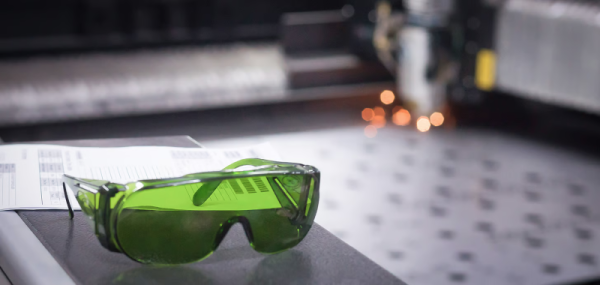
While many of us now have laser cutters — either a K40-style machine or one of the newer high-output diodes — you probably don’t have one that cuts metal. True, some hobby lasers now offer IR laser heads with modest power to engrave metal. The xTool S1, for example, accepts a 2 W IR laser as an option, but we doubt it would cut through anything thicker than foil. However, there are a growing number of fiber and carbon dioxide lasers that can cut metal at semi-reasonable prices, and [All3DP] has a primer on the technology that is worth a read.

According to the post, CO2 lasers are less expensive but require gas assist, can’t work with shiny metals well, and are finicky because of the mirrors and glass tube inside. Fiber lasers cost more, but don’t need gas, work on more materials, and have fewer parts that need maintenance or may be prone to damage. There are other kinds of lasers, but the post focuses on these, the most common ones.

Machines that can cut metal aren’t cheap. They start at about $10,000. However, prices are dropping and we remember when $10,000 would buy you what would today be a terrible oscilloscope, so maybe there’s hope for an impulse-buy metal-cutting laser one day.

It isn’t that diode lasers can’t cut metal at all, but the results are not terribly useful. What would you rather have? A metal cutter or a metal 3D printer?

Airline Seats Are For Dummies

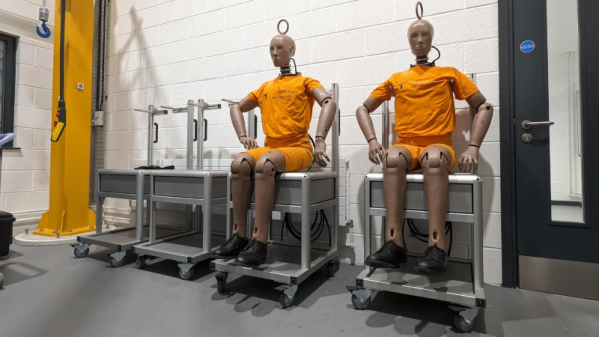
You normally don’t think a lot would go into the construction of a chair. However, when that chair is attached to a commercial jet plane, there’s a lot of technology that goes into making sure they are safe. According to a recent BBC article, testing involves crash dummies and robot arms.

Admittedly, these are first-class and business-class seats. Robots do repetitive mundane tasks like opening and closing the tray table many, many times. They also shoot the seats with crash dummies aboard at up to 16 Gs of acceleration. Just to put  that into perspective, a jet pilot ejecting gets about the same amount of force. A MiG-35 pilot might experience 10 G.

We didn’t realize how big the airline seat industry is in Northern Ireland. Thompson, the company that has the lab in question, is only one of the companies in the country that builds seats. Apparently, the industry suffered from the global travel slowdown during the pandemic but is now bouncing back.

While people worry about robots taking jobs, we can’t imagine anyone wanting to spend all day returning their tray table to the upright and locked position repeatedly. We certainly don’t want to be 16 G crash dummies, either.

Crash dummies have a long history, of course. Be glad airliners don’t feature ejector seats.