From High Level Language To Assembly

If you cut your teeth on Z-80 assembly and have dabbled in other assembly languages, you might not find much mystery in creating programs using the next best thing to machine code. However, if you have only used high level languages, assembly can be somewhat daunting. [Shikaan] has an introductory article aimed to get you started at the “hello world” level of x86-64 assembly language. The second part is already up, too, and covers control structures.

You can argue that you may not need to know assembly language these days, and we’ll admit it’s certainly not as important as it used to be. However, there are unusual cases where you really need either the performance or the small footprint, which is only possible in assembly language. What’s more, it is super useful to be able to read assembly from your high-level tools when something goes wrong.

Of course, one of the problems is that each assembly language is different. For example, knowing that the x86 assembly doesn’t completely transfer to ARM instructions. However, in most cases, the general concepts apply, and it is usually fairly easy to learn your second, third, or fourth instruction set.

We’ve had our own tutorials on this topic. You can also debate if you should learn assembly first or wait, although in this case, the audience is people who waited.

Hack Your Eyesight With High Tech Bifocals

As we get older, our eyes get worse. That’s just a fact of life. It is a rite of passage the first time you leave the eye doctor with a script for “progressive” lenses which are just fancy bifocals. However, a new high-tech version of bifocals promises you better vision, but with a slight drawback, as [Sherri L. Smith] found.

Remember how users of Google Glass earned the nickname “glassholes?” Well, these new bifocals make Google Glass look like a fashion statement. If you are too young to need them, bifocals account for the fact that your eyes need different kinds of help when you look close up (like soldering) or far away (like at an antenna up on a roof). A true bifocal has two lenses and you quickly learn to look down at anything close up and up to see things far away. Progressives work the same, but they transition between the two settings instead of having a discrete mini lens at the bottom.

The new glasses, the ViXion01 change based on what you are looking for. They measure range and adjust accordingly. For $555, or a monthly rental, you can wear what looks like a prototype for a Star Trek visor and let it deduce what you are looking at and change its lenses accordingly.

Of course, this takes batteries that last about ten hours. It also requires medical approval to be real glasses and it doesn’t have that, yet. Honestly, if they worked well and didn’t look so dorky, the real use case might be allowing your eye doctor to immediately download a new setting as your vision changes. How about you? How much odd headgear are you willing to wear in public and why?

Glasses have a long strange history. While a university prototype we saw earlier was not likely to win fashion awards, they did look better than these. Maybe.

Non-planar Ironing Makes Smooth Prints

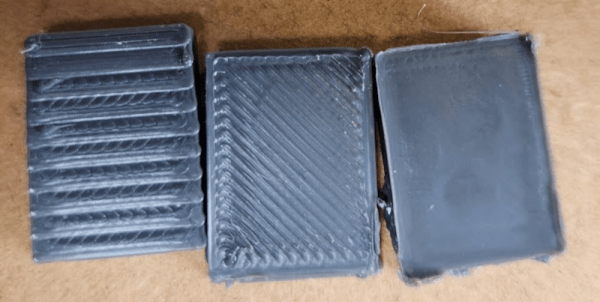
If you want to smooth out the top surface of your FDM 3D prints, you can try ironing. Many slicers allow you to set this option, which drags the hot printhead through the top surface with a tiny bit of plastic to smooth out the extrusion lines. However, a recent paper explains how non-planar ironing can provide a better result.

Usually, non-planar printing requires rotating the print bed in addition to the normal linear motion. However, you can also manipulate the layer height in real time to create bulges in the 3D print. This is the approach taken by Curvislicer, which shares authors with this paper. Another approach is to build a part conventionally but add non-planar printing to the last few layers.

The non-planar ironing is a variation of the latter technique. After slicing, the top layer of g-code passes through a Python script. The results on a test object look very impressive. We’d be interested to see how some more complex shapes look, though.

Of course, it looks like all you need is an ordinary printer, a modified copy of Slic3r, and the script, so if you try it yourself, let us know what you think. It would be great to smooth prints without extra chemicals and post-processing. While you can get good results, it is a lot of work.

A 1930s Ham Station

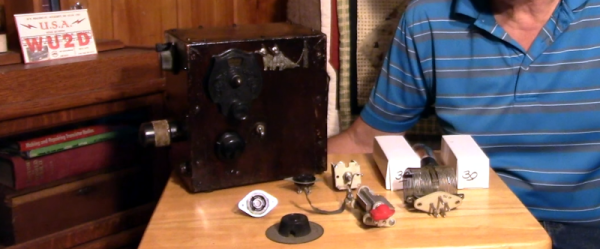
[Mikrowave1] wanted to build an authentic 1930s-style ham radio station that was portable. He’s already done a regenerative receiver, but now he’s starting on a tube transmitter that runs on batteries. He’s settled on a popular design for the time, a Jones push-pull transmitter. Despite the tubes, it will only put out a few watts, which is probably good for the batteries which, at the time, wouldn’t have been like modern batteries. You can see the kickoff video below.

According to the video, these kinds of radios were popular with expeditions to exotic parts of the world. He takes a nostalgic look back at some of the radios and antennas used in some of those expeditions.

Continue reading “A 1930s Ham Station”

Player Ukulele Pulls Your Strings

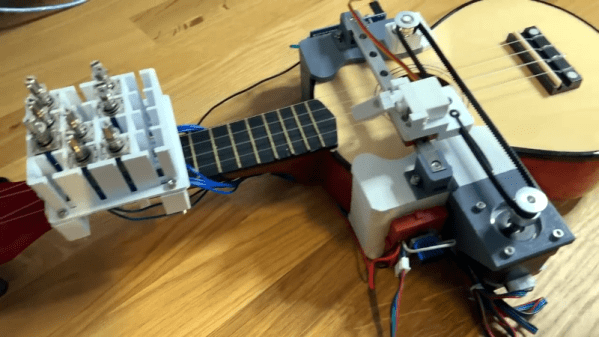
Automated musical instruments aren’t a new idea. From water chimes to player pianos, they’ve been around for a while. But we can’t remember the last time we saw a player ukulele. [Zeroshot] shows us one, though, and it uses an Arduino. You can see and hear it in the video below.

Honestly, with all the stepper motors, linear rails, and belts, we thought it looked like a 3D printer, at least up at the business end. [Zeroshot] thought it would be easier to build a robot than to actually learn to play the instrument. We aren’t sure we agree.

Continue reading “Player Ukulele Pulls Your Strings”

The Science Of Coating Steel

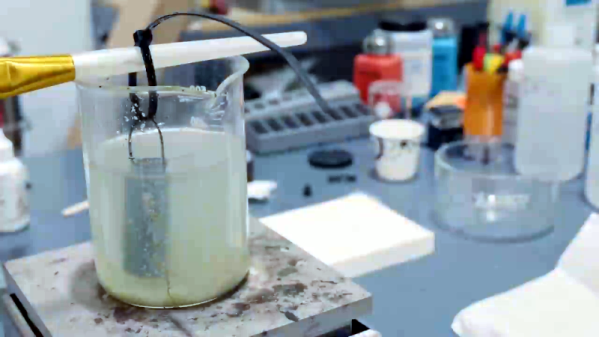
[Breaking Taps] has a look at “parkerization” — a process to coat steel to prevent rust. While you commonly see this finish in firearms, it is usable anywhere you need some protection for steel parts. The process is relatively easy. It does require heat and a special manganese solution made for the purpose. You scuff up the surface of the steel and degrease and wash it.

Once the part is ready, you insert the part in hot solution which is manganese and phosphoric acid. Rinse and displace the water and you are ready to oil the part.

But what we really liked was the electron micrographs of the steel before and after the process. The phosphates formed in the solution cover the iron and hold oil to prevent oxidization. However, the first attempt wasn’t uniform so it wouldn’t work as well. [Breaking Taps] thinks it was a failure to rough up the piece sufficiently before starting. He also raised the temperature of the bath and got a better, but not perfect, result.

We miss having an electron microscope at work and we really want one at home! The last fun coating project we remember used copper in a strange and wonderful way.

Continue reading “The Science Of Coating Steel”

Orion Ceases Operations, Future Of Meade Unclear

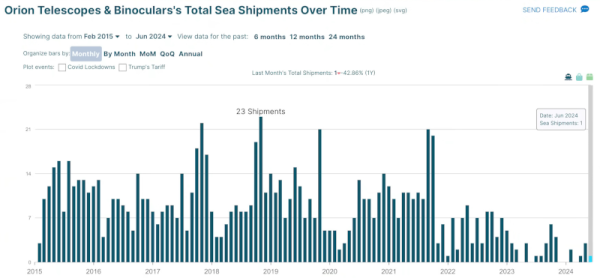
There was a time when building a telescope was a rite of passage for budding astronomers, much as building a radio was the coming age for electronics folks. These days, many things are cheaper to buy than build, even though we do enjoy building anything we can. Orion was a big name in telescopes for many years. Their parent company also owned Meade and Coronado, both well-known optical brands. A recent video from [Reflactor] brought it to our attention that Orion abruptly ceased operations on July 9th.

We always hate to hear when well-known brands that serve a big part of our community vanish. According to [Reflactor], people who have telescopes with the company for repair are likely to never see them again. [Dylan O’Donnell] also had a video about it (see below), and, as he notes, at that time, the website was still operating, but it’s gone now. To add further fuel to the fire Sky & Telescope ran an article on July 12th saying that Meade was also on the chopping block, although at the time of this writing, their site is still online.

You have to wonder what problems you might have selling telescopes today. Many people live where there is light pollution. We’d like to think there are still people who want to ponder the universe from their backyard, though.

There are still people selling telescopes, so presumably, one of them — maybe Celestron — will take up the slack. Or maybe we’ll see a resurgence in telescope homebrewing.

After all, if you have a 3D printer, you could make a 114/900 mm telescope on a tight budget. Or, try IKEA.

Continue reading “Orion Ceases Operations, Future Of Meade Unclear”