Building A WiFi Picture Frame With An EInk Display

LCD photo frames never really caught on — by emitting light, they didn’t seamlessly blend in with a home’s decor in the way printed photos do. [Sprite_tm] decided to see if a color e-Ink screen could do any better, and whipped up a WiFi-enabled photo frame using a Waveshare display.

The part in question is a 5.65-inch display with 640 x 448 resolution, and is capable of displaying seven colors. It’s not designed to display photorealistic images, so much as display simple graphics with block colors. However, with some dithering, [Sprite_tm] suspected it might do an okay job. An algorithm that uses Floyd-Steinberg diffusion and the CIEDE2000 color space takes regular RGB images and breaks them down into dithered images that are displayed using the screen’s 7 available colors.

The build relies on an ESP32-C3, which drives the display and fetches new images daily over WiFi. Thanks to the e-Ink screen, which uses zero power when not updating, the whole setup runs off two AA batteries and a Natlinear LN2266 boost converter.

There are some limitations; the screen’s color space is altogether quite limited, and images don’t look very high-fidelity in such low resolution. However, it does an able job of displaying photos for a device that was never designed to do so. It looks rather handsome all wrapped up as a 3D printed picture frame, and [Sprite_tm]’s monkey test photos are very cute.

Files are on GitHub for those that wish to roll their own. We’ve seen similar works before, like this e-Ink wall-hanging newspaper display that keeps up with the times. If you’ve got your own neat e-ink build, hit us up on the tipsline!

Alternatives To Pins And Holes For 3D Printed Assemblies

When we have two 3D printed parts that need to fit together, many of us rely on pins and holes to locate them and fix them together. [Slant 3D] has explored some alternative ideas in this area that may open up new avenues for your own designs.

Their first idea was to simply chamfer the pins and holes. This allows the object to be printed in a different orientations without compromising the fit. It also makes the features less brittle and creates a broader surface for gluing. Another alternative is using fins and slots, which again add robustness compared to flimsy pins. By chamfering the edges of the fins, they can be printed vertically for good strength and easy location without the need for support material.

Neither option requires much extra fuss compared to typical pin-and-hole designs. Plus, both are far less likely to snap off and ruin your day. Be honest, we’ve all been there. Meanwhile, consider adding folded techniques to your repertoire, too.

Continue reading “Alternatives To Pins And Holes For 3D Printed Assemblies”

Building A Receiver With The ProgRock2 Programmable Crystal

Crystals are key to a lot of radio designs. They act as a stable frequency source and ensure you’re listening to (or transmitting on) exactly the right bit of the radio spectrum. [Q26] decided to use the ProgRock2 “programmable crystal” to build a receiver that could tune multiple frequencies without the usual traditional tuning circuitry. 

 The ProgRock2 is designed as a tiny PCB that can be dropped into a circuit to replace a traditional crystal. The oscillators onboard are programmable from 3.5KHz to 200 MHz, and can be GPS discliplined for accuracy. It’s programmable over a micro USB pot, and can be set to output 24 different frequencies, in eight banks of three. When a bank is selected, the three frequencies will be output on the Clock0, Clock1, and Clock2 pins.There was some confusion regarding the bank selection on the ProgRock2. It’s done by binary, with eight banks selected by grounding the BANK0, BANK1, and BANK2 pins. For example, grounding BANK2 and BANK0 would activate bank 5 (as 101 in binary equals 5). Once this was figured out, [Q26] was on top of things.

In his design, [Q26] hooked up the ProgRock2 into his receiver in place of the regular crystal. Frequency selection is performed by flipping three switches to select banks 0 to 7. It’s an easy way to flip between different frequencies accurately, and is of particular use for situations where you might only listen on a limited selection of amateur channels.

For precision use, we can definitely see the value of a “programmable crystal” oscillator like this. We’ve looked at the fate of some major crystal manufacturers before, too. Video after the break.

Continue reading “Building A Receiver With The ProgRock2 Programmable Crystal”

Auto Tape Wrapping Machine Is Amazing For Cable Management

If you’ve dived under the hood of any car built in the last 40 years, you’ve likely noticed the bundles of neatly-wrapped cables making up the car’s wiring loom. [The Q] has built a tool for handling jobs like this yourself.

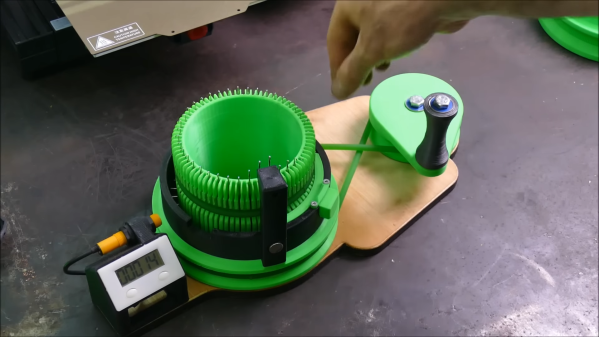
The build starts with a pair of sprockets linked up with bicycle chain, and mounted to a wooden frame. A motor drives the smaller sprocket, which turns the larger sprocket in turn. The larger sprocket itself is mounted on a series of internal rollers, while it mounts a carrier for a roll of tape. As the larger sprocket turns, it will happily wrap whatever you feed through the central hole in tape in a neat and tidy manner.

For those working with automotive looms, large robot cable runs, or PC builds, a tool like this can be of great utility. [The Q} even demonstrates it put to oddball tasks, like wrapping bicycle handlebars or pipe threads. We’ve seen similar builds before, too. Video after the break.

Continue reading “Auto Tape Wrapping Machine Is Amazing For Cable Management”

Cheap Deburring Tool Is Game Changer For 3D Printing

3D printing’s real value is that you can whip up objects in all kinds of whacky geometries with a minimum of fuss. However, there’s almost always some post-processing to do. Like many manufactured plastic objects, there are burrs, strings, and rough edges to deal with. Fussing around with a knife to remove them is a poor way to go. As explained by [Adrian Kingsley-Hughes] on ZDNet, a deburring tool is the cheap and easy solution to the problem.

If you haven’t used one before, a deburring tool simply consists of a curved metal blade that swivels relative to its straight handle. You can drag the curved blade over the edge of a metal, wooden, or plastic object, and it neatly pulls away the burrs. There’s minimal risk of injury, unlike when pulling a regular blade towards yourself. The curved, swiveling blade is much less liable to slip or jump, and if it does, it’s far less likely to cut you.

For plastic use, just about any old deburring tool will do. They last a long time with minimal maintenance. They will wear out faster when used on metals, but you can get replacement blades cheap if you happen to need them. It’s a tool every workshop should have, particularly given they generally cost less than $20.

Given the ugly edges and rafts we’re always having to remove from our 3D prints, it’s almost egregious that printers don’t come with them bundled in the box. They’re just a bit obscure when it comes to tools; this may in fact be the first time Hackaday’s ever covered one. If you’ve got your own quality-of-life hacks for 3D printing, sound off below, or share them on the tipsline! We have able staff waiting for your email.

Making Hydrogen With Solar Energy, With Oxygen And Heat A Bonus

Hydrogen is a useful gas. Whether you want to float an airship, fuel a truck, or heat an industrial process, hydrogen can do the job. However, producing it is currently a fraught issue. While it can be produced cleanly using renewable energy, it’s often much cheaper to split it out of hydrocarbon fuels using processes that generate significant pollution.

There are methods to generate hydrogen more efficiently, though, in a clean and sustainable process. that also produces useful heat and oxygen as byproducts. The key to the process? Concentrated sunshine.
Continue reading “Making Hydrogen With Solar Energy, With Oxygen And Heat A Bonus”

Smoke Some Weeds: Lasers Could Make Herbicide Obsolete

We’ve all tangled with unwelcome plant life at one point or another. Whether crabgrass infested your lawn, or you were put on weeding duty in your grandfather’s rose patch, you’ll know they’re a pain to remove, and a pain to prevent. For farmers, just imagine the same problem, but scaled up to cover thousands of acres.

Dealing with weeds typically involves harsh chemicals or excessive manual labor. Lasers could prove to be a new tool in the fight against this scourge, however, as covered by the BBC.

Continue reading “Smoke Some Weeds: Lasers Could Make Herbicide Obsolete”