Leaking Data By Ultrasound

Human ears are capable of perceiving frequencies from roughly 20 Hz up to 20 kHz, at least when new. Correspondingly, our audio hardware is designed more or less to target these frequencies. However, there’s often a little extra capability at the upper edges, which [Jacek] shows can be exploited to exfiltrate data.

The hack takes advantage of the fact that most computers can run their soundcards at a sample rate of up to 48 kHz, which thanks to the Nyquist theorem means they can output frequencies up to around 24 kHz — still outside the range of human hearing. Computers and laptops often use small speaker drivers too, which are able to readily generate sound at this frequency. Through the use of a simple Linux shell script, [Jacek] is able to have a laptop output Morse code over ultrasound, and pick it up with nothing more than a laptop’s internal microphone at up to 20 meters away.

[Jacek] enjoys exploring alternative data exfiltration methods; he’s previously experimented with Ethernet leaks on the Raspberry Pi. Of course, with any airgap attack, the real challenge is often getting the remote machine to run the exfiltration script when there’s no existing remote admin access to be had. Video after the break.

Continue reading “Leaking Data By Ultrasound”

No-Battery Pressure Sensors For Bike Tyres

Finding out you’ve got a flat tyres halfway into a long ride is a frustrating experience for a cyclist. Maintaining the

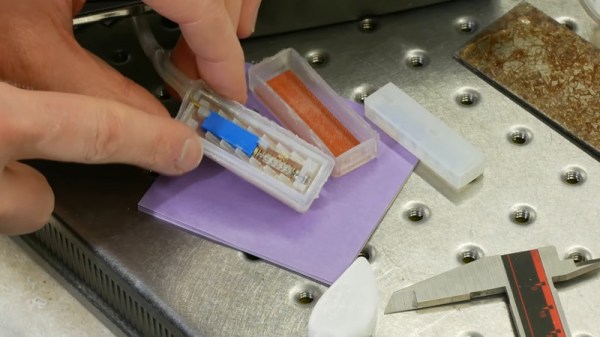
While the epoxy does a great job of sealing the PCB to the valve extension, the overmoulding process would likely be key to producing a product with shelf-quality fit and finish. This test run was done with 3D printed ABS moulds.

correct tyre pressures is key to a good ride, whether you’re stacking up the miles on the road or tackling tricky single track in the mountains. [CaptMcAllister] has put together a device that makes keeping an eye on your tyres easy.

The device consists of an ultra low power microcontroller from Texas Instruments, paired with a pressure sensor. Set up for Near Field Communication, or NFC, it’s designed to be powered by the smartphone that queries the microcontroller for a reading. We featured a prototype back in 2015 which required mounting the device within the inner tube of the tyre itself. However, this required invasive installation and the devices tended to wear out over time due to flex damaging the delicate copper coil antenna.

The new design consists of the same microcontroller hardware, but mounted in a modified valve extension that fits to the fill valve of the bicycle tyre. The PCB is directly epoxied on to the valve extension, ensuring air can’t leak out over time. The assembly is then overmoulded in an injection moulding process to provide further sealing and protection against the elements. This should help immensely in rough-and-tumble mountain biking applications.

The new device provides a simple screw-on solution for tire pressure monitoring that’s set and forget — no batteries required. [CaptMcAllister] is currently investigating options for a production run, and given the simple design, we imagine it couldn’t be too hard to rattle off a few hundred or thousand units. We could imagine it would also pair well with a microcontroller, NFC reader, and a display setup on the handlebars to give live readings where required. We look forward in earnest to seeing where this project goes next!

Hybrid Respirator Uses Repurposed Filters

With the coronavirus raging worldwide, 2020 has seen major shortages of personal protective equipment impact healthcare workers and individuals alike. This has led many to improvise their own solutions. One of the more complete offerings we’ve seen is this hybrid respirator build from [Ben Howard].

[Ben’s] build goes above and beyond the usual craft project masks. It uses a laser-cut chipboard frame to fit three HEPA filters, originally designed for the Roomba robotic vacuum cleaner. Two are used for exhalation, while one is used for inhalation. A small blower fan is installed with the intake filter, to provide mild positive pressure when breathing in. The assembly is wrapped up in fabric, using layers of spandex, fleece, and ripstop nylon to provide the best possible seal against the wearer’s face.

It’s a build that should appeal to those who want to breathe cleaner air and also protect others from exhaled particles that can spread respiratory viruses. We’ve seen all kind of masks hit the scene this year; the graphene-impregnated variety is one of the more interesting designs. Still, one can hope that future years lead to less reliance on such measures!

Underwater Drone Faces Trial By Water

Underwater Remote Operated Vehicles, or ROVs as they’re typically known, generally operate by tether. This is due to the poor propagation of radio waves underwater. [Simon] wanted to build such a drone, but elected to go for an alternative design with less strings attached, so to speak. Thus far, there have been challenges along the way. (Video, embedded below.)

The underwater drone uses a 3D printed chassis, replete with googly eyes that go a long way to anthropomorphizing the build. Four motors are used for control, with two for thrust in the horizontal plane and two mounted in the vertical plane for attitude control. This allows the drone to be set up at neutral buoyancy, and moved through the water column with thrust rather than complicated ballast mechanisms. The build aims to eschew tethers, instead using a shorter cable to link to a floating unit which uses radio to communicate with the operator on the shore.

The major struggle facing the build has been sealing the chassis against water ingress. This is where the layered nature of 3D printing is a drawback. Even with several treatments of paint and sealant, [Simon] has been unable to stop water getting inside the drone. Further problems concern the excess amount of ballast required to counteract the drone’s natural buoyancy due to displacement.

Regardless of the struggles, we look forward to seeing the next revision rectify some of the shortcomings of the current build. We’re sure [Simon’s] experience building an electric surfboard will come in handy. Video after the break.

Continue reading “Underwater Drone Faces Trial By Water”

Cheap DIY High Impedance Earphones

Crystal radios can feel magical, given their ability to tune in audio from distant stations with nothing but the energy from the radio signal itself. However, to achieve this feat, they typically rely on a high-impedance earphone to produce an audible sound with very little current. These earphones are hard to find, and thus can be expensive. However, [Billy] figured out a way to build them on the cheap. 

The build starts with a common piezoelectric buzzer. It’s torn down and the extraneous circuitry inside is removed. The piezo element itself is then directly hooked up to a mono audio jack for use with one of [Billy’s] crystal radios. To make it into a usable earpiece, the tip of a pen is cut off and glued to the buzzer’s plastic housing. Then, a rubber in-ear cup from regular modern earbuds is used to ensure a tight, comfortable fit in the ear.

It’s a great way to build something that’s now hard to source, and we bet that [Billy’s] design is more comfortable than the hard plastic models that shipped in Radio Shack kits in the 90s. Of course, there’s other ways to build high-impedance drivers, as we’ve featured before. And, if you’re looking to build a crystal radio, it’s hard to go past [Billy’s] credit card chip build. Video after the break.

Continue reading “Cheap DIY High Impedance Earphones”

Watercooling A Canon DSLR Leads To Serious Engineering Upgrades

The Canon EOS R5 is a highly capable, and correspondingly very expensive camera. Capable of recording video in 8K in a compact frame size, it unfortunately suffers from frustrating overheating issues. Always one to try an unconventional solution to a common problem, [Matt] decided to whip up a watercooling solution. What ensues is pure, top-notch engineering.

The watercooling setup is amusing, but the real star of the show is the custom copper heatsink that transforms the camera’s performance without spoiling its practicality.

Upon its original release, Canon had the R5 camera simply shut off on a 20 minute timer when recording 8K video. When the userbase complained, an updated firmware was released that used an onboard sensor and would only shutdown when excessive temperatures were reached. Under these conditions, the camera could record for around 25 minutes at 20 °C. [Matt] set about disassembling the camera to investigate, figuring out that the main processor was the primary source of heat. With a poor connection to its heatsink and buried under a power supply PCB, there simply wasn’t anywhere for heat to go, leaving the camera to regularly overheat and take hours to cool down.

After whipping up an amusing but impractical watercooling solution and verifying it allowed the camera to record indefinitely, [Matt] set about some proper thermal engineering. A custom copper heatsink was produced for inside the camera, bonded directly to the processor and DRAM with thermal paste instead of poor-quality thermal tape. This then directs heat out through the plastic back of the camera. In cool environments, this is enough to allow the camera to record continuously. In warmer environments, simply adding a small fan to the back of the camera was enough to keep things operational indefinitely.

[Matt] finishes the video by pointing out that Canon could have made the camera far more useful for videographers by simply investing a little more time into the camera’s cooling design, while also generating more profits by selling a cooling accessory for extended recording. We’ve seen some of [Matt’s] work before too, such as this DIY 4K projector build. Video after the break.

Continue reading “Watercooling A Canon DSLR Leads To Serious Engineering Upgrades”

Let’s Encrypt Will Stop Working For Older Android Devices

Let’s Encrypt was founded in 2012, going public in 2014, with the aim to improve security on the web. The goal was to be achieved by providing free, automated access to SSL and TLS certificates that would allow websites to make the switch over to HTTPS without having to spend any money.

Hundreds of millions of sites rely on Let’s Encrypt for their HTTPS certificate needs. HTTPS security helps protect sites and users, and makes it harder for malicious actors to steal private information.

The project has just announced that, come September 1, 2021, some older software will stop trusting their certificates. Let’s look at why this has come to pass, and what it means going forward.

Certificates Expire

When Let’s Encrypt first went public in early 2016, they issued their own root certificate, by the name ISRG Root X1. However, it takes time for companies to include updated root certificates in their software, so until recently, all Let’s Encrypt certificates were cross-signed by an IdenTrust certificate, DST Root X3. This certificate had been around much longer, and was already supported by the vast majority of OSes and browsers in regular use. This allowed Let’s Encrypt to hit the ground running while they waited for the majority of software to support their own root certificate. Continue reading “Let’s Encrypt Will Stop Working For Older Android Devices”