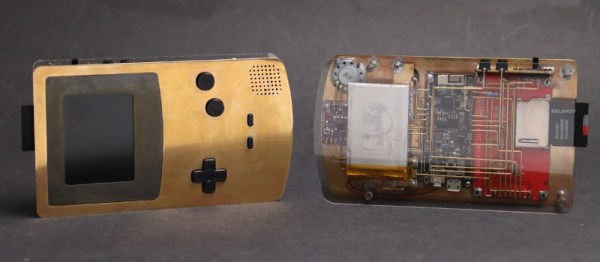
Nintendo’s Game Boy is legendary for being the meat in the handheld gaming revolution, as well as being nigh-on indestructible whether in the custody of children or soldiers in the Gulf War. However, [Jiri] decided to see if he could whip up a tribute of his own, in brass instead of plastic.
The hardware is based on the Odroid GO emulator firmware for the ESP32, running on a 2.2″ color TFT screen. It’s a great base for a custom build, which avoids gutting any precious classic hardware. It’s then assembled behind front plate milled out of brass, with delicate point-to-point brass wires giving it an artistic circuit sculpture look. The brass did prove difficult to work with at times, acting as a heat sink which prevented easy soldering of the standoffs in place. To get around this, [Jiri] used a hotplate to heat the plate from below, keeping it warm enough so that a hand iron could do the job.
The final result is a fun Game Boy emulator in a stylish case – though one you shouldn’t throw in a back pack lest it short out the exposed conductors. It would make a great gift for any lifelong Nintendo fan. [Jiri] is no strange to circuit sculpture, as we well know – we’ve featured his tools and methods before. Video after the break.
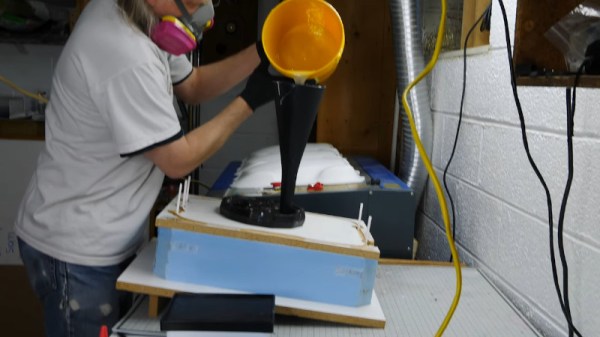
The overarching process is simple, but followed properly, it produces great results. [Eric] starts by building a mold box out of wood, coated in shellac to ensure it doesn’t stick to the silicone. The master part is then stuck to the base, surrounded by a lasercut cardboard strip which acts as a seal and key. Once properly degassed silicone is poured in and cured, the second half can be made. The mold is flipped in the mold box, the seal key removed, and release agent applied to the silicone surfaces. With another pour and cure, the mold is ready for casting new parts.
While simple, if the correct equipment isn’t used or steps skipped, you’ll end up with a useless mold full of air bubbles or surface irregularities. It’s useful to see just what it takes to get a mold of such scale (13″ x 19″!) completed without flaws. We’ve featured [Eric]’s work before, such as his fine detail improvements on the Apple Pencil. Video after the break.
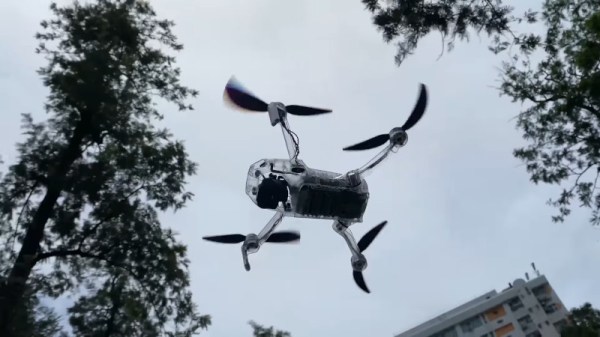
Apparently, in the drone scene, sticker wraps are popular for a custom aesthetic. [Useless Mod] wanted to go a little further, however, and decided to build a full crystal enclosure for his Mavic Mini, facing some hurdles along the way. (Video, embedded below.)
The first stage of the build was disassembly, with the compact 249 gram drone requiring a deft touch to avoid damaging the delicate ribbon cables and mechanisms inside. With the drone stripped down to its bare components, a silicone mould was made of each individual piece of the case, with new parts being cast in clear epoxy. It’s not a job for the faint of heart, with many undercuts and complex features to contend with. However, [Useless Mod] managed to produce the parts and get it all back together.
An initial test flight ended poorly, when the drone entered an uncontrollable wobble due to the case not being fully assembled. However, with fresh internals and with everything properly put together, everything worked! It’s not a build we’d suggest for the inexperienced, as the moulds required are complex and the electronics quite fragile. The final result is a good one though, and it even weighs 10 grams less than the original casing!
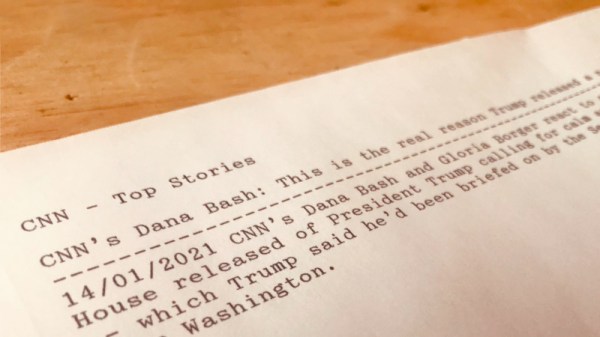
These days, we’re alerted to the rise of Bitcoin and the fall of nations via little buzzes from the smartphones in our pocket. Go back fifty years or so and it was all a bit more romantic, with noisy teletype machines delivering hot tips straight to the newsroom for broadcast to the wider public. [Joshua Coleman] wanted a bit of that old fashioned charm, so set up a news printer at home with his old Apple II.
The Apple II in this case isn’t directly connected to the Internet. Instead, it talks to a modern Macintosh, acting as a serial terminal. The Macintosh then connects to a modern BBS that delivers news headlines over Telnet. The Apple II then routes the headlines as they come in to a beautiful Epson LQ-500 dot matrix printer, replete with vintage tractor feed paper. [Joshua] takes the time to highlight just what hardware is required, as well as how to set up the Apple II to redirect the serial output to the printer so the news automatically prints as it comes in.
It’s a fun and noisy way to stay up to date, and you can be sure that if you hear the printer really start going for it, you might want to switch on the TV for more information on just what’s going wrong at the present minute. Old computers may not have the grunt to really hang with the modern net, but they can make a charming interface for it; this SE/30 does a great job with Spotify, as an example. Video after the break.
The United Kingdom is somewhat unique in the world for requiring those households which view broadcast television to purchase a licence for the privilege. Initially coming into being with the Wireless Telegraphy Act in 1923, the licence was required for anyone receiving broadcast radio, before being expanded to cover television in 1946. The funds generated from this endeavour are used as the primary funding for the British Broadcasting Corporation.
Of course, it’s all well and good to require a licence, but without some manner of enforcement, the measure doesn’t have any teeth. Among other measures, the BBC have gone as far as employing special vans to hunt down illegally operating televisions and protect its precious income.
The Van Is Coming For You
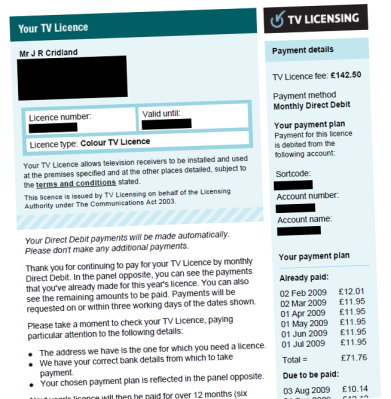
To ensure a regular income, the BBC runs enforcement operations under the TV Licencing trade name, the entity which is responsible for administering the system. Records are kept of licences and their expiry dates, and investigations are made into households suspected of owning a television who have not paid the requisite fees. To encourage compliance, TV Licencing regularly sends sternly worded letters to those who have let their licence lapse or have not purchased one. In the event this fails, they may arrange a visit from enforcement officers. These officers aren’t empowered to forcibly enter homes, so in the event a homeowner declines to cooperate with an investigation, TV Licencing will apply for a search warrant. This may be on the basis of evidence such as a satellite dish or antenna spotted on the roof of a dwelling, or a remote spied on a couch cushion through a window.
Alternatively, a search warrant may be granted on the basis of evidence gleaned from a TV detector van. Outfitted with equipment to detect a TV set in use, the vans roam the streets of the United Kingdom, often dispatched to addresses with lapsed or absent TV licences. If the van detects that a set may be operating and receiving broadcast signals, TV Licencing can apply to the court for the requisite warrant to take the investigation further. The vans are almost solely used to support warrant applications; the detection van evidence is rarely if ever used in court to prosecute a licence evader. With a warrant in hand, officers will use direct evidence such as a television found plugged into an aerial to bring an evader to justice through the courts.
After early experiments with supervised learning, [Yosh] decided to implement a genetic algorithm to produce an AI to drive in the game. The AI takes distance from the track walls as an input, and has steering and accelerator values as an output. Starting with 100 AIs in generation 1, [Yosh] iterated by choosing the AIs that covered the longest distance in 13 seconds. Once the AIs started to get the hang of the first few corners, he changed the training to instead prioritize the lowest time taken to traverse each of the checkpoints along the track.