During World War II, as the Allies planned the invasion of Normandy, there was one major hurdle to overcome—logistics. In particular, planners needed to guarantee a solid supply of fuel to keep the mechanized army functional. Tanks, trucks, jeeps, and aircraft all drink petroleum at a prodigious rate. The challenge, then, was to figure out how to get fuel over to France in as great a quantity as possible.
War planners took a diverse approach. A bulk supply of fuel in jerry cans was produced to supply the initial invasion effort, while plans were made to capture port facilities that could handle deliveries from ocean-going tankers. Both had their limitations, so a third method was sought to back them up. Thus was born Operation Pluto—an innovative plan to simply lay fuel pipelines right across the English channel.
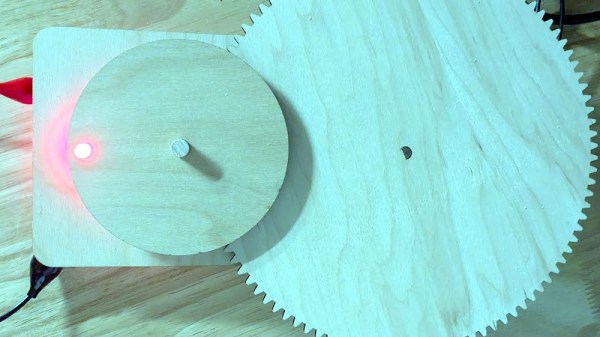
Making an LED blink is usually achieved by interrupting its power supply, This can be achieved through any number of oscillator circuits, or even by means of a mechanical system and a switch. For the 2025 One Hertz Challenge though, [jeremy.geppert] has eschewed such means. Instead his LED is always on, and is made to flash by interrupting its light beam with a gap once a second.
This mechanical solution is achieved via a disk with a hole in it, rotating once a second. This is driven from a gear mounted on a 4.8 RPM geared synchronous motor, and the hack lies in getting those gears right. They’re laser cut from ply, from an SVG generated using an online gear designer. The large gear sits on the motor and the small gear on the back of the disk, which is mounted on a bearing. When powered up it spins at 60 RPM, and the LED flashes thus once a second.
We like this entry for its lateral thinking simplicity. The awesome 2025 One Hertz Challenge is still ongoing, so there is still plenty of time for you to join the fun!
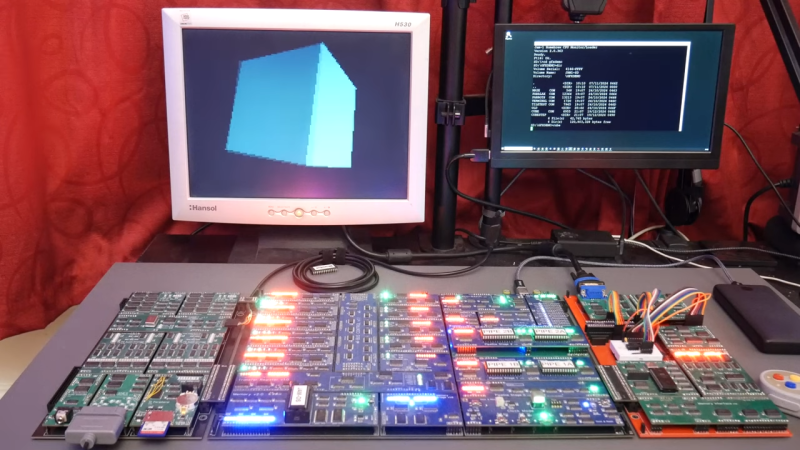
[James Sharman] designed and built his own 8-bit computer from scratch using TTL logic chips, including a VGA adapter, and you can watch it run a glorious rotating cube demo in the video below.
The rotating cube is the product of roughly 3,500 lines of custom assembly code and looks fantastic, running at 30 frames per second with shading effects from multiple light sources. Great results considering the computing power of his system is roughly on par with vintage 8-bit home computers, and the graphics capabilities are limited. [James]’s computer uses a tile map instead of a frame buffer, so getting 3D content rendered was a challenge.
The video is about 20 seconds of demo followed by a detailed technical discussion on how exactly one implements everything required for a 3D cube, from basic math to optimization. If a deep dive into that sort of thing is up your alley, give it a watch!
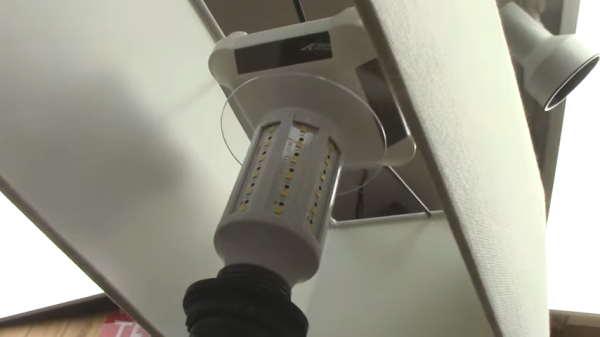
Two things we love are economical solutions to problems, and clever ways to use things for other than their intended purpose. [CelGenStudios] hits both bases with a simple illuminated and spinning sign made from a lamp and a couple economical pieces of hardware: an LED bulb, and a solar-powered product spinner. Both are readily and cheaply available from your favorite overseas source.
The first step in making a cheap illuminated sign is to not buy one, but instead make do with a standing lamp. Plug a bright LED bulb into the socket, decorate the lampshade with whatever logos or signs one wishes to display, and one has an economical illuminated sign suitable for jazzing up a table at an event. But what really kicks it up a notch is making it rotate, and to do that is where the clever bit comes in.
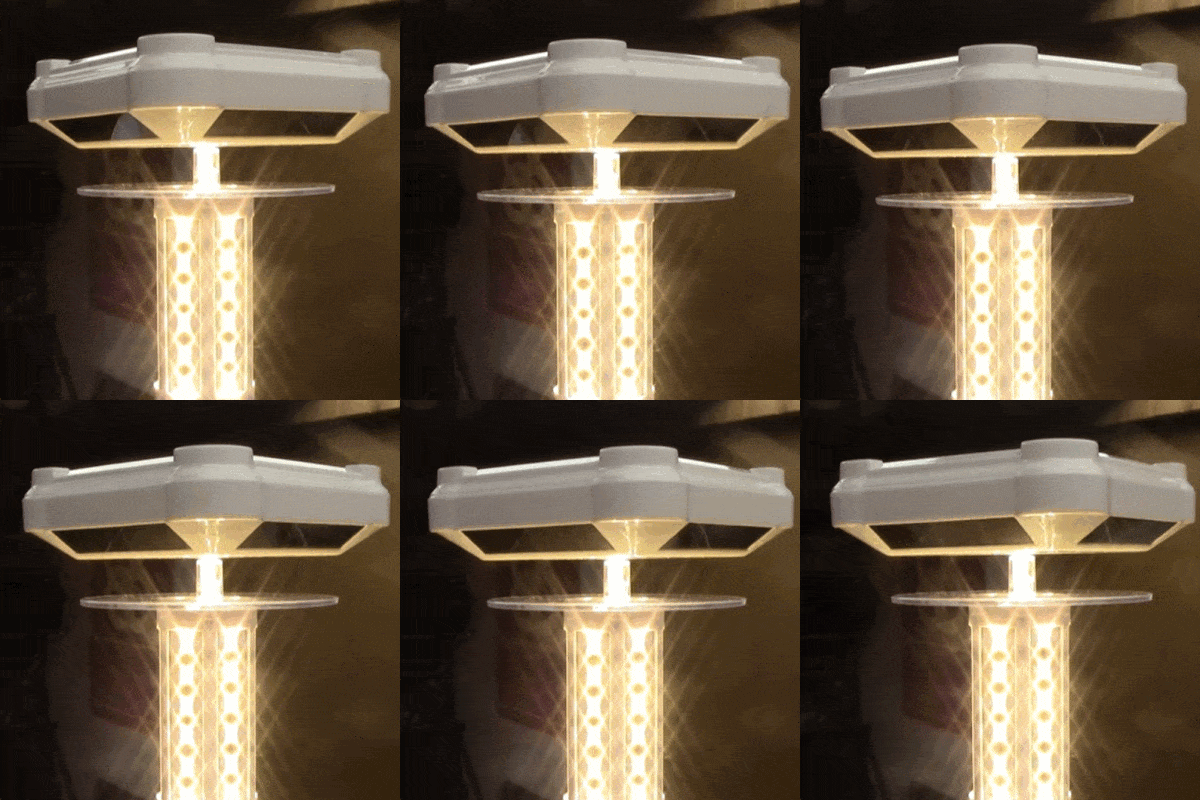
Mounting the lampshade to the solar turntable body yields a simple, rotating, illuminated sign.
The first attempt used a BBQ rotisserie motor to turn the whole lamp, but it was too loud and not especially stable. The second attempt used a “disco ball effect” LED bulb with a motorized top; it worked but turned too quickly and projected light upward instead of into the lampshade.
The winning combination is LED bulb plus a little solar-powered turntable onto which the lampshade mounts. As a result, the lampshade spins slowly when the lamp is turned on. It might not be the most durable thing to ever come out of a workshop, but as [CelGenStudios] says, it only needs to last for a weekend.
The basic concept is far more simple than it might sound, so check it out in the video (embedded below) to see it in action. Curious about what’s inside those little solar spinners? Skip to 5:55 in the video to see how they work. And if you’re intrigued by the idea of using solar power for motive force but want to get more hands-on with the electrical part, we have just the resource for turning tiny motors with tiny solar cells.
Traditionally, robot arms have been controlled either by joysticks, buttons, or very carefully programmed routines. However, for [Narongporn Laosrisin’s] homebrew build, they decided to go with gesture control instead.
The MeArm robotic arm is built using laser cut acrylic parts, and can be had in a kit if so desired. It features four servo motors, charged with rotating the arm’s base, pushing the arm forwards and backwards, up and down, and actuating its gripper. The servos are under the command of a micro:bit microcontroller board, which itself receives signals from a second micro:bit which is strapped to the human wishing to control the arm. The second micro:bit detects gestures with its accelerometer, and then sends the relevant commands to the robotic arm’s micro:bit over its built-in radio link. The arm controller then commands the servos to execute the maneuver.
It may be a small robotic arm that doesn’t have the capacity to lift much, but that’s not the point. This project is a great way to teach students how to program microcontrollers, work with sensor inputs, and just generally how to solve engineering puzzles. To that end, it looks like [Narongporn] has a great project on hand for teaching their students. Video after the break.
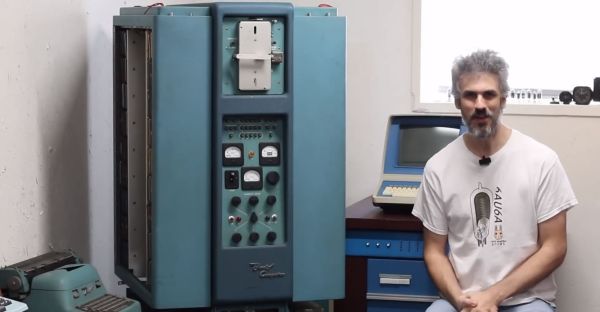
When it’s the 1950s and you are tasked to design a computer system that features not only CPU registers but also a certain amount of RAM, you do not have a lot of options. At this point in time, discrete logic was the rule, and magnetic core memory still fairly new and rather expensive. This is where the rotating drum comes in, which is somewhat like a cross between an old-style cylinder record and a hard drive. In a recent [Usagi Electric] video, a 1950s Bendix G15 system is demonstrated, which features such a rotating drum device, alongside both tube-based circuits and newfangled diode-based circuitry.
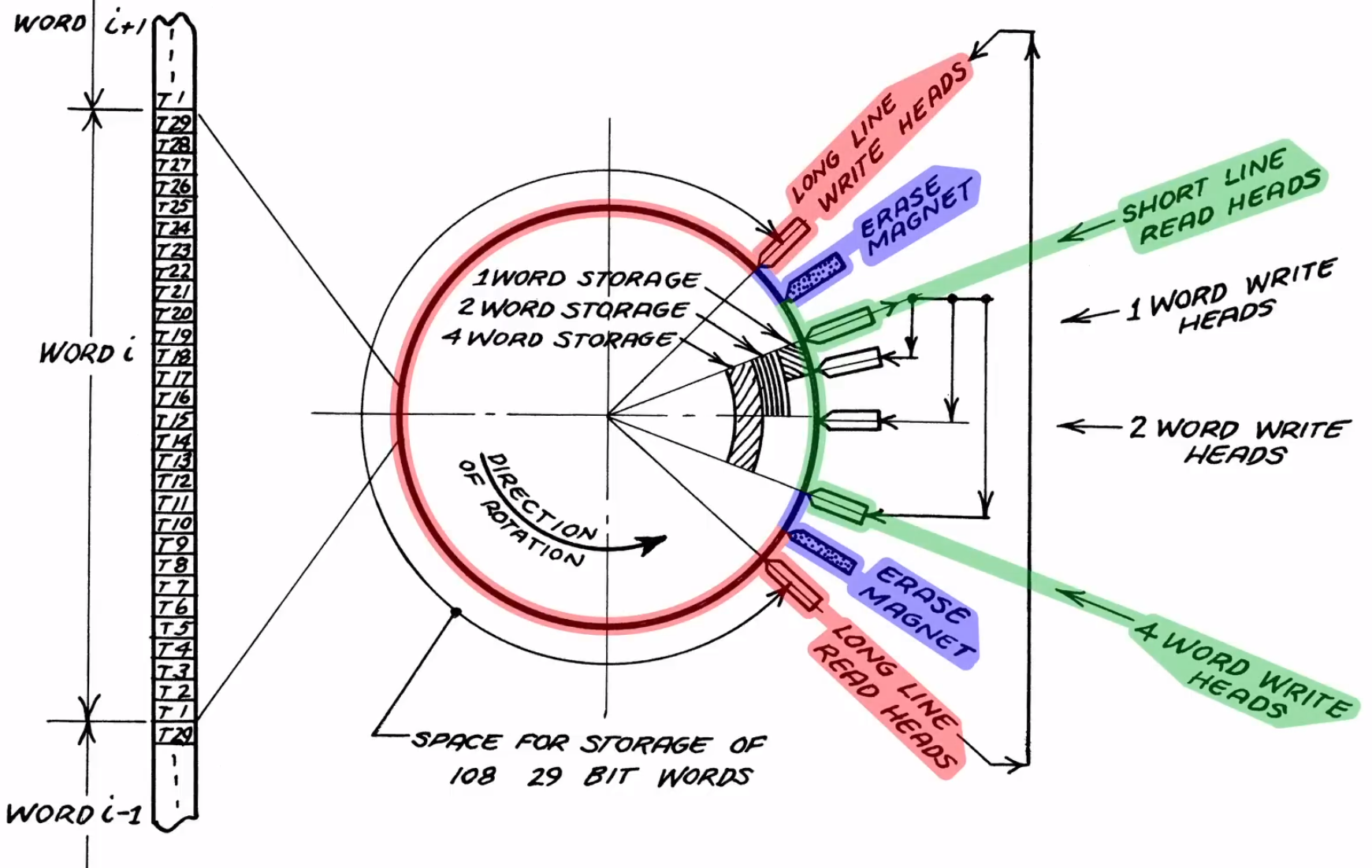
Simplified diagram of a rotating drum random access memory unit, showing the read-erase-write process as the drum spins.
This particular unit was borrowed from the System Source museum, with the intent to restore it to a working condition. Part of this process involved figuring out the circuitry, which was made easy by the circuit schematic drawings that came with the original machine. According to the official brochure by the manufacturer, the ‘short lines’ that are intended for the CPU registers, the access time was less than 1 millisecond, which is pretty darn fast considering the era and the discrete CPU’s clock speed.
For the drum itself, however, popping the cover off the unit showed that it had suffered some damage that had resulted in the multiple heads contacting the surface. Despite this disappointment, it’s not the end of the restoration, however. The museum has one more Bendix G15 standing around, with a rotating drum unit that looks to be in mint condition. The damaged magnetic coating on the other rotating drum may conceivably be resurfaced, which if successful could provide new hope to a lot of retro systems out there that also use magnetic media, whether in drum or disk format.
The Moon has fascinated humanity for centuries. These days, though, it’s a trial and a bore to go outside and stare upwards to check on the natural satellite. Instead, why not bring the Moon to your bedside with this rotating phase lamp?
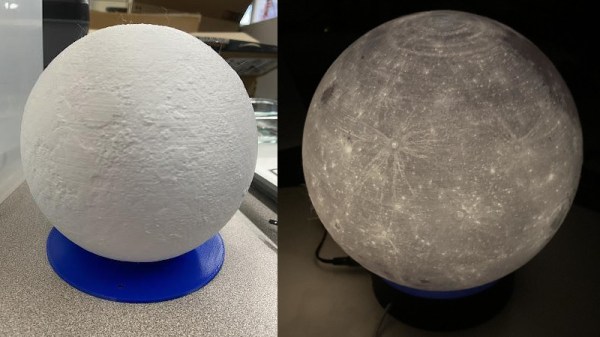
The build comes to us from [payasa_manandhar], who did a good job of replicating the Moon in both form and function. It’s based around a lithophane of the lunar surface, which adequately duplicates the Moon’s grey pockmarked visage thanks to topographical data sourced from NASA. It looks a treat when backlit from the inside. However, this is no mere ornamental lamp. With the aid of a stepper motor controlled by an Arduino, a shade inside the lamp actually rotates to shadow the Moon as per the appropriate phase.