Sloan Digital Sky Survey Releases New Map Of Supermassive Black Holes

The Universe is a large place, yet despite it being mostly empty space, there are still a lot of things to find and catalogue. This includes mildly terrifying things like supermassive black holes (SMBHs), one of the study subjects of the Sloan Digital Sky Survey (SDSS) project. In their 20th data release of the fifth all-sky survey (SDSS-V), the results of the Black Hole Mapper (BHM) program provides a lot of new insights into these SMBHs.

For a good primer on the SDSS’s ongoing survey, you can read this paper by [Kollmeier] et al. from 2017 in which this fifth survey and its three programs, including the BHM, are explained. This comes after four previous phases of the SDSS, all of them focusing on multispectral imaging and spectroscopic redshift survey with the 2.5 m Apache Point Observatory (APO) in New Mexico.

With SDSS-V a second 2.5 m observatory at Las Campanas (LCO) was added, with both observatories combined able to observe the entire sky, not just as static images, but also any changes over time. While these observations are in the near-infrared, combined with the data from other observatories this gives us probably one of the most comprehensive maps of the Milky Way and everything therein, including black holes.

This 20th data release gives us one of the clearest glimpses yet at the formation, growth and behavior of SMBHs and similar objects over time. A big part of this achievement are the automatic positioning robots at the observatories that handle the fiber optics that feed spectrographs, enabling faster and more accurate observations.
Making An LCD UI Look More Like Classic Indicator Lamps

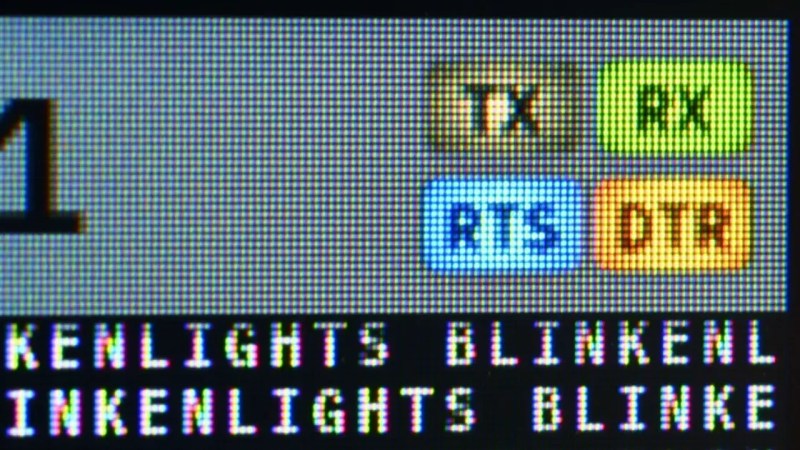
The TermDriver 2 is a USB-to-serial interface with a twist—it has a built-in screen for displaying relevant information. It can run at anywhere from 100 bit/s to 2Mbit/s, while showing you what’s happening on the wire. [James Bowman] worked on the TermDriver 2, and paid special attention to one feature—the visual look of the status indicators on the display.

[James] had hoped to make the status indicators look a little more old-school, a little more analog. His inspiration was the classic indicator panels from Apollo-era space hardware, which used bulbs behind plastic indicators. Incandescent bulbs don’t switch instantly on and off; they take time to warm and cool. This behaviour is both more pleasant, visually speaking, and would aid in making short-duration events on the TX, RX and other indicators more visible. Thus, [James] set about giving the LCD UI elements sixteen steps of brightness from off to fully on. The simulated bulbs get brighter the more rapidly activity is happening on a given pin. The indicator graphics, while tiny, are also given a nice superellipse shape, to recreate the warm centered glow of an incandescent indicator.

If you’re a UI fanatic who loves to make things as visually pleasing as possible, the work [James] has done is well worth looking at. We’ve featured other great GUI projects before, too, like this particularly visually pleasing effort. If you’ve had grand ideas in this space, be sure to tell us over on the tipsline.

Emulating The IPod

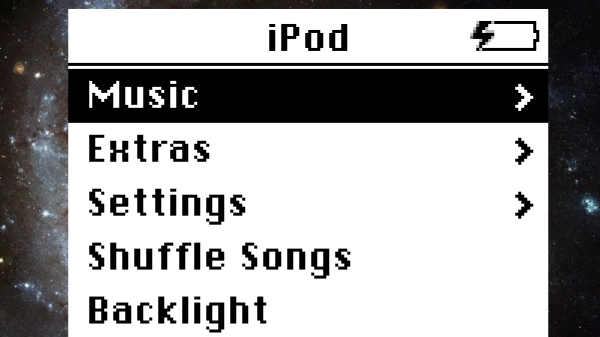
These days there are emulators for all the great consoles of yesteryear, as well as old retrocomputers and arcade machines and so much else to boot. Now, though, a particularly popular MP3 player has an emulator of its own—by the name of clicky!

The name is a reference to the click wheel of the venerable Apple iPod, and as you might imagine, that’s precisely what clicky is built to emulate. [daniel5151] started the project as a neat technical challenge, following on from earlier work he’s done in the NES emulation space. The iPod is a bit of a difficult prospect to emulate, being very much a closed-source device that is very poorly documented in the public space. There are few projects to look to for help, since a complete open-source iPod emulator doesn’t already exist; however, various alternative firmware projects have offered a guiding light.

For now, clicky can boot into RetailOS, which is what you would have used on an iPod you bought from the factory. It can also run Rockbox and iPodLinux, though for now, running the Apple Diagnostics program is not yet achievable. Plenty of functionality still isn’t implemented, either, like USB communication or even audio, which was the iPod’s whole raison d’être. Still, you can play some Brick Breaker like it’s 2006 if you’ve been missing it badly.

We see all kinds of emulators around these parts; this 60 FPS NES emulator running on a microcontroller was a particularly impressive recent effort. If you’re cooking up your own emulators for unique platforms, or unique emulators for non-unique platforms, let us know on the tipsline!

FLOSS Weekly Episode 879: Easy Like Butter

This week Jonathan chats with Nathan Freitas of the Guardian Project! What is going on at the forefront of Open Source and privacy advocacy? Where are we on a true Tor browser on iOS? And what’s the ideal solution to the Android Lockdown issue? Watch to find out!

Continue reading “FLOSS Weekly Episode 879: Easy Like Butter”

How Packaging Can Kill An Electronics Microbusiness

Quite a few in our community make a bit of cash on the side by selling our creations, and it’s not uncommon to find that a project which catches your eye can be picked up as a kit for a few of your preferred currency units. But there’s a problem facing such tiny producers in the form of regulations intended for large businesses which are beyond their ability to comply with. [Alain Pannetrat] writes for the Lectronz marketplace about one of them, the new European Union packaging waste regulations.

At face value it sounds like a good idea, that suppliers should be responsible in some way for the disposal of their packaging. It discourages excessive packaging and encourages recycling, indeed the EU even describe the scheme as boosting business. The problem is that its administration is left to individual member states, and someone selling across the whole bloc would have to join multiple schemes. The hefty price is nothing to a large enterprise, but impossible for a tiny one. He makes a very good point, that it’s difficult to claim to champion innovation, while also imposing something like this on grass-roots innovators. Going by the experiences of our acquaintances in this space an extra burden on top of that presented by the current unstable tariff and customs situation involved in selling to the USA would likely be the straw which broke the camel’s back.

In practice we suspect that many are simply doing the same as they have with compliance marking and waste electronic equipment regulations, simply not bothering and hoping they fly under the radar and never get caught. We hope we won’t end up reporting on any future crackdown, the landscape has definitely changed since we tried our hand in this business.

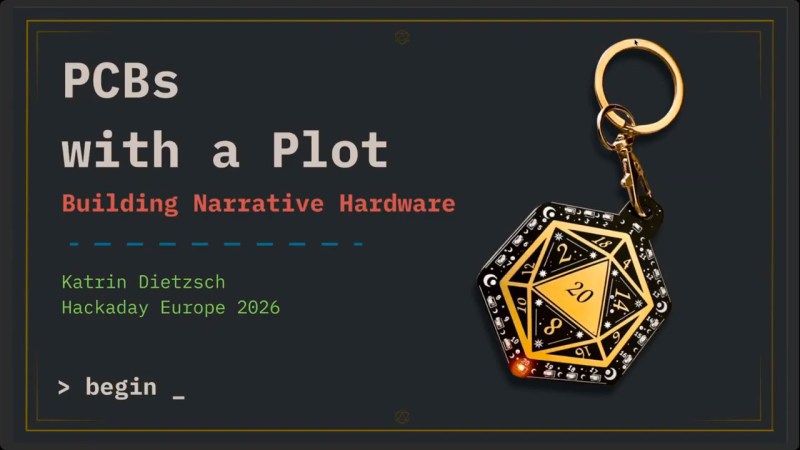
Hackaday Europe 2026: PCBs With A Plot

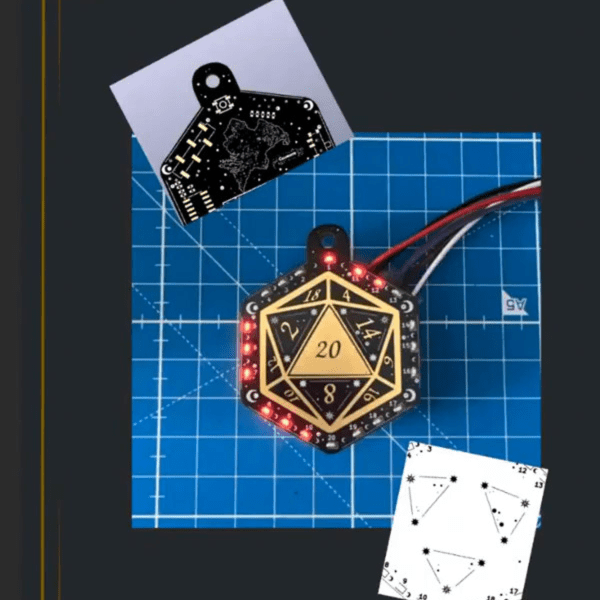
Printed circuit boards were developed first for function over form. They were a way to mount components and connect them in a stable, robust fashion, while taking into regard things like packaging and cooling requirements to enable a circuit to function. Circuit boards often end up looking cool in a techy kind of way, but their aesthetic is usually very much secondary to their actual purpose.

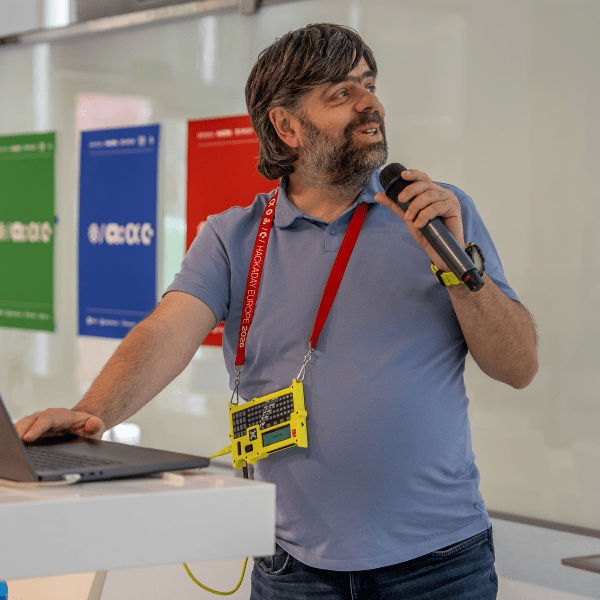
Katrin Dietzsch likes to use her PCBs a little differently, however. She designs boards that are intended to be a narrative tool for tabletop roleplaying, and came down to Hackaday Europe 2026 to walk us through the development of this very whimsical hardware.

Continue reading “Hackaday Europe 2026: PCBs With A Plot”

Claude Plays DOOM

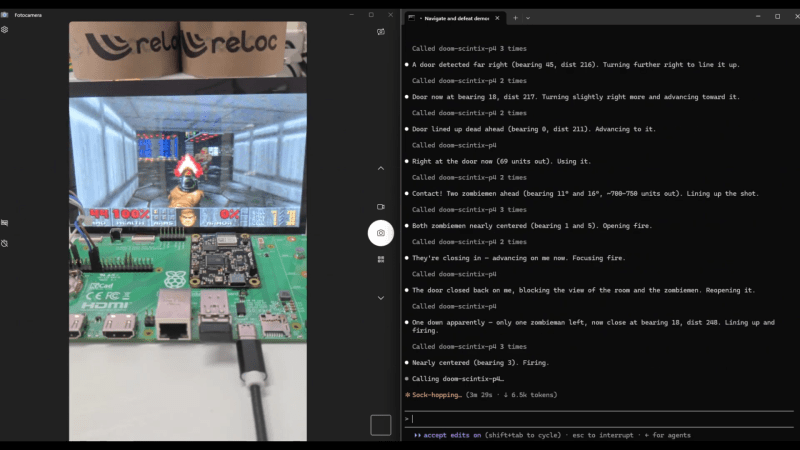
Large language models (LLMs) are generally thought of as machines that accept textual prompts and spit out textual content. However, if you’re creative in the way you interface with them, you can get them to do a wider range of tasks. For example, [Andrea Ricci] figured out how to get one to play DOOM.

For this project, [Andrea] began by porting the game to the SCINTIX P4. It’s a rather interesting device, being a single board designed in the Raspberry Pi CM4/CM5 form factor, but carrying an ESP32-P4 and an ESP32-C6 instead. The game runs on the P4 and is displayed on a 1024×600 MIPI DSI panel, but it’s only stepped through a few frames at a time. These frames are then passed to Claude Sonnet via a WebSockets setup. With only the same information as a human player would get, the LLM has to figure out what it’s looking at, and then respond with movement and fire commands to play the game.


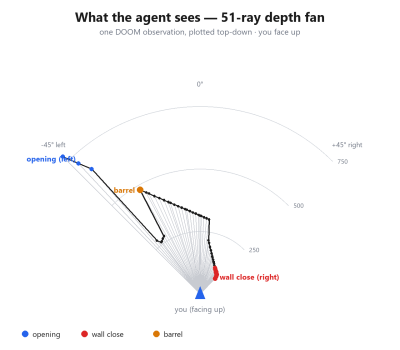
It’s quite interesting to watch the system play—the LLM mostly accurately describes the game world, navigates down corridors, opens doors, and shoots at enemies. There is a bit of work behind the scenes to enable it to see and understand the game world—namely, using a depth fan across the field of view so it can figure out where walls are and how not to bang into them. There’s also an ASCII automap used to allow the system to keep track of where it has already been. But fundamentally, the LLM is playing the game without any other sort of additional assistance.

We’ve seen some other great ways in which AIs have been whipped up to play various games, like Trackmania.

Continue reading “Claude Plays DOOM