A cylindrical grey robot sits on a white mat. The robot is made of three grey sections connected by a series of radially-arranged copper pillars.

Controlling A Vibrobot With Only One Motor

The vibrobot – a vibrating motor and battery attached to the head of a brush – isn’t truly a robot, since its movement can’t be controlled, but it’s whetted the interest of many future roboticists. With a clever control method, though, it is in fact possible to drive them in any desired direction while using only one motor.

[Namaskar Mitro] based the design of this robot on this research paper; if the vibrating motor is mounted at an angle above the base of the robot, it causes the bot to rotate, and if the motor is mounted off-center from the center of mass, the robot moves in a circle. Crucially, reversing the direction of the motor’s rotation reverses the direction of the robot’s rotation. By rapidly switching the direction of rotation, the bot can move in a series of short, shallow arcs which approximate a straight line.

The robot which [Namaskar] built was based on an ESP-01F microcontroller, which let it be remote-controlled over Wi-Fi. It used a DRF8212 motor driver to control a vibrating pager motor, which was housed inside a 3D-printed enclosure. To move in a straight line, the ESP-01F switches the motor’s direction every 250 milliseconds, which still produces a slightly erratic movement. It can, however, approximately follow a traced path.

This adds to the previous vibrobot control methods we’ve seen: a pair of differentially-driven vibrating motors or a weight-shifting mechanism.

Thanks to [110y6] for the tip!

Robot Sees Light With No CPU

If you ever built a line following robot, you’ll be nostalgic about [Jeremy’s] light-seeking robot. It is a very simple build since there is no CPU and, therefore, also no software.

The trick, of course, is a pair of photo-sensitive resistors. A pair of motors turns the robot until one of the sensors detects light, then moves it forward.

Continue reading “Robot Sees Light With No CPU”

Behold Self-Synchronizing, Air-Flopping Limbs That Hop And Swim

Dutch research institute [AMOLF] shows off a small robot capable of walking, hopping, and swimming without any separate control system. The limbs synchronize thanks to the physical interplay between the robot’s design and its environment. There are some great videos on that project page, so be sure to check it out.

A kinked soft tube oscillates when supplied with continuous air.

Powered by a continuous stream of air blown into soft, kinked tubular limbs, the legs oscillate much like the eye-catching “tube man” many of us have seen by roadsides. At first it’s chaotic, but the movements rapidly synchronize into a meaningful rhythm that self-synchronizes and adapts. On land, the robot does a sort of hopping gait. In water, it becomes a paddling motion. The result in both cases is a fast little robot that does it all without any actual control system, relying on physics.

You can watch it in action in the video, embedded below. The full article “Physical synchronization of soft self-oscillating limbs for fast and autonomous locomotion” is also available.

Gait control is typically a nontrivial problem in robotics, but it doesn’t necessarily require a separate control system. Things like BEAM robotics and even the humble bristlebot demonstrate the ability for relatively complex behavior and locomotion to result from nothing more than the careful arrangement of otherwise simple elements.

Continue reading “Behold Self-Synchronizing, Air-Flopping Limbs That Hop And Swim”

The Design Process For A Tiny Robot Brain

As things get smaller, we can fit more processing power into devices like robots to allow them to do more things or interact with their environment in new ways. If not, we can at least build them for less cost. But the design process can get exponentially more complicated when miniaturizing things. [Carl] wanted to build the smallest 9-axis robotic microcontroller with as many features as possible, and went through a number of design iterations to finally get to this extremely small robotics platform.

Although there are smaller wireless-enabled microcontrollers, [Carl] based this project around the popular ESP32 platform to allow it to be usable by a wider range of people. With that module taking up most of the top side of the PCB, he turned to the bottom to add the rest of the components for the platform. The first thing to add was a power management circuit, and after one iteration he settled on a circuit which can provide the board power from a battery or a USB cable, while also managing the battery’s charge. As for sensors, it has a light sensor and an optional 9-axis motion sensor, allowing for gesture sensing, proximity detection, and motion tracking.

Of course there were some compromises in this design to minimize the footprint, like placing the antenna near the USB-C charger and sacrificing some processing power compared to other development boards like the STM-32. But for the size and cost of components it’s hard to get so many features in such a small package. [Carl] is using it to build some pretty tiny robots so it suits his needs perfectly. In fact, it’s hard to find anything smaller that isn’t a bristlebot.

Continue reading “The Design Process For A Tiny Robot Brain”

Micro Robot Disregards Gears, Embraces Explosions

Researchers at Cornell University have developed a tiny, proof of concept robot that moves its four limbs by rapidly igniting a combination of methane and oxygen inside flexible joints.

The device can’t do much more than blow each limb outward with a varying amount of force, but that’s enough to be able to steer and move the little unit. It has enough power to make some very impressive jumps. The ability to navigate even with such limited actuators is reminiscent of hopped-up bristebots.

Electronic control of combustions in the joints allows for up to 100 explosions per second, which is enough force to do useful work. The prototype is only 29 millimeters long and weighs only 1.6 grams, but it can jump up to 56 centimeters and move at almost 17 centimeters per second.

The prototype is tethered, so those numbers don’t include having to carry its own power or fuel supply, but as a proof of concept it’s pretty interesting. Reportedly a downside is that the process is rather noisy, which we suppose isn’t surprising.

Want to see it in action? Watch the video (embedded below) to get an idea of what it’s capable of. More details are available from the research paper, as well.

Continue reading “Micro Robot Disregards Gears, Embraces Explosions”

Random Robot Makes Random Art

For the price of a toothbrush and a small motor with an offset weight, a bristlebot is essentially the cheapest robot that can be built. The motor shakes the toothbrush and the bristle pattern allows the robot to move, albeit in a completely random pattern. While this might not seem like a true robot that can interact with its environment in any meaningful way, [scanlime] shows just how versatile this robot – which appears to only move randomly – can actually be used to make art in non-random ways.

Instead of using a single bristlebot for the project, three of them are built into one 3D printed flexible case where each are offset by 120°, and which can hold a pen in the opening in the center. This allows them to have some control on the robot’s direction of movement. From there, custom software attempts to wrangle the randomness of the bristlebot to produce a given image. Of course, as a bristlebot it is easily subjected to the whims of its external environment such as the leveling of the table and even the small force exerted by the power/communications tether.

With some iterations of the design such as modifying the arms and control systems, she has an interesting art-producing robot that is fairly reliable for its inherently random movements. For those who want to give something like this a try, the code for running the robot and CAD files for 3D printing the parts are all available on the project’s GitHub page. If you’re looking for other bristlebot-style robots that do more than wander around a desktop, be sure to take a look at this line-following bristlebot too.

Thanks to [johnowhitaker] for the tip!
Continue reading “Random Robot Makes Random Art”

Making Art With Keycap Bots

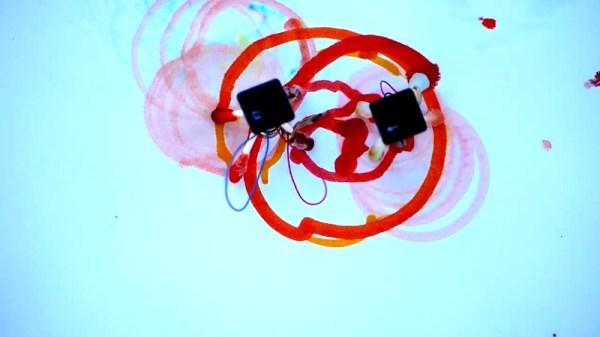
Robots come in all shapes and sizes, from remote landers on distant planets to assembly arms working hard in auto plants. Of course, the definition is broad and can contain more frivolous entities, too. [smdavee]’s watercoloring ‘bots may not be particularly complex or sentient, but they’re a fun creative build.

The design is akin to that of the BristleBot, with a pager vibration motor allowing the ‘bot to wobble about on unsteady feet. In this case, a keyboard cap is used, with cottontips inserted in the base to act as legs. These are then dipped in watercolor paints, and the attached motor is then switched on to vibrate the ‘bot around the page.

It’s an easy build, and one that would be particularly well-suited to teaching young children basic electronic concepts. Plus, there’s the added fun of getting to make a mess with watercolors, too. If you’ve got a fun art robot hiding away in your garage, be sure to let us know. Video after the break.

Continue reading “Making Art With Keycap Bots”