DIY Ultra Wideband Impulse Synthetic Aperture Radar And A MakerBot

state

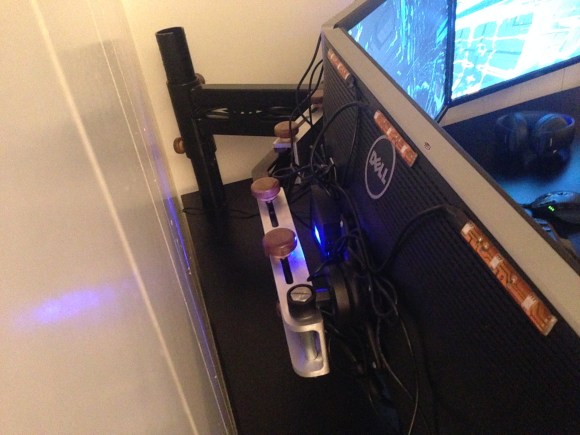
What could possibly be better than printing out a few low-resolution voxels on a MakerBot? A whole lot of things, but how about getting those voxels with your own synthetic aperture radar? That’s what [Gregory Charvat] has been up to, and he’s documented the entire process for us.

The build began with an ultra wideband impulse radar we saw a while ago. The radar is built from scraps [Greg] picked up on eBay, and is able to image a scene in the time domain, creating nice linear sweeps on a MATLAB plot when [Greg] runs in front of the horns.

With an impulse radar under his belt, [Greg] moved up the technological ladder to something that can produce vaguely intelligible images with his setup. The synthetic aperture radar made from putting his radar horns on the carriage of a garage door opener. The horns slowly scan back and forth along the linear rail, taking single impulse readings and adding them together in an image. In the video below, [Greg] is able to image a few pieces of copper pipe only a few inches in diameter. The necessary equipment for this build only cost [Greg] a few hundred bucks at the Dayton Hamvention, and a similar setup could be put together for even less.

If building an X band impulse synthetic aperture radar isn’t impressive enough. [Greg] also 3D printed one of his radar images on a MakerBot. That’s just applying stlwrite to the 2D radar image and feeding it into MakerWare. Gotta have that blog cred, doe. It also makes for the best headline I’ve ever written.

Continue reading “DIY Ultra Wideband Impulse Synthetic Aperture Radar And A MakerBot”

The Hackaday Prize: Thinking Really, Really Big

Dome

In case you’ve been living under a rock for a few weeks, we’re giving away a trip to space for the best, most grandiose connected hardware project. [coxrandy], a.k.a. [Phillip Cox] realized the best way to build something awesome was to think big, and his plan for building a 1km dome (yes, 1000 meters) is the most ambitious project we’ve ever seen.

The BuckyBot, as [Phil] is calling his build, relies on the ideas of the great [Buckmister Fuller] and his idea to build a huge geodesic dome covering all midtown Manhattan. [Fuller] didn’t have the resources to build a structure this large in the 1950s, and to be honest, we don’t have the resources to build it nowIt would be a ludicrous effort to build something like this one beam at a time, and [Phil] concludes that to build something this big, we need to think small.

Instead of thousand ton cranes and several thousand vehicles trucking in building supplies, [Phil]’s idea uses small “BuckyBots” – a combination 3D printer and robot – that builds one structural cell of a giant dome at a time. These BuckyBots climb around the structure, build the internal and support structure, slowly climbing to the skies on their fractal-inspired creation.

The Hackaday Prize contest will end far before [Phil]’s BuckyBots will have the ability to build a kilometer-wide dome, so the current plans are to modify his RepRap Mendel to crawl. Once that’s done, he’ll have his newly built BuckyBot build a 2 meter hemisphere in his garage. From there, construction moves to the back yard where a 10 meter dome will be built.

Even if this project never makes it past the planning stages, it’s an awesome example of thinking big, something you’re going to need if you’re trying to win a trip to space.

Plug And Play Portable Console Saves Space So You Don’t Have To!

Plug and Play console

Remember all those fun plug and play consoles they used to make? Usually just one offs with a few games here and there, typically designed to get poor old grandmothers to try buying them instead of the official Nintendo or SEGA systems for their grandchildren…

Anyway, some of the games were actually pretty good! But who wants to store a system for every individual game? [Sharon] decided to make the ultimate portable console — and jammed every plug and play console… into cartridges for safe keeping!

Wait what? [Sharon] took 12 of the plug and play consoles, hacked them to pieces, and managed to stuff the guts into custom game cartridges she made herself. She then made the HandyPNP, a “base console” with buttons and controls, video output and an LCD screen. She meticulously mapped out every consoles’ controls, and wired them accordingly, so when you plug the cartridge into the HandyPNP, it’s like your playing the original system.

It’s probably one of the most impressive handheld console hacks we’ve seen in a while, just considering the amount of work required to convert one console, let alone 12, to a standard connection for the HandyPNP to communicate with. Stick around after the break to hear [Sharon] explain the project herself!

Continue reading “Plug And Play Portable Console Saves Space So You Don’t Have To!”

Tell Time And Blink An LED On Your Wrist With WatchDuino

Watchduino Open Source Watch

Is your hipster wrist having a hard time waiting for the debut of the iWatch? There’s a new open hardware/software project out that could help calm your nerves. The WatchDuino is exactly what it sounds like, an Arduino-based wrist watch.

The component list is short and inexpensive. The meat and potatoes consist of an ATMega328, crystal, Nokia LCD screen and LiPo battery. The USB-rechargeable battery lasts about a week before needing to be such. Besides presenting the Time and Date in both analog or digital formats (as you would expect) there is an alarm and timer. Additionally, there are 2 games, Pong and Snake. Any lack of features is made up for the fact that the software is open and can be modified and added to by the community. We’re sure the development of this watch will be quick and significant.

Continue reading “Tell Time And Blink An LED On Your Wrist With WatchDuino”

Hands-on With The FlexyDualie 3D Printer Extruder

Flexydualie Extruder

Ever heard of the FlexyDualie extruder? It’s a new opensource dual extruder from Aleph Objects (makers of the Lulzbot and TAZ), specifically designed for printing in a hard material — and a flexible one!

[James Bruton] of XRobots just got his hands on one and a new TAZ printer, and he’s shared his thoughts. He’s using ABS plastic and Ninjaflex rubber filament to test it out. Sure you can sometimes print with Ninjaflex using a regular extruder… but get ready for headaches as it jams in your extruder guide. The FlexyDualie is specifically designed for extruding flexible filaments which results in a lot less headaches, and a lot more productivity!

In the following demonstration video, [James] shows us the awesome possibilities of printing parts in both a hard and soft material. He even goes into detail on how to setup Slic3r for multi-material STL files.

Continue reading “Hands-on With The FlexyDualie 3D Printer Extruder”

Dual Port RAM Teaches An Old NES New Tricks

nesDPR

[Andrew] is developing a game for the Nintendo Entertainment System (NES). Emulators are great for this, but [Andy] loves running on the real iron. To help, he’s created a dual port RAM interface for his NES. As the name implies, a dual port RAM is a memory with two separate data and address buses. The Cypress Semiconductor CY7C136 [Andy] used also includes arbitration logic to ensure that both ports don’t attempt to access the same memory cell and cause data corruption. In [Andy’s] case the NES was on one side, oblivious to the new hardware. On the other side of the dual port RAM, [Andy] installed an ATmega164 running his own custom firmware.

The new hardware gives [Andy] a live view of what’s going on in the NES’s memory. He added a live memory view/edit screen similar to the FCEUX emulator. The window runs on a PC while the game itself is running on an NES. [Andy] was even able to add rudimentary break and step features by connecting his circuit to the Non Maskable Interrupt (NMI) line of the NES. By holding the NMI asserted, the ATmega can essentially freeze the game in progress.

[Andy] has even used his circuit to teach the NES some new tricks. By reading the timer and score memory locations on Ice Hockey, he was able to create a scoreboard and goal light. Similar techniques were used to give Contra a muzzle flash light which puts Ambilight systems to shame.

We don’t know what [Andy] is planning next, but we hope it’s a source release so we can start hacking some some games ourselves!

Click past the break to see a couple of [Andy’s] Vine videos.

Continue reading “Dual Port RAM Teaches An Old NES New Tricks”