A Really, Really Tiny Microcontroller Board

Here’s something very cool from the wonderful world of Adafruit: The Trinket, an Arduino compatible microcontroller platform that’s not only small enough to fit in your pocket, it’s small enough to lose in your pocket.

Like the similarly specced Digispark, the Trinket features an ATTiny85 microcontroller with 5 IO pins. Unlike the Digispark, the Trinket is a bit more substantial, featuring 3.3 and 5 Volt regulators along with a real USB port and mounting holes. As this is based on the ‘tiny85, it’s possible to connect this up to I2C and SPI sensors and peripherals

One thing to note about the Trinket is the fact that it’s so cheap. Either version of the Trinket goes for about $8, inexpensive enough to simply leave in a project when you’re done with it. Given the cool stuff we’ve already seen created with the Digispark, including a homebrew stepper motor and an Internet meme and lame pun assessment tool, we can’t wait to see what’s made with the Trinket,
Jack The DVD Ripping Robot

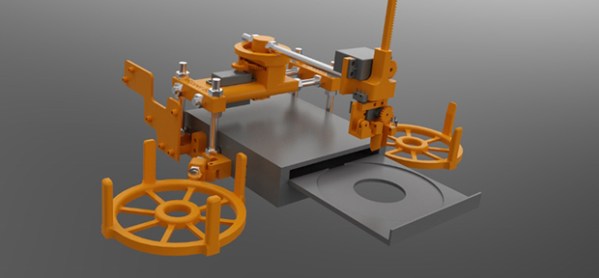
[Andy] had a fairly large problem on his hands. For the last 15 years, he’s been collecting DVDs, and since he began, he’s run out of space on his shelves for these miraculous plastic discs. Everything’s going to the cloud now, so he decided to build a media server, replete with rips of all his DVDs. As anyone who has ever tried to rip a movie knows, this can be a very long and tedious process. His solution to this should be something near and dear to all of us – he decided to build a robot to rip all his DVDs automatically.

With a brand new 3D printer, [Andy] set to work on designing Jack the Ripper Bot. The design has two trays mounted to a standard computer DVD drive, an ‘in’ tray and an ‘out’ tray. The frame of the machine bolts directly to the drive, and the entire contraption is driven by only three standard hobby servos.

The robot is driven by a Raspberry Pi, but the ripping actually takes place on an old laptop. [Andy] says it takes about an hour and a quarter to rip a DVD, so a full ‘in’ tray of 24 discs means about 28 hours of ripping time. Feeding the machine once a day is a lot better than returning to the computer every hour or so, we think.

All the STLs for the printed parts and the software for the Raspi and computer are up on [Andy]’s github, should anyone want to upgrade this to a Blu Ray ripper.

Thanks [Stephen] for sending this one in.

Continue reading “Jack The DVD Ripping Robot”

Making Asteroids Miniature

Asteroids

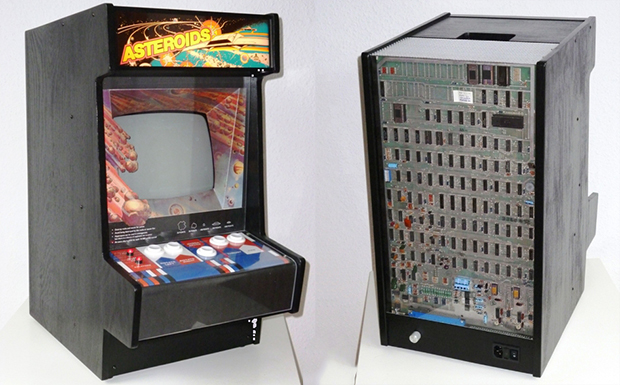
Mini arcade cabinet builds are fairly common, but we’ve never seen anything like [Jurgen]’s mini vector Asteroids cabinet that takes an original Asteroids circuit board and a true vector monitor and shrinks it down to table top size.

Unlike the raster monitors of a later generation’s arcade games, the original Asteroids cabinet used a vector monitor just like one would find in an oscilloscope. [Jurgen] found the perfect CRT in, of all places, a broken Vectrex console. The video circuitry in the Vectrex was rather primitive and the beam deflection was far too slow for the video signals generated by the Asteroids PCB. To get around this, [Jurgen] added a custom XY driver board. While the Asteroids game – and other vector Atari games – were designed for a screen with 1 MHz of bandwidth, [Jurgen] found that 300 kHz was ‘good enough’ to display proper Asteroids graphics.

While the cabinet isn’t a miniaturized version of any proper cabinet, [Jurgen] did manage to build a rather nice looking case for his luggable version of Asteroids. The exposed PCB on the back is a great touch, and an awesome project for any ancient video game aficionado.

Custom Car Keypad Entry

jeepKeyless

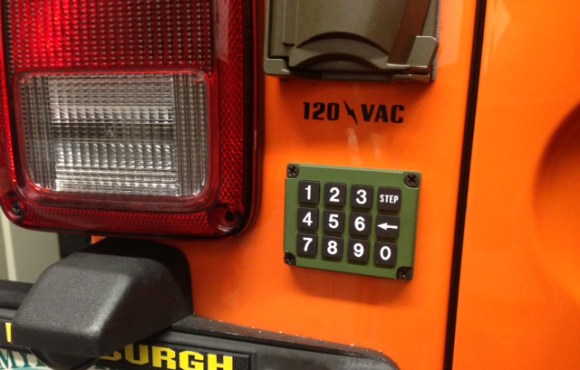
[EdsJunk] loves the outdoors and using his Jeep Wrangler to get him there, but hiding a key just to go for a swim makes him nervous. After a friend showed him how convenient it was to have keypad entry to his vehicle, [EdsJunk] decided it was time he built his own.

The build uses a spare waterproof keypad attached to an Arduino Micro. [EdsJunk] simplified things by cannibalizing his extra keyless entry keyfob; if the ‘duino receives the right code from the keypad, it presses the unlock button on the keyfob to grant access. [EdsJunk] admits that the Wrangler’s soft top is easy enough to get into, but explains that the goal of this project is to keep the alarm activated, which would presumably go off if someone tried to break in through the soft top. You can watch a video demo of the keypad access below. This is another great addition to the multitude of hacks he’s performed on one vehicle.

We do, however, hope that there’s some kind of lockout built into the code to prevent brute forcing: it should be easy enough to activate the car’s panic button after a set number of failed attempts. Car hacks are popular this summer: check out the Real Car Remote Control if you missed it.

Continue reading “Custom Car Keypad Entry”

‘conus’ Mixes Media, Math And Mollusks

conusCA

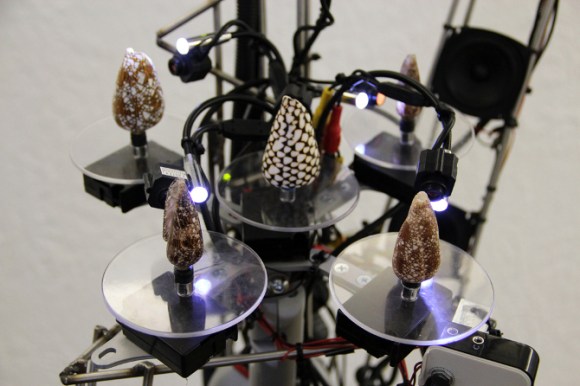
We love art installations that use technology in ways probably never before considered, and Moscow media artist [Dimitry Morozov] has done just that with ‘conus’, which reads the surface of mollusk shells and translates the data into real-time audio and video. These shells are unique; their pigmentation generates natural cellular automata. (If you’ve never heard of cellular automata, Conway’s Game of Life is a good example, where a rule set determines whether a cell lives, dies, or regenerates.

[Dimitry’s] installation uses homemade digital microscopes to scan the naturally-created cellular automata of several shells, each rotating on its own disc. As the shell spins, the scans from the microscopes are fed into an algorithm which transforms the signals into data for multiple audio channels and three video monitors. You can watch the mathematical translation of the biologically-formed patterns in a video after the break.

Check out the MSP430 game of life shield for another example of cellular automata.

Continue reading “‘conus’ Mixes Media, Math And Mollusks”

Diesel Bike Build: Round 2

alexDieselBike02

[Alex] has been hard at work on his second vegetable-oil-powered diesel bike build. The last time we checked in, he was finishing off work on his Honda CB400. Unfortunately, he felt it wasn’t quite big enough to ride comfortably, and as most first builds go, it was burdened with its share of problems. Now he’s snagged a Yamaha XJ600 off eBay, cleaned it up and started the modifications. [Alex] extended the frame to accommodate a new engine, rebuilt the gearbox, and perhaps most daunting: turned down the pulleys with a vintage 1950’s lathe.

Now that [Alex’s] bike has passed the MOT inspections, he can enjoy cruising around while doing his part to save the environment. His build log details the process, and is packed with enough pictures to keep you busy for a few hours while it walks you through each step. You can watch the bike’s test-run video below. For you off-road types, check out the all-wheel drive motorcycle from last month.

Continue reading “Diesel Bike Build: Round 2”

Solar Power For Your Bike

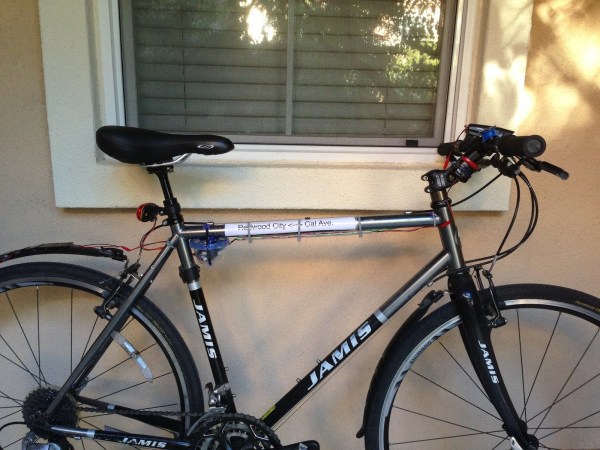
After the headlight on his bike died, [Patrick] decided this was the best time to hack the remains and solve a few problems: namely a constantly drained battery from accidentally forgetting to turn the light off. He opted for a solar solution, as he already had both an Adafruit solar lithium charger and a Seeed Li-po Rider. [Patrick] picks the Adafruit board for its extra safety features like temperature sensing to prevent the cell from overheating.

The build uses 9 eBay-sourced 2V mini solar panels attached neatly on the bike’s mudflaps. Three groups of 3 panels in series provide the needed 6V into the Adafruit lithium board which safely charges a spare 900mAh Nokia phone battery from the junk drawer. [Patrick] admits this solar setup may be overkill. He decided to include a USB jack to keep his phone charged for some Google maps navigation. The Adafruit board does not step up to 5V, however, so [Patrick] tacks on a Mintyboost kit to kick the Lipo’s output up high enough to charge the phone.

Solar’s not the only alternative way to power your bike’s lights. Check out the RattleGen from earlier this year if you missed it.