Self Balancing Robot Uses Cascading PID Algorithms

At this point we’re beginning to think that building a self-balancing robot is one of the rights of passage alongside blinking some LEDs and writing Hello World on an LCD screen. We’re not saying it’s easy to pull off a build like this one. But the project makes you learn a lot about a wide range of topics, and really pushes your skills to the next level. This latest offering comes from [Sebastian Nilsson]. He used three different microcontrollers to get the two-wheeler to stand on its own.

He used our favorite quick-fabrication materials of threaded rod and acrylic. The body is much taller than what we’re used to seeing and to help guard against the inevitable fall he used some foam packing material to protect the top level. Three different Arduino boards are working together. One monitors the speed and direction of each wheel. Another monitors the IMU board for position and motion feedback, and the final board combines data from the others and takes care of the balancing. Two PID algorithms provide predictive correction, first by analyzing the wheel motion, then feeding that data into the second which uses the IMU feedback. It balances very well, and can even be jostled without falling. See for yourself in the clip after the break.

Continue reading “Self Balancing Robot Uses Cascading PID Algorithms” →

Viewing CCTV On Every Street Corner

2.4 GHz video transmitters are everywhere these days, in many, many products ranging from baby monitors to CCTV setups. Surprisingly, most owners of these video devices don’t realize they’re transmitting an unencrypted video signal, a belief [Benjamin] hopes to rectify.

[Ben]’s project started with him driving around cities recording unencrypted 2.4GHz video feeds. His idea has since expanded to include building metal boxes with an LCD display and attaching them to light poles. Think of it as an education via technology; most people don’t know these devices are receivable by everybody, and showing them it is possible is the first step in learning.

If you’re looking for something a little more creepy than a metal box attached to a lamp-post, [Ben] is also the brainchild behind the Surveillance Video Entertainment Network, an installation (also in van form) that exposes unencrypted 2.4 GHz video transmissions in cities around the world.

You can check out a few intercepted surveillance videos after the break.

Continue reading “Viewing CCTV On Every Street Corner” →

Building An Autonomous Robot From An Xbox 360 Controller

Wow, it’s amazing what [Carl] was able to build using an Xbox 360 control PCB as the base for his robot. His forum posts just touches the surface of the build, but he linked to a PDF file which has the full details.

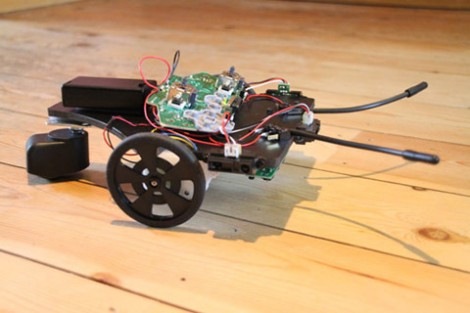
This build basically attaches sensors and replacement motors to the controller board… and that is it! Some distance sensors are connected to the analog inputs for the left and right trigger. The whiskers use a couple of leaf switches soldered to controller button pads. The motors are geared replacements that use the same connectors as the rumble motors did.

The idea is that the controller is connected to a PC via the wireless radio it has on the PCB. Once the connection is made the PC software can read from all of the sensors and drive the motors accordingly. It would also be really easy to use a single-board solution like the RPi to do away with the need for a remote PC. But this is a fantastic start, and an approach which we had never before considered. See some video of the little guy getting around the room after the break.

Continue reading “Building An Autonomous Robot From An Xbox 360 Controller” →

Retrotechtacular: The Miracle Of Vacuum Tubes

We take our digital life for granted these days, but back in 1943 it was vacuum tubes, not transistors, which made it all possible. This video on the types and industrial uses of vacuum tubes was sent into the tips line by [Polar Bear]. The nearly 70-year-old video is part of a collection preserved by the New Jersey Amateur Radio Club.

The video was underwritten by Westinghouse, and as you can expect it has a bit of propaganda spin for the company. The time period in which the reel was produced is also telling. Coming about two years after the attack on Pearl Harbor, the applications for technology of the time are almost all military in focus. But we’re sure you’ll be entertained by both the film style and the tech explanation. It’s something of a How It’s Made of yesteryear. All twenty-one minutes of it are found embedded after the break.

Continue reading “Retrotechtacular: The Miracle Of Vacuum Tubes” →

Batarangs For The Dark Knight Rises

The Dark Knight Rises is out now, and [Christian] over at MakeIt Labs decided to show up everyone at this year’s Halloween party with these custom made Batarangs.

After the Batarangs were plasma cut out of 11-gauge steel, [Rob] beveled the trailing edges of the wing, powder coated them, and sharpened them with a grinder and a diamond stone. Yes, these Batarangs are probably much better weapons than the on-screen logo shaped shuriken, but it’s questionable how useful they are compared to perfectly balanced CGI weaponry. They’re a really awesome looking build perfect for this year’s Halloween costume.

One small word of warning for all the commentors: We know a few of you have already seen the midnight showing of The Dark Knight Rises, but posting any spoilers will result in a member of the Hackaday team hunting you down and savagely beating you. Also, given the shooting at the premier in Aurora, Colorado you probably don’t want to bring weapons – even prop ones – to a movie theatre.

You can check out the making of video for [Christian]’s Batarangs after the break.

Continue reading “Batarangs For The Dark Knight Rises” →

copper-islands

Cutting Islands Into Copper-clad PCBs With A Drill

If you’re looking to build some small radio circuits, or if you are simply seeking a new look for your PCBs, you might want to check out what YouTube user [AndyDaviesByTheSea] has been working on lately. He has been building RF circuits as of late and was searching for a better way to create islands or “lands” on copper-clad PCBs.

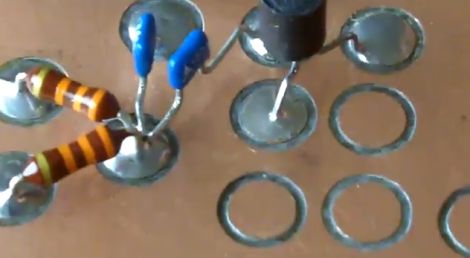
He says that these sorts of islands are traditionally cut into the PCB with a scalpel or file – hardly an efficient process. [Andy] did a little experimenting and found a great way to quickly and precisely cut lands with a drill. Borrowing a bit of metal from an old VHS tape, he crafted a circular land cutter with a metal file. When mounted as a drill bit, his cutter produces clean, shallow cuts which create perfect lands on which to solder his components.

The only drawback to this method is that [Andy] found his bits were being dulled by the fiberglass boards pretty quickly. His solution was to carefully grind a broken heavy duty drill bit to do the task, which he says works even better than his original cutter.

Hackaday Links: July 20, 2012

Hey, it’s the 43rd anniversary of men first walking on the moon. Here’s some stuff we found to celebrate that. Fun trivia: for Apollo 11, [Neil] and [Buzz] didn’t go more than 200 feet from the LEM.

This is so incredibly sad

Remember Heathkit? A lot of cool kit-based electronics came from them. They’re out of business, but you can get all the Heathkit swag you can imagine from the repo man. A ton of stuff from the old Heathkit headquarters is being auctioned off in Byron Center, Michigan this Tuesday, July 24. Notable lots include a HE-Robot and a nice pair of o’scopes. If someone wants to pick up one of the catalog lots for us, we’d be thankful.

Troll Physics: ‘What is with this guy’ edition

We’ve seen [Fredzislaw]’s LED trickery before. The first time was a crazy 3 LED circuit, the reveal of which showed two AC power supplies in a battery connector. This time, [Fred] has two switches and an LED. Turn one switch on, the LED lights up. Turn that switch off and flip the other one, the LED still lights up. Turn both switches on, the LED goes off. Your guess is as good as ours.

Prototyping with a key fob remote

[Gary] wrote in to tell us about the dev board he’s been working on. It has either a PIC or AVR on the back side, broken out into 0.1 inch headers on the front. There’s a small solderless breadboard and an on-board RF link that uses a five-button key fob remote. Seems very useful, no matter what side of the PIC/AVR holy war you’re on.

Consumer Alerts: Software defined radio

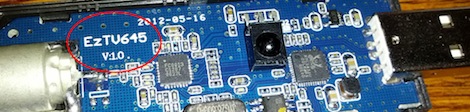
Over on the RTLSDR subreddit, [photoscotty] bought this TV tuner dongle from Deal Extreme and received the inferior EZTV645 tuner. Unsurprisingly, Chinese manufacturers will just grab whatever is available, put it in an envelope, and ship it off on a slow boat from China. [photoscotty] is trying to return his dongle to DX, but until Sparkfun or Adafruit start selling these things (yes, there’s a market now get on it) you’ll have to be careful out there.

Wouldn’t this feel terrible against your skin all day?

[Colin] printed a watch band on his Makerbot. Apparently Shenzhen humidity didn’t play nicely with his nylon strap, so [Colin] made his own out of plastic. It’s flexible and has a neat looking clasp, as well as an awesome demo for what a 3D printer can actually do. Thingiverse files here.