
Stop Motion Animation Creation

PVC man stop motion animation

Stop Motion Animation has always been interesting to me since I “discovered” that one could make animated flip books by drawing each frame a little different. Fast forward 20 years or so, and computer technology has gotten to the point where this sort of thing can be done electronically quite easily and at an incredibly low price of a camera, computer, and free or paid-for software (here’s the technique using GIMP, a free, good quality photo editing tool) to put everything together.

The frames in the picture above are of my latest [PVC man] animation, which can be made with some electroluminescent lights, gloves, and some PVC pipe.  Each frame was individually photographed, and after several hours of work we had enough footage for 17 seconds of so of stop-motion animation.

Although by no means perfect, the quality of these animations has gone up dramatically from the first animations that I made using an old ENV2 camera phone. Although I was using a “custom mount” for it, it’s amazing these came out as well as they did. As with everything hacking related, this process is a constant work in progress. Check out the videos after the break for the [PVC man] video as well as one of the early ENV2-produced stop-motion shorts!

Continue reading “Stop Motion Animation Creation”

Kits To Fund Hackerspaces

[Overflo] recently tipped us about HackerspaceShop; his plan to help fund the Viennese and European hackerspaces by creating a marketplace for electronic kits. The idea is to not only sell kits, but to also create an easy way for others to sell their own kits through the platform, which is pretty awesome if you ask us.

Their kit they sent us to play with is a sun tracking flower developed by [daniel schatzmayr] in the metalab hackerspace. All and all, it’s a pretty awesome kit that’d be perfect for any geeky girlfriend, and of course, it’s arduino controlled. Whether or not that is a good or a bad thing is up to the hackaday trolls to decide, but it does have an FTDI header; something we’d personally like to see on a lot more of these electronic kits.

Currently there’s not to big a catalog on their site but hey, wickedlasers started out as a guy selling modified laser pointers and Hewett Packard started out as two guys selling a better function generator. It’s always awesome when a hacker uses their skills to become an entrepreneur, especially for a good cause.

Good luck [overflo]!

Automated Bed Leveling With Our 3D Printer

Anyone with a RepRap or other 3D printer knows how much of a pain leveling the bed is. To get a good quality print, the bed – the surface the printer prints on – must be exactingly level, and may the engineering gods help you if your surface has the slightest bump in it. [Atntias] is developing a solution to this problem: an auto leveling platform that shouldn’t require any parts at all if you already have a metal bed.

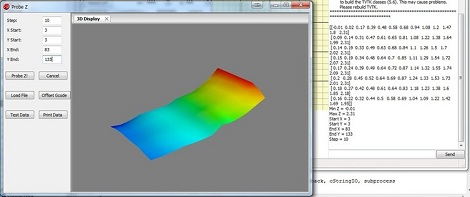
The idea is incredibly simple: Just ground your metal bed, and apply a small voltage to the tip of your hot end. [Atntias]’ code (available on GitHub) probes the surface of the bed and shoots out a 3D mesh of your current bed profile. This can be used as a GCode offset, so the bottom of your print is always directly on the top of the bed.

Although the utility of leveling a bed down to the micron level is of questionable utility for 3D printers, it’s vitally important if you want to mill a PCB on your printer. [Atntias] says his idea is currently being implemented into the Marlin firmware, so it looks like another firmware update is in our future.

Thanks go to [technodream] for sending this one in. Check out the video after the break to see the bed leveling process in action.

Continue reading “Automated Bed Leveling With Our 3D Printer”

Building New Interfaces With An IPad

There’s a word – synchronicity – to describe two disparate events that occur together in a meaningful way. We see this a lot in the Hackaday tip line; two people send in somewhat similar hacks solving similar problems in similar ways nearly simultaneously. Here’s two builds by [Bryce] and [spektakx] that hit our inbox within minutes of each other that both implement existing interfaces with iPads.

iPad turntable controller

[spektakx] sent in an iPad powered DJ MIDI controller he built as a prototype to test out the size, orientation and layout for an upcoming build. The turntable controllers are simple USB affairs made to jog and scratch records digitally. Although [spektakx] admits it’s a little unfinished, it’s still just a prototype. Also, he can use a Windows 7 tablet laptop for ‘more suited’ hardware. Check out [spektakx]’ video demo after the break.

an iPad cash register

[Hacktheory] found [Bryce]’s Flickr photolog of a DIY ‘Square’ cash register. The electronics part of this build is practically non-existent; it’s just an iPad with a credit card readers that plugs into the headphone jack. Yes, we just saw these ‘Square’ credit card readers this last week. The fabrication portion of this build is incredible – [Bryce] has a few wonderful pieces of walnut there, and did an exceptional job with the wood work. It’s probably not well suited to high-volume retail, but we couldn’t think of a better cash register for a boutique shop.

Continue reading “Building New Interfaces With An IPad”

Miniaturized N64 Controller Fits The Tiniest Of Hands

n64-controller-mod

The controllers that came with the Nintendo 64 don’t exactly measure up to the “Duke” of Xbox fame, but they’re not the smallest in the world either. Made by Bacteria forum member [Bungle] says that his girlfriend has incredibly tiny hands, so he thought he might try trimming some of the fat from an N64 controller by cramming its components into an N64 cartridge.

He tore down a 3rd-party N64 controller, tossing out the D-Pad, plug, and rumble motor, retaining all of the other buttons. After gutting the game cartridge, he heated the back side under a lamp and stretched the plastic over a roll of electrical tape to make room for the N64’s trademark “Z” button. Having only removed the rumble motor due to size constraints, he found a suitable replacement at Radio Shack, which fills in for the original nicely.

After a good amount of careful trimming, wiring, and mounting, he came up with the little gem you see above. We’re sure [Bungle’s] girlfriend is pleased with his work, and he seems happy with how it came out as well.

Continue reading to see a short video showing off [Bungle’s] latest creation.

[Thanks, Chris Downing]

Continue reading “Miniaturized N64 Controller Fits The Tiniest Of Hands”

Slow Motion Destruction Of Random Things

Though we can’t really tell you how this is hacking related, we’ve always shared random videos of stuff getting destroyed with you. Invariably someone in the comments goes on a rant about how wasteful and/or dangerous it is. This clip, from a Danish TV show called  Stupid and Dangerous, fits that description quite well. It is also freaking awesome.

We’re really not sure what draws us to these videos exactly. Is it vicarious destruction or possibly our natural affinity for slow motion?

[via Dvice]

http://www.youtube.com/watch?v=lUZ-e2SkeMI

Sassy Disco Bots Of The 80s

Surely, this is a glimpse into the future. No? Ok, its a glimpse into 1983. A small chinese fast-food restaurant in California put two 4.5 foot tall, 180 pound robots to work delivering food. Tanbo R-1 and Tanbo R-2 were their names and delivering food was their game. At least, when there wasn’t radio interference or their batteries were running low.  They were built to deliver food to the tables and be polite to the customers. They also had some interesting quirky behavior, like responding “that’s not my problem” and dancing off to some disco music if they didn’t understand you.  Do yourself a favor and go read some of the stories. We wish we could have seen them in action, they sound fantastically absurd.