Reading NAND Flash With An Arduino

[HC] took a gander around the Googles and saw a number of people trying to read NAND flash chips with an Arduino. It’s an interesting problem; at 16 Megahertz, [HC] is looking at about 60 nanoseconds per instruction cycle, and flash chips normally operate around 20 ns. He got the build working, and was able to read the memory contents and ID of a flash chip.

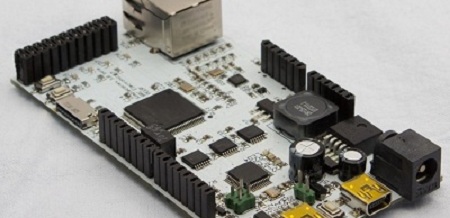
Right now, it’s just a proof-of-concept to demonstrate that reading flash memory is possible. [HC] used an Arduino Mega to pull the manufacture ID off a flash chip. Because there isn’t exactly a whole lot of storage on an Arduino to hold Megabytes of data, so [HC] is looking for a way to pull data off his flash chip. He’s considering sending it over Ethernet or storing it on an SD card.

This isn’t the first time we’ve seen a roundabout way to use those cheap, ubiquitous NAND flash chips. Considering we’ve got a few dozen of them housed in unused thumb drives, [HC]’s work shows a lot of potential. He posted a topic on his forum to see if there’s any interest in further developments, something we’d like to see.

Milling Ice Molds For Craft Cocktails

Want some fancy ice for your next cocktail party? You can try to find spherical ice-cube trays but you won’t get the kind of results seen here. It turns out the trick to this isn’t how you freeze the water, it’s how you melt the ice.

[Brendan O’Connor] started this project after seeing an ice mold that could make beautiful shapes rather than just cubes. But the price tag was $1400. If he could make his own at a hackerspace we’d bet that would pay his membership for an entire year!

The concept is pretty simple. The video after the break shows the mold he was trying to recreate. It’s two hunks of metal with a shape milled into them. The mold is pre-heated, then an oversized hunk of ice is placed between the blocks. The heat melts away the parts you don’t want, and leaves a perfectly shaped ice orb in between. Gravity is responsible for pulling the mold halves together as they slide along some machined rods.

With a big hunk of scrap aluminum he milled two halves of a sphere. They can be sufficiently heated if held under running water, and a some leftover printer rails keep the two parts aligned as the ice orb is formed. Now [Brendan] just needs to work on his method of creating a crystal-clear ice block as a starter and he’ll have achieved total win.

Continue reading “Milling Ice Molds For Craft Cocktails”

Exposing Some Fake Electronics With Too-good-to-be-true Prices

[Giorgos Lazaridis] needed an AC adaptor for his Canon PowerShot camera. He hit eBay and was excited to find this branded adaptor for just five bucks! It works and, even though it would sometimes reboot his camera if the cord was twisted around in the jack, he was satisfied that it did what it was supposed to.

That is, until one day he observed some very peculiar behavior while taking pictures of a PIC circuit he was prototyping. When holding the camera and putting his other hand near the breadboard one of the status LEDs in his circuit began flashing sporadically. If he was using the camera with batteries instead of the adapter this didn’t happen.

His first instinct was to hook up the adapter to his oscilloscope and see what is happening on the power bus. The signal is incredibly noisy. Shockingly so. [Giorgos] cracked open the case to see what is going on with the power supply circuit inside. You simply must view the video after the break to see the horror-show he found. The board is poorly soldered, components are not properly seated in their footprints, and our favorite is when [Giorgos] points out a squiggly trace which takes the place of the smoothing inductors.

Have you documented your own fake electronic hardware finds? We’d love to hear about them. Continue reading “Exposing Some Fake Electronics With Too-good-to-be-true Prices”

Line-follower Is An Homage To [Homer]; Plans To Infringe Copyrights

The Chief Knock-a-Homer robot is [Psycho Freaky’s] shout out to The Simpsons. The robot design appeared in an episode where [Homer] built [Bart] a fighting robot. Since he’s not robot builder, [Homer] actually climbed inside the shell and dished out sweet vengeance while suffering some severe injuries at the same time.

But [Psycho] has the skills necessary to make this autonomous and keep it looking just like the TV show at the same time. He has a friend with a CNC mill, and used it to cut out case parts from Masonite which were assembled with hot glue. A pair of small servos drive two wheels at the rear of the base, with a ball-bearing universal wheel centered in the front. There are also two downward-pointing sensors which lend it the ability to follow a line as seen in the video after the break.

We love the paint job, it really polishes the look. But [Pyscho] isn’t quite done yet. He plans to add an audio circuit that will give the robot the ability to play back classic sound clips.

Continue reading “Line-follower Is An Homage To [Homer]; Plans To Infringe Copyrights”

Over-engineering A Two-zone Thermometer

We love the extra touches that [Andrianakis Haris] added to his two-zone electronic thermometer. It includes features that you just wouldn’t find on a mass-market commercial product because of issues like added cost. For example, you can see that the PCB juts up above the LCD display, allowing the module to be mounted on a pair of screws thanks to the keyhole shape that was drilled in the substrate. I increases the board size greatly, but on a small hobby run this won’t usually affect the price of the board depending on the fab house pricing model.

The design uses an ATmega8 microcontroller to monitor sensors in two different places. There is an onboard LM35 temperature sensor for monitoring the space where the unit resides. A remote sensor module uses a DHT-11 chip to gather data about temperature and humidity. That sensor is wired, but there is one wireless option for the device. Data can be pulled down from it via an optional Bluetooth module which can be soldered to a footprint on the back of the board.

Check out the video after the break to see temperature readings pulled down wirelessly. Continue reading “Over-engineering A Two-zone Thermometer”

Power Protection Circuit Tutorial

Building your first circuit is empowering, but make sure it’s not too empowering. [Jon] sent in a great tutorial of power protection circuits to make sure you don’t release the mystical blue smoke that make electronics work.

There’s an in-depth tutorial of the classic series diode that’s the simplest of all power protection circuits. There’s not much to it – just a diode that provides reverse polarity protection. A fuse and parallel diode doesn’t have the voltage drop a series diode has, but doesn’t do anything for an overvoltage. A P-channel MOSFET gets around the problem of voltage drop, and [Jon] gives us some really nice empirical data to demonstrate his testing setup.

There’s a ton of nice write ups on [Jon]’s site that are perfect for getting ideas for projects like ten switches on one pin and some strange stuff [Jon] picked up at his Goodwill. If you’ve got any tutorials on general electronics, be sure to send them in on our tip line.

Backplane And Mainboard For A 6502 Computer

[Quinn Dunki] has been busy through the holidays giving her 6502 processor-based computer a place to live. The most recent part of the project (which she calls Veronica) involved designing and etching a mainboard for the device. In the picture above it’s the vertical board which is right at home in the backplane [Quinn] also designed.

The project is really gaining momentum now. You may remember that it started off as a rather motley arrangement of what we’d guess is every breadboard she owns. From there some nifty hex switches gave [Quinn] a way to program the data bus on the device. Many would have stopped with these successes, but the continuation of the project makes the hardware robust enough to be around for a while. The single-sided boards are playing nicely together, and the next step is to redesign the ROM emulator to use chips for storage. [Quinn] alludes to a side project in which she plans to build her own EEPROM programmer to help with getting code into the experimental computer.