Building The Second Tiniest Tetris

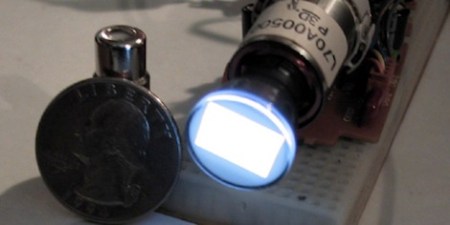
A few years ago, [Richard] pulled a crushed camcorder out of a junk box at a hamfest. After pulling the half-inch CRT out of the viewfinder, he needed to find a project. [Richard] ended up building the second tiniest game of Tetris we’ve ever seen.

After futzing around with the CRT, [Richard] discovered that one of the pins would accept an NTSC input. He also found a similar project that used a dime-sized CRT to play Tetris. With ready to go code, [Richard] started assembling his project into a handsome wooden box.

There are two PCBs for the build – a CRT driver circuit, and a small custom board that handles the game and controller code. The circuit for the game board was found on this site, but the featured boards there were too large for the project. A stripped-down board was fabricated by BatchPCB and put into the box.

There aren’t any controls on the console itself, for that a standard DB-9 connector was installed so a vintage Atari joystick could be used. For a more ergonomic Tetris experience, a Sega Genesis controller could be used. For something that looks like it comes out a steampunk laboratory, playing Tetris is a bit unexpected. Check out the demo video of the screen at 20x magnification after the break.
Continue reading “Building The Second Tiniest Tetris”

Tiny MP3 Module Is Perfect For Your Next Project

tiny_embedded_mp3_module

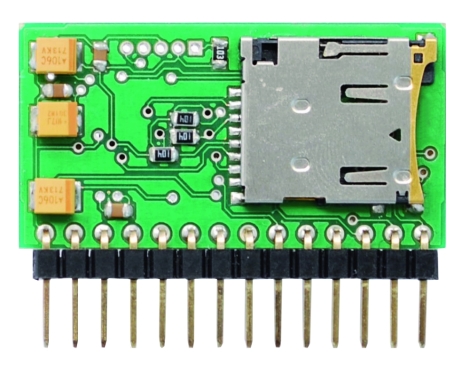
If your next project needs the ability to play MP3s but you don’t have a lot of room to spare in your enclosure, [Boris] has just the thing you need. His tiny embedded MP3 module supports playback of up to 65,536 songs or as many as you can fit on a 16GB microSD card, which isn’t bad in the least.

The module relies on a PIC24F for input and control, while a VS1011 handles all of the MP3 decoding responsibilities. He says that the module would be great for voice-enabled vending machines, telephone systems, cars, and more.

With such a wide range of possible applications, he decided that the module should be able to support several different input methods. The board can be controlled via a set of digital input buttons, which is perfect for direct human interaction, while it also supports serial control for scenarios where it is part of a larger embedded system.

Of course, we’ve seen tiny MP3 players like this before, but we like the fact that this module was designed to operate in standalone mode or as a component in a larger device. Of course all of the device’s schematics, code, and a BoM are available, allowing you to build your own if you are comfortable with SMD soldering.

A CD Changer Made Of Wood

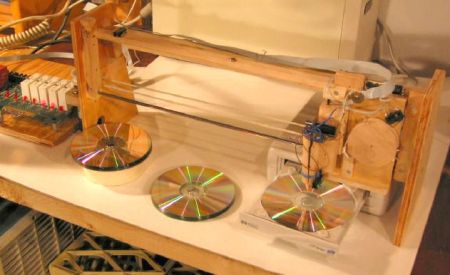
Although this is by no means a new hack – it was made circe 2002 – this wooden CD changer is an interesting piece of machinery. The whole thing is a simple pick-and-place device. The gripper is brilliant in it’s simplicity, using only a rubber band, wood, and a solenoid. It grips the CD by the middle hole, picks it up, and the assembly then travels to the CD tray or the stack. Everything works with DC motors and string, and several micro-switches make sure everything is picked up and dropped in the correct position.

Although we may think this is a pretty cool device, [Matthias] is quite humble about his machine’s abilities. In his estimation, although one could probably duplicate 12 CDs with relative ease, if you really wanted to duplicate a large number, it’d be best to buy one. Maybe he works in manufacturing.

Continue reading “A CD Changer Made Of Wood”

Powering Kids’ Toys By Hand

hand_cranked_toy_piano

[Dominik’s] daughter had an old toy piano that she loved, but when the batteries started to die down, it played awful tones and sounded generally out of tune. While this is likely something our circuit bending friends might be interested in, [Dominik] preferred when things sounded more cheery.

He considered simply replacing the batteries, but it seemed like a far better idea to do away with them altogether. he hunted around for a solution, and eventually found one at the local IKEA store. He grabbed a LJUSA hand-powered flashlight and disassembled it, saving the crank and circuitry.

He installed the crank on the back side of his daughter’s piano, and mounted the electronic bits inside the toy’s shell. The crank spins a brushless motor, generating an AC current which is rectified to DC before being stored in a capacitor. He says that a 30 second crank will play just a few tunes, which isn’t ideal, though it is better than frequently replacing batteries.

[Thanks, Roger]

On The Life Of [Dennis Ritchie]

Chances are you have already heard of the passing of [Dennis Ritchie]. We admit, we’re among the throngs who knew little of his life, but [Cade Metz] has posted an excellent remembrance of his life which we think is well worth reading.

[Dennis] passed on October 12th at the age of 70. This image shows him receiving the National Medal of Technology awarded to him by [Bill Clinton] in 1998. His legacy lives on in the work that earned him this award as the creator of the C programming language; a side project which he developed to help him achieve the creation of a new system kernel called UNIX. This work, of course, was the precursor that led to universal software packages like OSX, iOS, Linux, and even Windows (which at one point was itself written using the C language).

There has been some Internet fodder regarding media coverage of [Steve Jobs’] death and not of [Dennis’] passing. It’s harder for those lacking experience with programming to comprehend [Dennis’] contributions. We’re glad to have an opportunity to pass on the story of his life and to take a moment to appreciate his accomplishments.

[Thanks Dave]

[Photo Source]

anodizing_aluminum_without_battery_acid

Anodizing And Dyeing Aluminum Without Battery Acid

While many people have tried their hand at anodizing aluminum at home, there are plenty who would just as soon leave it up to the professionals due to the highly concentrated sulfuric acid required for the process. [Ken] started thinking about the process and wondered if there was a way to get comparable results using chemicals that are easier to obtain and dispose of.

Through some experimentation he found that sodium bisulfate (NaHSO4), which is a sodium salt of sulfuric acid, can easily be used in its place with great results. The chemical is typically advertised in hardware and pool stores as “Aqua Chem”, and can be had at a very reasonable price. When paired with the proper DC current along with a cathode, the sodium bisulfate easily anodizes an aluminum workpiece and renders it ready for coloring with RIT, readily available cloth dye.

We were impressed with the results, and when looking at [Ken’s] test pieces, it seems that the metal dyed with sodium bisulfate has a more uniform, less streaky coloring to it. It’s also worth mentioning that [Ken] has found it is fairly easy to etch the aluminum before anodizing using a solution of sodium hydroxide, which is great for individuals who prefer a more matte finish.

If this is something that interests you, be sure to swing by his site. He has a posted nice video overview of the process that may be of some help.

Halloween Hacks: Transform That Annoying Dancing Santa Into A Halloween Mummy!

Halloween Hacks Banner

santa_mummy

If you have one of those annoying dancing (Santa/Elvis/Frankenstein) decorations sitting around collecting dust, you could always repurpose it like [mischka] did. He originally wanted to enter our Santa-Pede challenge and purchased a dancing Santa, but time eventually got the best of him. With no other use for it in mind, he decided to make his dancing Christmas toy into a fun Halloween decoration.

An electronic rendition of “Jingle Bells” isn’t exactly the scariest thing around, so he dismantled the dancing toy and started fiddling with the sound board. A few well placed resistors later, his circuit-bent Santa Claus started to sound like he had five too many egg nogs, which was perfect for the dancing mummy [mischka] had in mind.

He transplanted some LEDs from Santa’s base into his head, and masked it off with some electrical tape so that only the eyes were visible. He then wrapped the mummy in the requisite bloodied bandages and set him out for the kids to enjoy.

Since it’s hard to find someone who genuinely likes these dancing toys, we think this is a great way to make them useful again. If you’ve got a few of these things kicking around, we suggest reenacting the dance routine from Thriller using an army of Santa-zombies and sending a video our way.

Continue reading to see a video of [mischka’s] mummy in action.

Continue reading “Halloween Hacks: Transform That Annoying Dancing Santa Into A Halloween Mummy!”