Hackaday Links: October 4, 2011

Playing Snake on a MIDI controller


While you’re waiting for your bandmates to finish arguing/making out/their beer, you can play Snake on your MIDI controller. Luis wrote a Snake game for an Akai APC40 controller. Everything is built with Processing and should provide a great distraction from (for?) your 14-year-old groupies.

Cheap & simple PCB holder


[Robert] sent in a tip for a very simple PCB holder. Take a neo magnet, embed it in oven-hardening modeling clay, and use it on a steel worktop. Check out the pics he sent in (1, 2). It’s too simple not to work.

Lose weight by running people over


[binaryhead] is using a stationary bicycle to play Grand Theft Auto: San Andreas. (Spanish, Google translate here). A pot and magnet/reed switch is connected to an Arduino that outputs keys to San Andreas. There’s no word on an ambulance simulator yet.

Giant Android tablet


[Martin Draskov] made a 23 inch Android tablet. He used off the shelf parts (multitouch monitor and a small PC) with the x86 Android port. There’s a video that doesn’t include Angry Birds. Sad, that.

T-shirt bleaching for the modern fabricator


With t-shirt bleaching, you can put a custom design on clothes without a screen printing setup. Reddit user [Admiral_Noosenbaum] used a CNC machine to make templates. Now if only we can find an .SGV file of Che Guevara. Video here.

DSLR Focus Stacking Assistant Takes The Hard Work Out Of Macro Photography

canon_dslr_focus_stacking_assistant

Focus stacking makes for fantastic macro images, but the process can be tedious without the right tools. While some focus stacking rigs require the camera to be moved away from the subject in small increments, others choose to keep the camera stationary while focusing the lens before each shot.

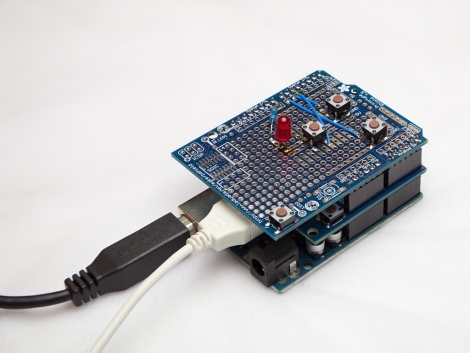
Both methods produce great results, but you need a steady hand and a lot of patience to get the job done. [Oleg] uses the focus stacking technique relatively frequently, so he decided to automate the process in order to save himself some time. Using an Arduino and a USB host shield from Adafruit, he put together a focus stacking assistant for his Canon EOS camera.

The assistant allows him to set two focal points, leaving the Arduino and his camera with the task of taking pictures. The Arduino commands the camera to tweak the focal point ever so slightly between each image, resulting in an array of images ready for stacking.

He says that the process is a bit slow at the moment, but he’ll be cleaning up the code and building a Nikon-compatible unit in the weeks to come.

PC Temperature Monitoring System Lights Up When Things Get Hot

gpu_overheating_warning_system

[Taylor] popped a new graphics card into his computer, but before he could settle in for a round of gaming, his card started to overheat. He eventually tracked the problem down to an undersized power supply, but the prospect of cooking his new GPU to death made him think twice about how he was monitoring his system’s health.

To continually keep tabs on his video card’s temperature going forward, he put together a small circuit that will alert him if things start to get too hot. He mounted a small temperature sensor on his graphics card near the GPU, wiring it to an Arduino. The Arduino monitors his video card, lighting an RGB LED blue if conditions are alright. If the temperature rises above 50C, the LED changes to red, signaling a problem.

We’re aware that there are all sorts of software applications that can monitor component temperatures for you, but the appeal of [Taylor’s] system is that it can be easily seen from across the room rather than via the desktop. That said, we think that his system could take advantage of his PC’s case fan lighting for a more visible warning, and it wouldn’t hurt to wire in an auto-shutdown feature in case his computer overheats while he’s away.

Slick Robot With Tank Treads Can Move Every Which Way

omnicrawler

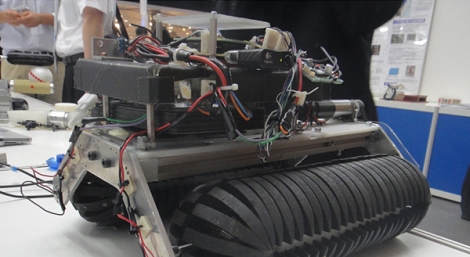
It’s always interesting to see new and innovative means of robot locomotion. At the recent “Innovation Japan 2011” conference researchers from Osaka University unveiled the Omni-Crawler, which is aimed at changing the way both robots and people move.

The Omni-Crawler’s movement is provided by Omni-Balls, an Osaka University creation that moves in all directions, not unlike a swivel caster. The Omni-Ball is simpler and sturdier in design however, making it far more robust than its office chair counterpart.

Several of these Omni-Balls are attached to the crawler, and wrapped in a rubber tank tread like gripper material. The resultant motion is predictably omnidirectional, though we’re guessing you figured that out already thanks to Osaka University’s naming conventions.

While we’re not sure this technology will be making it into production cars any time soon, we would certainly be OK with having an RC Omni-Crawler to play around with in the office.

Stick around after the break to see a short video of the Omni-Crawler in action.

[via BuildLounge]

Continue reading “Slick Robot With Tank Treads Can Move Every Which Way”

Build Your Own Portal Turret In 150 Easy Steps

If there were a contest for the most thorough step-by-step project log [Kurt] would the champion. He recently a posted 150 step build log for his fleece-covered Portal turret project. If you can get over the need to click-through 30 pages of steps, there’s a lot to like about this project.

First, what it doesn’t do: The Turret doesn’t split up the middle and fire bullets at you. This is a relief, but the fact that it’s not lethal doesn’t mean it just sits there looking interesting. It can detect movement, it knows when you pick it up, and it can tell when it’s been knocked over. All of these interactive sensory inputs are used to playback various sound bytes from the Portal games, making it a great piece of desk art for those working in geek-centric offices. See for yourself in the video after the break.

The body itself is a food storage container which houses the barebones Arduino and Adafruit Wav shield. As near as we can tell, a PIR sensor detects movement, and leaf switches on the legs tell it when it’s been picked up or tipped over. But we only made a cursor examination of the assembly steps so we might be missing something.

If you’re not into the turrets, maybe this potato is more up your alley.

Continue reading “Build Your Own Portal Turret In 150 Easy Steps”

Hone Your Skills By Building Control Modules

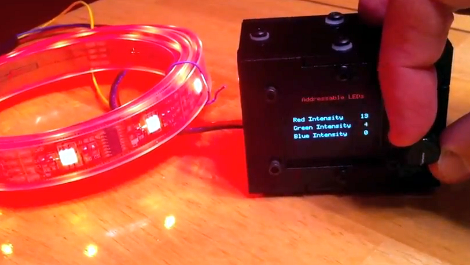
If you ask us, there’s no substitute for learning by doing. But often the hardest part of acquiring new skills is coming up with the idea for a project that utilizes them. [Mike Rankin] wanted to develop a project using laser cut acrylic, and settled on building a control box for an RGB LED strip. He got some practice modeling objects in SolidWorks and seeing the process through to the final build. But it also let him explore an area of microcontroller programming in which he had little experience.

The LED strip he’s using depends on the HL1606. This is an SPI addressable chip that we see popping up in a lot of projects these days. It’s pretty simple to send red, green, and blue values through the data bus, and it allowed [Mike] to try his hand at programming menus and sub-menus. The controller takes input from a clickable rotary encoder. The settings are displayed on an OLED screen, with all the hardware nestled comfortably in his custom-cut enclosure.

Don’t miss the demo video embedded after the break.

Continue reading “Hone Your Skills By Building Control Modules”

AVR Chiptune Project Turns This Simple Code Into Music

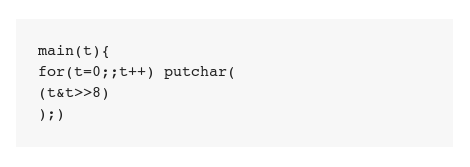
[Mark] had seen a few examples of algorithmic music generation that takes some simple code and produces complex-sounding results. Apparently it’s possible to pipe the output of code like this directly to audio devices on a Linux box, but [Mark] decided to go a different direction. His project lets you play simple algorithms as audio using AVR microcontrollers.

Now the code work for this is very simple, but he hardware implementation is where things get interesting. Ostensibly, [Mark] didn’t have the components available to build a filter to use PWM as an audio signal. Being that he’s a ham operator, he grabbed some radio equipment he had on hand and whipped up an alternative. He’s feeding the PWM from an Arduino into the voltage controlled oscillator on a board meant for high-altitude balloon telemetry. The signal broadcast by this board is then picked up by his radio receiver, and played on some speakers.

Rube-Goldberg contraptions aside, the effect is pretty interesting, as you can hear in the latter half of the video clip which we’ve embedded after the jump.

Continue reading “AVR Chiptune Project Turns This Simple Code Into Music”